Entering Vietnam can be exciting for foreign SMEs, but completing the company registration is only the beginning. Many entrepreneurs rely on market entry services that promise a quick setup – incorporation, licensing, and then they’re “done.” Unfortunately, this setup-only approach ignores the complex reality that true market entry extends far beyond initial licenses. Successful entry “extends far beyond licensing” and instead “requires continuous compliance across tax filings, labor regulations, investment reporting, and profit repatriation procedures”. In other words, if you treat incorporation as an administrative checkbox, you may face costly fines or operational roadblocks once you start doing business.
Our earlier blog posts warned of these very dangers. We stressed that obtaining a license is “only part of the journey,” and that many foreign companies struggle after the setup phase without on-the-ground support. We also explained how a fragmented advisory approach – splitting tasks among multiple providers – causes “misaligned advice, compliance gaps, and higher fees”. Both points are directly relevant here: setup-only services create a fragmented process where no single provider manages your entire compliance calendar. This piecemeal approach may cut fees upfront, but it hides real risks once operations begin.
The Limitations of Setup-Only Market Entry Services
Setup-only providers focus on the licensing phase: they handle company formation, investment certificates, and initial registrations. However, once the certificates are issued and bank accounts opened, they often hand you the keys – and step back. At that point, the burden falls on you (or a new advisor) to run payroll, file taxes, and comply with hundreds of local rules. Vietnam’s regulatory system is detailed and evolving; ignoring it can be dangerous.
Vietnam’s FDI rules, licensing processes, and taxes are strict and vary by industry, so most experts advise working with local consultants “from day one” to navigate approvals and compliance. A setup-only firm rarely provides that ongoing guidance. Instead, you may find yourself scrambling for help with payroll audits, accounting standards, or sector-specific regulations – tasks the initial provider never covered.
Setting up an entity should be the first step, not the last word, in a market entry strategy. Many businesses treat licensing as “optional” or “just formalities,” only to face penalties or disruptions later. For example, if you miss the 90-day deadline for depositing capital, Vietnamese law imposes VND 30–50 million in fines and can even revoke your license. Similarly, failing to register employees for social insurance attracts hefty penalties (VND 50–75 million for as few as 50 unregistered workers). Without a post-setup partner to remind you of these deadlines, small oversights can become big problems.
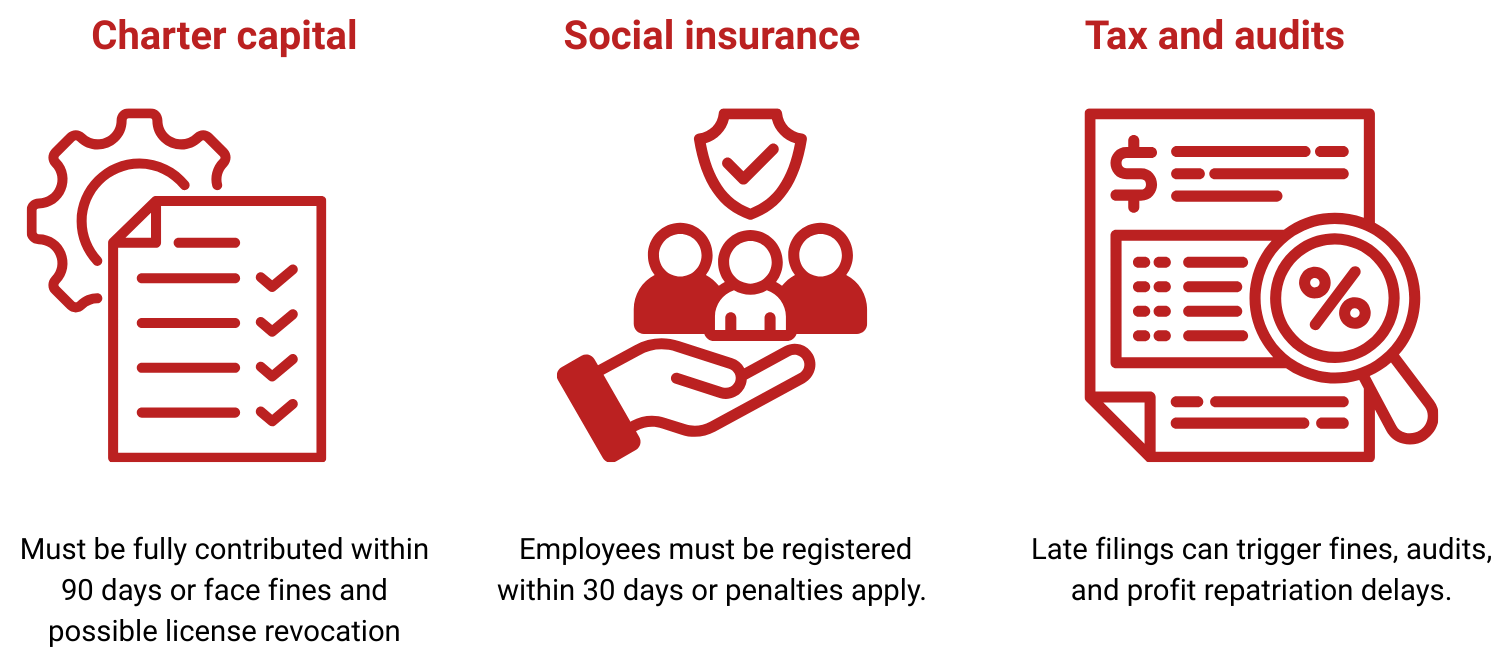
- Charter capital contribution: Contributing full capital within 90 days of your business registration is mandatory. Incomplete capital triggers fines (VND 30–50 million) and risks license revocation.
- Social insurance registration: You must register new hires for social and health insurance within 30 days. Missing this window can incur fines of VND 50–75 million for a small workforce.
- Tax and audit filings: Monthly VAT returns, quarterly corporate tax, annual financial statements and audits all have strict deadlines. Incomplete filings can delay profit repatriation or lead to penalties and audits.
Each bullet above is a critical post-entry task that a setup-only service might not cover. Without integrated support, you’ll need to manage them yourself or contract new advisors on the fly. That risk is compounded by Vietnam’s high compliance standards. In 2026 and beyond, authorities expect foreign firms to demonstrate substance – not just paperwork – in areas like governance, accounting, and labor. Your choice of market entry services should reflect that reality.
Post-Entry Compliance and Operational Challenges
Even after incorporating, Vietnam demands ongoing attention. You must implement reliable accounting, tax, and HR systems immediately. For example, payroll must follow local labor laws on contracts and benefits, and accounting must comply with Vietnamese standards. One compliance guide warns that authorities now “expect foreign companies to run compliant, well-structured operations rather than informal setups”. In practice, that means if your setup-only firm disappears after licensing, gaps will emerge in these vital processes.
To avoid surprises, plan for day-to-day operations from the outset. This includes budgeting realistic timelines for tasks like hiring (social insurance takes time) and bank account opening (often slower than expected). It also means establishing a local tax and accounting framework that fits your business scope. Otherwise, you could face scenarios like blocked profit repatriation if annual taxes aren’t finalized correctly. As one advisory source notes, a full-service approach designates an “operating model” from day one – not just a license – so that all functions are “designed to function properly from the start”.
In short, market entry services should not end at setup. Without on-the-ground, ongoing guidance, you risk delays and penalties once operations begin. If you want your investment to thrive beyond the opening phase, consider whether your provider offers sustained compliance support – or if you’ll be left handling complex tasks alone.
Fragmentation is often the real risk behind compliance failures. See Beyond Market Entry: Business Consulting Risks of Working with Multiple Advisors for FDIs in Vietnam.
The Hidden Costs of Fragmented Services
Fragmentation is the curse of setup-only strategies. When you engage separate advisors for each task – one for incorporation, another for tax, another for HR – coordination breaks down. InCorp Vietnam’s research shows this misalignment creates “hidden costs” even if it seems efficient at first. Common pitfalls include overlapping work and missed deadlines. For instance, if your accountant thinks your law firm filed a tax report (and the law firm thinks your accountant did it), nobody does it on time. The result can be severe: Vietnam’s strict tax and reporting rules carry penalties up to 20% of the tax due and even license suspension. Such compliance gaps and oversights don’t surface immediately – they quietly erode budgets and momentum over time.
Language barriers make fragmentation worse. All official filings and licenses in Vietnam must be in Vietnamese, and inconsistent translation by different vendors leads to errors or re-submissions. InCorp highlights that this often means “even small translation gaps can trigger prolonged back-and-forth” with authorities, adding weeks or months to your timeline. Meanwhile, senior management ends up juggling multiple vendors, spending hours clarifying who is responsible for what. Ultimately, the apparent cost savings of hiring piecemeal advisors are offset by duplicated fees, delayed filings, and managerial headaches.

These risks highlight why setup alone is not enough. Read Beyond Market Entry: Why FDIs Need a One-Stop Operating Partner in Vietnam to understand how integrated support reduces post-entry risk.
In practice, the solution is a unified support strategy. When a single partner oversees all market entry and post-entry tasks, “no one oversees how licensing, tax, payroll, and compliance connect” is no longer a problem. By contrast, an integrated provider plans your business structure from the start, handles entity setup with downstream requirements in mind, and continues through payroll and tax after entry. This coordination means you won’t miss that social insurance deadline or forget a quarterly report because “all functions sit within one operating framework”. As InCorp explains, this continuity helps foreign investors avoid “misaligned tax treatment, duplicated advisory costs, or compliance gaps” caused by handoffs between vendors.
In essence, working with a disjointed, setup-only provider replicates the pitfalls discussed in our previous posts about one-stop partners and multiple advisors. Both show that success in Vietnam requires moving from a series of isolated tasks into a cohesive, end-to-end plan. By centralizing accountability, you protect against hidden penalties and free your team to focus on business rather than admin.
Secure your Vietnam operations today – reach out for complete market entry and post-entry support.
Choosing the Right Market Entry Services
Foreign SMEs must be especially cautious: your resources are limited, so the cost of errors is high. When evaluating providers, look for continuity. A true full-service partner will cover accounting, tax, payroll, HR, legal advisory, and corporate secretarial under one engagement. Ask if key functions are handed back to third parties; if so, coordination gaps will likely remain. Check for local expertise and experience with FDIs, and insist on a dedicated relationship manager who coordinates all teams. These are the traits of the integrated approach we’ve been discussing – exactly the kind of one-stop support we described in our blog on one-stop operating partners.
Ultimately, beyond just “incorporation,” your Vietnam market entry should be a strategic, ongoing partnership. Foreign investors who treat Vietnam like a test market often find themselves stalled by compliance issues. Instead, plan for the full journey: market research, entity setup, licensing and daily operations.
Plan for success beyond setup – get in touch with our Vietnam market entry specialists today.
Learn the Right Setup for Business
Expansion in the Vietnam
FAQs about market entry services
What do market entry services include?
- Market entry services typically cover incorporation and licensing. Full-scope market entry services also include accounting, tax, payroll, HR, and ongoing compliance.
Why are setup-only market entry services risky?
- They end after licensing, leaving companies to handle complex post-entry compliance alone.
When should post-entry planning start?
- Before incorporation. Effective market entry services plan compliance from day one.
How do integrated market entry services help?
- They centralize responsibility, reduce compliance gaps, and simplify ongoing operations.