For years, Vietnam VAT Refunds had a reputation problem. Exporters and investors were eligible on paper, but the process to actually get the money back could stretch on for months, often over paperwork that had nothing to do with the claimant’s own compliance. Since mid-2025, that picture has shifted in two directions at once. Eligibility got broader. Processing got stricter. Understanding both halves matters, because a wider door doesn’t help much if the process behind it still trips you up.
What Changed First: Who Can Claim a VAT Refunds in Vietnam
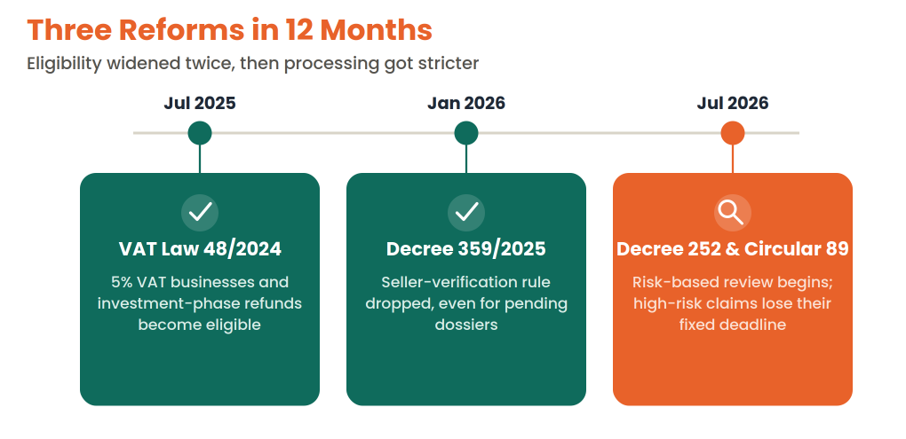
The 2024 VAT Law (Law No. 48/2024/QH15), effective 1 July 2025, is where the eligibility side of the story starts. It kept the core threshold in place: a business becomes eligible once its accumulated, uncredited input VAT from exports or an investment project reaches VND 300 million, roughly US$12,000. What it changed is who gets to use that threshold and when.
Two additions stand out. First, businesses newly subject to the 5% VAT rate became an eligible refund category in their own right, a group that previously had no clear path to a refund at all. Second, and more significant for foreign-invested manufacturers, companies undertaking an expansion investment can now apply for a refund during the investment phase itself, rather than waiting until the project generates revenue.
Businesses have one year from the completion of the project, phase, or unit to file that claim, which gives finance teams real breathing room to assemble documentation instead of scrambling at the deadline. Companies still in the process of setting up their Vietnamese entity can find the groundwork for this in our guide to company incorporation in Vietnam, or work directly with our incorporation team if you’re structuring a new investment project now.
Not sure whether your project qualifies under the new investment-phase window? Ascentium Vietnam’s accounting and tax team can review your VAT position and flag eligible claims before a filing deadline sneaks up on you.
Vietnamm VAT Refund Updated 2026: Two Bottlenecks Removed, One Boundary Kept
Two further changes, both taking effect after the main law, addressed problems that businesses had been complaining about for years rather than expanding who qualifies.
The first came through Law No. 90/2025, which moved on-spot import and export transactions, goods that change ownership without physically leaving Vietnam, onto the same 0% VAT treatment as ordinary exports. The second, and arguably more consequential, arrived through Decree No. 359/2025/ND-CP, effective 1 January 2026. It eliminated a condition that had quietly blocked a large share of refund claims: the requirement that a buyer’s supplier must already have declared and paid VAT on the relevant invoices before the buyer could get a refund. Under the old rule, one non-compliant supplier anywhere in a supply chain could freeze a completely unrelated company’s refund. That link has now been cut, and the change applies retroactively to dossiers already filed but not yet decided.
Not every gap closed, though. Import-for-re-export arrangements, bringing goods into Vietnam and shipping them back out without adding domestic value, remain permanently outside the refund system. Regulators have treated this category as a persistent source of abuse, and neither the 2024 law nor the decrees that followed reopened it. transaction. The inability to obtain a refund may affect the structure, timing, and cash-flow implications of the reorganization.
The Trade-Off: Risk-Based Processing Since July 2026
Expanding eligibility was only ever half of the reform. Decree No. 252/2026/ND-CP and Circular No. 89/2026/TT-BTC, both effective 1 July 2026, rebuilt how the tax authority actually processes a claim once it lands on their desk, replacing the older Circular 80/2021 framework.
The headline change is a shift to risk-based review. After a business submits its dossier, the tax authority now has 3 working days to confirm whether the application is complete. From there, the path splits. Claims classified as low risk go through what’s informally called refund-first, audit-later: the tax authority issues its refund decision within 6 working days of accepting the dossier, and any deeper examination happens after the money has moved, not before. Claims flagged as higher risk go the other direction entirely, into pre-refund inspection, and critically, the new framework sets no fixed statutory deadline for that process. That’s a real departure from the old system, which guaranteed a decision within 40 working days of a complete dossier regardless of risk category.
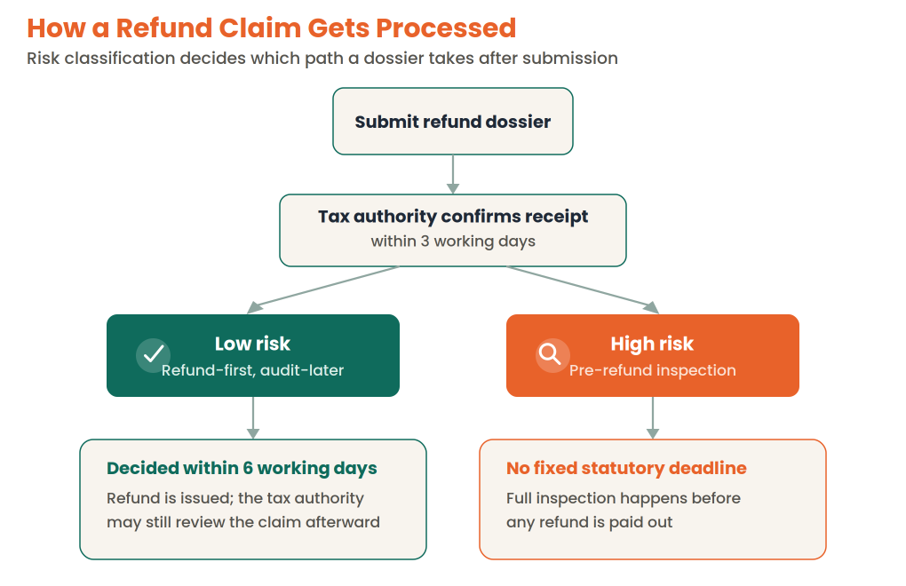
The new rules also cut back on paperwork for straightforward cases, leaning more heavily on data the tax authority already holds through e-invoices and its own systems rather than requiring businesses to re-submit information on record. And there’s new flexibility on the taxpayer’s side too: a business can now withdraw a refund application before a decision or inspection order is issued, and carry the VAT forward as an input credit instead, an option that didn’t clearly exist before.
Related read: our breakdown of common tax problems and solutions in Vietnam covers how these compliance shifts fit into the broader 2026 tax landscape.
Export Refunds Come With a Ceiling
One more limit is worth flagging for exporters specifically. Under Circular 69/2025, VAT refunds tied to export activity are capped at 10% of export revenue for the relevant period. For most manufacturers this ceiling is comfortably above their actual claim, but companies with unusually high input VAT relative to export turnover, often in the early stages of a project, should model this cap before assuming a claim will be paid in full. A market entry and structuring review can help flag this early if your cost structure looks unusual for your industry.
Getting Ready for a Refund Application
None of this changes the basic discipline a refund claim requires, it just raises the cost of getting it wrong. A few things matter more under the new framework than they did before:
Decide early whether an investment-phase refund or a carry-forward credit makes more sense for your cash flow, since the new withdrawal option makes switching between them easier than before. Our guide to working with a tax consulting partner in Vietnam walks through how that decision typically gets made
Keep e-invoices and accounting records consistent with each other, since the tax authority is now pulling more of its picture directly from that data rather than from submitted paperwork; our guide to outsourcing accounting services in Vietnam covers what “consistent” actually means in practice
Track supplier reliability as a matter of good practice even though the legal requirement was removed, because a supply chain with a poor compliance history can still influence how a claim gets risk-scored
Model the 10% export revenue cap in advance if input VAT is running high relative to export turnover.
How Ascentium Vietnam Can Help
Reforms like this tend to reward businesses that treat compliance as an ongoing discipline rather than a once-a-year scramble, and penalize the ones that don’t. Ascentium Vietnam works with foreign-invested companies on exactly this: reconciling e-invoice data against accounting records, tracking which category a refund claim is likely to fall into, and preparing dossiers that hold up under the new risk-based review rather than triggering it.
Ascentium Vietnam (formerly InCorp Vietnam) is a trusted partner for foreign investors, providing comprehensive corporate advisory and outsourcing solutions across Vietnam and Asia. As part of Ascentium Group, we focus on providing transparent and reliable services to overseas clients in Vietnam and Asia.
If your business has a VAT position building up, whether from exports, an investment project, or the new 5% category, it’s worth a conversation before you file. Talk to the Ascentium Vietnam team about where your claim stands under the current rules.
Learn the Right Setup for Business
Expansion in the Vietnam
Frequently Asked Questions
What is the minimum VAT amount needed to apply for a refund in Vietnam?
- A business becomes eligible once its accumulated, uncredited input VAT from exports or an investment project reaches VND 300 million, roughly US$12,000. This threshold has not changed under the 2024 VAT Law.
Do I still need to prove my supplier paid their VAT before I can get a refund?
- No. Decree 359/2025/ND-CP, effective 1 January 2026, removed that requirement entirely, including for dossiers already filed but not yet decided. A supplier's non-compliance can no longer block your refund.
How long does a VAT refund take in Vietnam now?
- It depends on risk classification. Low-risk claims are typically accepted within 3 working days and decided within 6. Claims flagged as high risk go through pre-refund inspection, which no longer has a fixed statutory deadline.
Can new investment projects claim a VAT refund before generating revenue?
- Yes. Under the 2024 VAT Law, businesses undertaking an expansion investment can apply for a refund during the investment phase itself, with up to one year from project completion to file the claim.