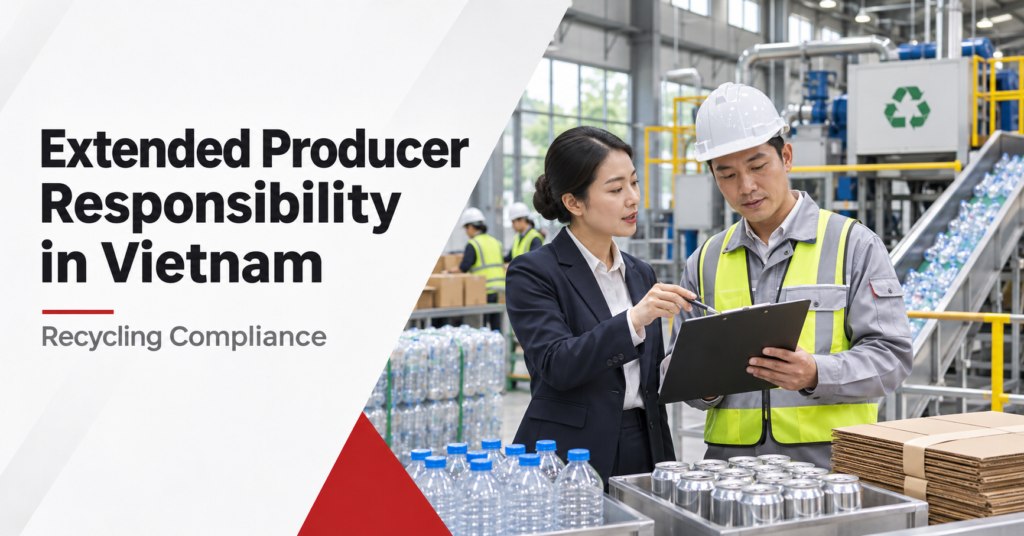
Extended Producer Responsibility (EPR) makes manufacturers and importers responsible for specified products and packaging after consumers discard them. A foreign brand selling packaged goods in Vietnam therefore needs to budget for recycling, identify the responsible Vietnamese entity and maintain reliable product-weight records.
Vietnam's current framework is Decree 110/2026/ND-CP, effective from 25 May 2026. It sets out who must comply, the available compliance routes and annual reporting and payment requirements. This guide explains those obligations for businesses placing goods on the Vietnamese market.
Key Takeaways
- EPR can apply to both locally manufactured and imported goods, including goods supplied from export processing enterprises into the domestic market.
- Businesses can organise recycling or contribute to the Vietnam Environment Protection Fund, with a route selected for each regulated product or packaging group.
- The packaging exemption for revenue below VND 30 billion a year is a specific exemption; it does not exempt every small manufacturer from every EPR obligation.
- Annual recycling submissions and contribution declarations are due before 1 April; declared financial contributions must be paid before 20 April.
- Commercial contracts with recyclers must be supported by evidence of eligible quantities actually recycled.
The transition rule applies the new decree to obligations for 2026 onward. Obligations for 2025 and earlier remain under the preceding framework, so historical corrections need to use the rules for the relevant obligation year.
Which Businesses Are Responsible for EPR in Vietnam?
The obligation generally falls on the manufacturer or importer placing listed goods on Vietnam's market. For contract manufacturing, the party commissioning production carries the obligation. Where the same brand is produced by several manufacturers, the entity responsible for product labelling is responsible. For entrusted imports, responsibility also follows the legally responsible labelling entity. These allocation rules appear in Article 4 of the EPR decree.
This matters when an overseas brand uses a Vietnamese distributor or contract manufacturer. The distribution agreement should identify who measures packaging, provides sales data, files the declaration and pays the cost. The contractual allocation must follow the statutory responsible party.
For example, a brand commissioning packaged products from a local factory should not assume the factory's waste contractor covers the brand's post-consumer obligation. Factory waste disposal and the recycling of packaging placed on the consumer market require separate records.
Businesses planning local production should incorporate these responsibilities into their manufacturing company setup and product specifications.
Which Products and Packaging Are Covered?
The recycling list includes packaging, batteries and accumulators, lubricating oils, tyres and tubes, specified electrical and electronic equipment, and road vehicles. Each group has its own material definition, recycling rate and permitted recycling method.
Covered commercial packaging includes the direct and outer packaging of food, cosmetics, medicines, fertilisers, animal feed, veterinary medicines, detergents and household sanitary preparations, and cement. Food coverage excludes chewing gum under this packaging provision. The relevant scope is defined in Article 4.
Road-vehicle recycling obligations begin on 1 January 2027. Existing obligations for other listed groups continue under the current decree. Product components must be classified carefully: a finished electronic appliance and a separately sold component may not have the same treatment.
What Are the Main Exemptions?
The decree excludes goods manufactured or imported for export, temporary import and re-export, and qualifying research, study or testing purposes. It also exempts manufacturers and importers whose annual revenue from the specified packaged goods falls below VND 30 billion.
Reusable packaging collected and refilled for sale can qualify for exemption where its collection and reuse rate meets the mandatory recycling rate. Keep return records and a calculation of the reuse ratio; merely describing packaging as reusable is insufficient.
What Recycling Rates Apply to Packaging?
The following rates apply to the listed packaging groups in Appendix I of Decree 110. The percentage is applied to relevant mass, rather than revenue or the number of retail units.
|
Packaging group |
Mandatory recycling rate |
|---|---|
|
Paper and cardboard, including qualifying coated paper |
20% |
|
Multilayer packaging containing paper |
15% |
|
Aluminium |
22% |
|
Iron and other metals |
20% |
|
Rigid PET |
22% |
|
Rigid HDPE, LDPE, PP and PS |
15% |
|
Rigid EPS, PVC and other covered rigid plastics |
10% |
|
Flexible plastic packaging |
10% |
|
Glass |
15% |
The output also matters. For rigid PET, the prescribed routes include producing commercial plastic pellets or packaging and other specified products; collecting bottles or producing flakes alone does not meet the listed recycling specification. Procurement teams should write the required output into recycler contracts.
How Can a Business Meet Its Recycling Obligation?
Option A: Organise Recycling
A business can recycle through its own qualifying facility, hire a recycler, authorise a producer responsibility organisation (PRO), or combine these arrangements. Self-operated and contracted facilities must hold environmental permissions covering the relevant activity. A PRO must verify the recycled quantity and cannot pass its authorisation to another PRO. These requirements are set out in Article 6.
Before signing a contract, obtain the recycler's environmental licence, permitted waste categories, processing capacity, proposed recycling method and evidence format. Match payment milestones to accepted recycling results, not simply collection receipts.
Option B: Make a Financial Contribution
The alternative is a contribution to the Vietnam Environment Protection Fund. The statutory calculation is F = R × V × Fs, where F is the contribution in dong, R is the required recycling proportion, V is the relevant mass in kilograms and Fs is the government-issued unit contribution for that category.
Illustrative calculation: assume a business places 100,000 kg of covered rigid PET packaging on the market. Applying the statutory PET rate of 22% gives a recycling obligation of 22,000 kg. Under the financial route, the contribution is 22,000 multiplied by the applicable Fs. The mass is an example, not a market statistic; Fs must be taken from the rate applicable to that category and obligation year.
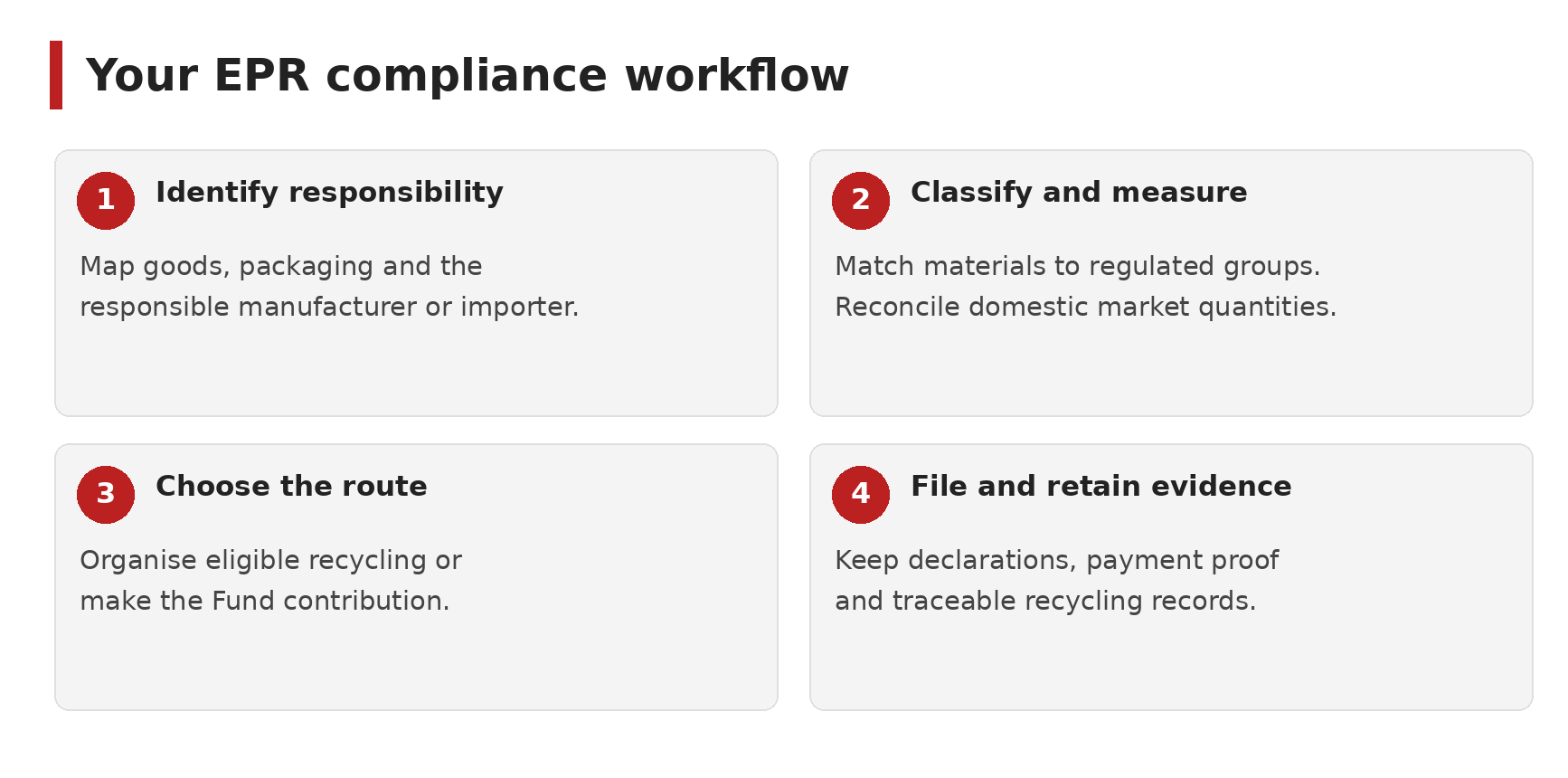
What Records and Annual Submissions Are Required?
Create a packaging register alongside your Vietnam product labelling records. Record each product's material, unit packaging weight, domestic quantities, exports and exemption evidence.
|
Record or submission |
What it must establish |
|---|---|
|
Product and packaging register |
Applicable category, material and weight placed on the Vietnamese market |
|
Sales, production and import records |
Reconciliation between declared quantities and commercial records |
|
Exemption evidence |
Relevant revenue, export records, testing purpose or qualifying reuse quantities |
|
Recycling contract and licence |
Authorised operator, covered category and compliant recycling method |
|
Collection and recycling evidence |
Separate handover, receipt, warehouse and processing records for claimed quantities |
|
Annual recycling submission |
Previous-year results and the plan relating to goods placed on the market in the previous year |
|
Financial-route declaration |
Calculation by category and proof of payment to the Fund |
Businesses organising recycling submit the required plan and results through the national EPR information system before 1 April each year. Businesses choosing the Fund route submit the financial declaration instead of the recycling plan and results, then pay in full before 20 April.
Imported scrap, packaging waste generated in industrial production and rejected products discarded during manufacturing cannot be counted as eligible post-consumer recycling results under Article 5. This is a frequent reason to require separate material records at a recycler handling several waste streams.
How Does the Waste-Treatment Contribution Differ?
A separate regime applies to the products and packaging in Appendix II. These obligations finance waste treatment rather than offering the same organise-recycling choice. Businesses with mixed portfolios should classify each line separately and maintain distinct calculations. The annual declaration and payment calendar is also set out in the decree.
FAQs
Does EPR Apply to Foreign-Owned Manufacturers?
Yes. Responsibility follows the covered goods and the manufacturing or importing activity. Foreign ownership does not create an exemption.
Does Hiring a Recycler Remove the Company's Reporting Duty?
No. The responsible company still needs accurate declarations and evidence supporting the quantities claimed. The contract should give it access to the recycler's records.
Can a Business Use Different Compliance Routes for Different Materials?
Yes. The decree allows the route to be selected by regulated product or packaging group. Keep the classification and the chosen route consistent in the annual submission.
Can Exported Packaging Be Excluded?
Qualifying export and re-export goods are exempt. Retain records that distinguish them from packaging placed on the Vietnamese domestic market.
Is Collecting Used Packaging Enough?
Collection alone is insufficient for the recycling route. The claimed mass must reach an eligible recycling process and satisfy the group's prescribed recycling specification.
Conclusion
EPR compliance starts with accurate product and packaging data. Manufacturers and importers should identify the responsible entity, classify every covered material, select a workable recycling or contribution route and retain evidence throughout the year. InCorp Vietnam can support the wider company establishment process so that reporting responsibilities are assigned before domestic sales begin.