A business license in Vietnam is not one document that automatically authorizes every commercial activity. Foreign investors need to distinguish company registration from investment procedures and the permissions attached to their actual operations. Getting that distinction right helps avoid signing a lease, importing equipment or announcing a launch before the business is ready to operate.
This guide explains the approval categories, current registration workflow, government filing charges and practical checks for a new business. InCorp’s company formation services can help turn a proposed ownership structure and business activity into a coordinated setup plan.
Which Registration or License Do You Need
| Document or approval | Purpose | What it does not settle |
| Enterprise Registration Certificate or ERC | Records enterprise registration and also serves as the enterprise’s tax registration certificate. | Whether a regulated activity is authorized to operate. |
| Investment Registration Certificate or IRC | Records an investment project where the law requires registration. | All construction, environmental, sector or operating conditions. |
| Project approvals and sector permissions | Address requirements attached to the project, activity, product, premises or profession. | Every other registration or continuing compliance obligation. |
The government expressly states that the ERC is not a business license. “Business license” may be used informally for registration, but it can also refer to a specific permission for a regulated business model.
How the Foreign Investor Registration Route Works
Under Article 19 of the Investment Law, a foreign investor may establish an economic organization before the IRC is issued or amended. The investor must still satisfy the relevant market-access conditions. This creates flexibility in sequencing; it does not make the investment project exempt from registration.
Article 26 identifies projects requiring an IRC, including projects of foreign investors and specified foreign-invested economic organizations. Domestic-investor projects and share-purchase transactions follow different rules. A share acquisition can require separate approval even when it does not involve an IRC issuance procedure.
Where an IRC is required, the law requires it before the investment project is implemented. Assess any investment-policy approval, land or other project conditions before fixing the establishment and launch timetable.
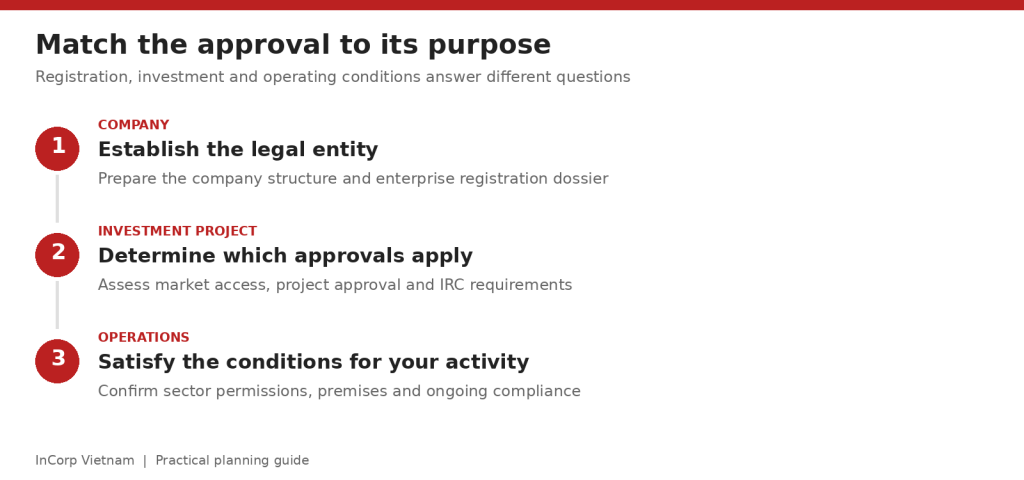
Use this map to assign each required approval to the right workstream. The actual sequence depends on the project; it is not a universal filing order.
Does Owning 50% or Less Remove the Need for Investment Approval?
No. A foreign investor may still need approval even when buying a small share of a Vietnamese company. For example, buying a 30% stake requires approval if the purchase increases foreign ownership in a business sector with restrictions on foreign investment. Approval may also be required if the company holds land-use rights in designated border, coastal or other areas relevant to national security. The ownership percentage alone does not determine whether approval is needed.
Before choosing a structure, discuss the proposed business lines and foreign-market-access position with InCorp’s legal advisory team.
How to Apply for Enterprise Registration
Step One: Define the Business and Ownership Structure
Describe what the business will actually sell or do, who will own it and where it will operate. Identify the entity form, proposed name, registered address, legal representative and capital plan. Check market access and sector conditions before treating an activity code as confirmation that the business can begin trading.
Step Two: Prepare the Current Dossier
Use the current checklist and forms for the chosen entity and filing route. Typical preparation includes the application, charter, relevant member or shareholder information, identity or corporate documents and authorization for the filer. Confirm any required beneficial-ownership disclosures and the treatment of foreign-issued documents with the receiving authority.
| Preparation item | Practical check |
| Names and identities | Match spellings, identification details and legal names throughout the dossier. |
| Ownership and authority | Keep the ownership chart, signing powers and representative documents consistent. |
| Foreign documents | Confirm translation, certification and legalization requirements or exemptions before commissioning work. |
| Business scope and location | Check whether the address and premises suit the intended activity and related approvals. |
Step Three: Use the Current Online Filing Route
Government guidance on rules effective from 23 July 2026 explains that applicants sign in through the National Public Service Portal using electronic identification to access the enterprise registration system. Use the National Business Registration Portal and current official instructions to locate the relevant procedure.
Confirm that the intended signatory or authorized representative can complete the identity step before starting. Requirements differ between directly entered information and uploaded documents; follow the current procedure’s signing and authorization instructions.
Step Four: Submit and Track the Application
Check the entered information against the signed supporting documents. Complete electronic authentication, pay the applicable charges and retain the electronic receipt and appointment notice. Keep any correction request with the application record and respond consistently across the affected documents.
Step Five Complete the Remaining Approvals
After registration, verify the company details and complete the investment and operating requirements that apply to the project. An issued ERC does not confirm that a clinic, school, factory, restaurant or other regulated operation is ready to open. Make the launch decision against an activity-specific compliance checklist.
Which Sectors Need Additional Checks
The following matrix is a scoping tool, not an exhaustive list of licenses. Requirements depend on the exact activity, goods, premises and ownership. InCorp’s conditional business licensing services can help identify the permissions relevant to the proposed model.
| Business activity | Issues to assess before launch |
| Trading and retail | Foreign-investment market access, goods restrictions and any trading or retail-outlet permissions applicable to the model. |
| Food and beverage | Food safety, product requirements, premises, fire safety and any alcohol-related activity. |
| Healthcare and medical products | Facility and practitioner permissions for clinical care; separate classification and product requirements for devices or other goods. |
| Education and training | The type of education offered, establishment and operation requirements, premises and qualified personnel. |
| Manufacturing | Site and land arrangements, construction, environmental obligations, fire safety and product standards. |
| E-commerce and financial services | The platform or sales model, consumer and data obligations, and any separately regulated payment or financial activity. |
Do not assume that all businesses within a broad sector need identical approvals. For example, selling a product, operating a marketplace and providing payment services are different activities. Describe the actual customer journey and revenue model when asking for a licensing assessment.
Businesses supplying regulated goods should also review InCorp’s product registration services before importing or placing products on the market.
Government Fees and Setup Costs
Keep enterprise filing charges separate from professional fees and project-specific approvals. The following published charges concern enterprise registration and disclosure, not an all-inclusive price for establishing a foreign-invested business.
| Charge | Published amount and scope |
| Enterprise registration fee | The temporary reduced charge is VND 25,000 per registration for fee-liable filings through 31 December 2026. |
| Online registration fee | Exempt from the enterprise registration fee. |
| Publication of registration information | VND 100,000 per publication under the published enterprise-information fee schedule. |
Check the charge displayed for the procedure when filing, especially if the application falls after the temporary reduction period. Request a quotation that identifies government charges, translations, certification, legalization, advisory work and any separate sector applications.
How Long Does Registration Take
Distinguish the authority’s processing period for a complete, valid dossier from the total setup timetable. Preparation, overseas documents, corrections, project approvals and premises-dependent permissions can all affect the launch date. Ask the adviser to identify dependencies and assumptions rather than quote one guaranteed period for every business.
What to Do After the ERC Is Issued
The ERC also serves as the enterprise’s tax registration certificate. This does not complete the practical work of running a compliant business. Assign responsibility for the following tasks as applicable:
- Complete disclosure, investment-project and activity-specific requirements before the relevant operations begin.
- Arrange banking and capital contributions in the correct form and within the applicable timetable.
- Set up accounting, tax reporting, invoicing and document retention for the actual business model.
- Prepare employment, payroll, social-insurance and immigration processes before hiring or deploying staff.
- Track changes to registered details, ownership, project scope and licenses, together with renewals and continuing conditions.
Growing employers can coordinate the people-related work through InCorp’s HR and payroll services.
How InCorp Vietnam Can Help?
InCorp can coordinate company formation, investment procedures and the assessment of conditional activities. Start with the intended operating model so that the engagement covers the approvals and ongoing obligations the business actually needs.
Contact InCorp Vietnam with your proposed activities and ownership structure to discuss a tailored establishment and licensing plan.
Learn the Right Setup for Business
Expansion in the Vietnam
Frequently Asked Questions
Is an ERC the Same as a Business License?
- No. The ERC records enterprise registration and tax registration. It does not replace the specific permission or conditions attached to a regulated activity. Ask advisers and partners to name the exact document they mean by "business license".
Does Every Foreign-owned Company Need the Same Licenses?
- No. Requirements depend on the investor and transaction structure, project, business activity and location. A trading company, manufacturer and healthcare operator should not rely on an identical checklist.
Can I Start Trading as Soon as the ERC Arrives?
- Only after the business has met all requirements applicable to the activity and project. Check investment procedures, sector conditions, premises and practical tax or invoicing arrangements before launch. Registration alone should not be treated as a blanket operating clearance.