In Vietnam’s fast-moving economy, foreign companies face a clear choice when scaling their teams: rent local employment infrastructure through an Employer of Record (EOR) or build their own through a Vietnamese legal entity. This is not a simple “setup fee versus monthly fee” calculation. Government registration costs are modest, but the real expense lies in the compliance machine you must run every month—payroll, Personal Income Tax (PIT) withholding, compulsory social, health and unemployment insurance, iron-clad labor contracts, and the ability to survive inspections.
Vietnam Social Security (VSS) audited 20,432 units by the end of 2024, uncovered more than 54,000 workers with missing or insufficient contributions, and recovered approximately VND 227.4 billion in overdue payments. The General Department of Taxation (GDT) continues to publish tens of thousands of inspections annually with material adjustments. Enforcement is active, data-driven, and unforgiving. Choosing the wrong model early can lock you into higher costs or expose you to back payments, reinstatement orders, and reputational damage.
Executive Summary
An EOR is the fastest, lowest-commitment route for early hires when headcount is uncertain or speed-to-hire is critical. Leading providers publish list prices clustering between US$499–$699 per employee per month (some starting as low as US$399).
The math flips once you have sustained headcount and a three-year plan. Using realistic mid-case assumptions, the break-even point where an entity becomes cheaper typically lands between 12–25 employees, depending on whether you need foreign-invested licensing, annual audits, and in-house finance/HR capacity.
Below we walk through the decision tree, operating realities, pricing benchmarks, a three-year cost model, onboarding timelines, enforcement risks, and a practical checklist.
The Practical Decision Flow: EOR First or Entity Now?
Most Asia expansions follow a proven pattern: enter fast, prove the market, then institutionalize. Vietnam’s enforcement environment makes the reassessment step non-negotiable.
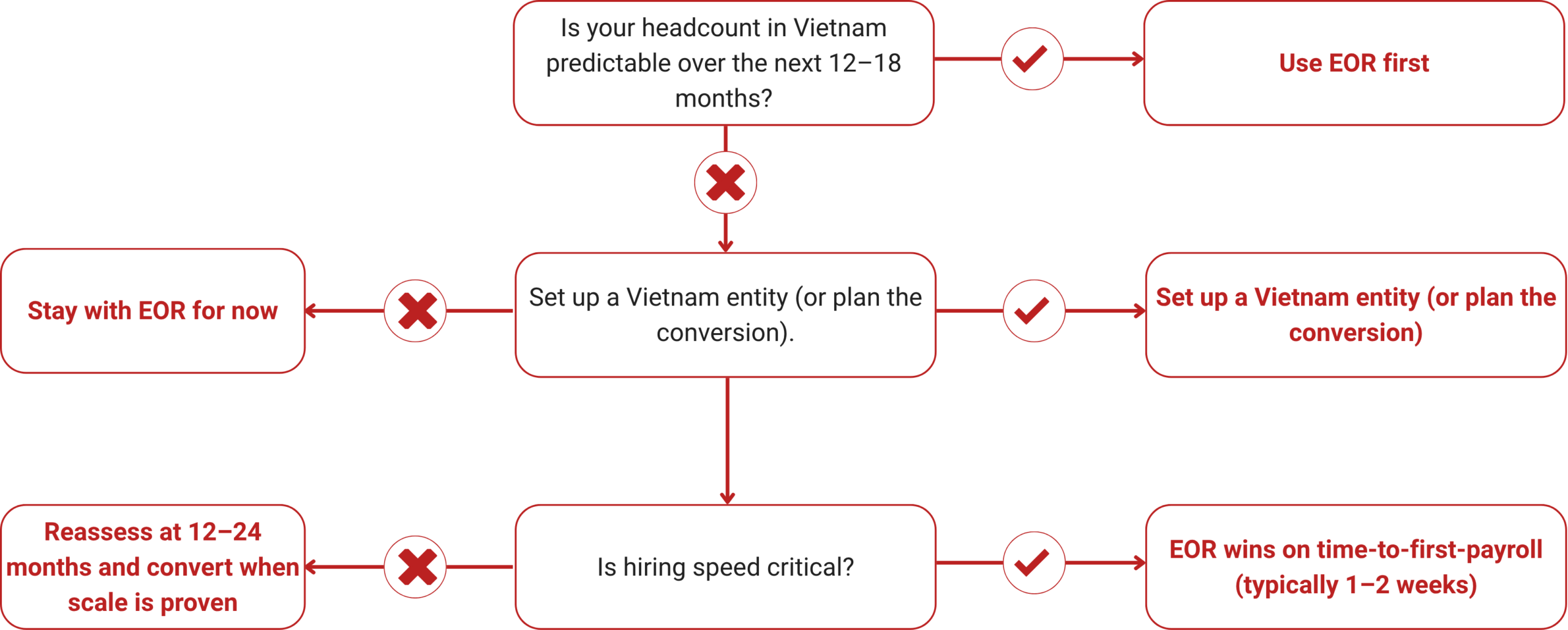
This decision tree reflects what we see daily at InCorp Vietnam: companies that start with EOR often convert once they hit 12–15 employees and have revenue traction. The longer you operate without proper infrastructure, the higher the risk that inspectors will treat your payroll and insurance history as incomplete.
What It Really Takes to Operate a Vietnam Entity
For foreign investors, “just incorporate” is rarely true. Depending on sector and ownership, you move through Investment Registration Certificate (IRC) and Business Registration Certificate (BRC) steps. Practical timelines stretch from several weeks to several months when document legalization or sector conditions apply.
Government filing fees (enterprise registration and public announcement) are defined in Ministry of Finance Circulars and remain small. The heavy lift is the operating system you must build and maintain:
- Compliant labor contracts under the Labor Code (notice periods, termination grounds, procedural safeguards).
- Mandatory insurance: Social Insurance (SI), Health Insurance (HI), and Unemployment Insurance (UI). A common PwC baseline shows combined employer contributions around 21.5% and employee 10.5% (with caps). UI applies only to Vietnamese nationals.
- PIT administration: monthly or quarterly declarations, annual finalization.
- Tax governance, e-invoicing, and readiness for inspection.
Two Vietnam-specific realities increase the cost of getting this wrong:
- Inspections are not hypothetical. VSS and GDT publish recovery numbers and inspection volumes every year. Clean documentation from day one is table stakes.
- Compliance simplification is real but narrow. Resolution 198/2025/QH15 eliminated the business license fee (lệ phí môn bài) from 1 January 2026. Helpful, yet it does not touch core payroll, insurance, or tax obligations.
Termination risk is especially material. The Labor Code requires strict procedures; illegal unilateral termination can trigger reinstatement, back pay (including insurance for the period not worked), and at least two months’ wages in compensation. This liability exists under both models—what changes is who drafts the paperwork and guides the process.
Build your Vietnam team the smart way. Start fast with InCorp EOR today, then convert to your own entity when scale makes sense. Book a quick 15-min call now.
EOR Scope and APAC Pricing Benchmarks
EOR providers act as the legal employer on paper. They handle contracts, payroll runs, statutory payments, onboarding, and compliance tooling. You retain day-to-day management and commercial direction.
Public pricing anchors (as of early 2026):
- Deel: starting at $599 per employee/month
- Papaya Global: from $499 per employee/month
- Oyster HR: $699 per employee/month
- Remote: $699 per employee/month
- Playroll: references as low as $399 per employee/month
Practical planning ranges (service fee only, excluding salary and statutory contributions):
- Vietnam: US$399–$699 per employee/month
- Southeast Asia (ex-Singapore): US$350–$750
- Singapore / Hong Kong: US$650–$1,200
- Japan / Korea: US$700–$1,300+
- Australia / New Zealand: US$700–$1,300+
Vietnam often lands toward the lower-middle of global pricing, but volume discounts, benefit complexity, and service tier still matter. The key economic difference is linearity: EOR cost scales directly with headcount; entity cost is mostly fixed plus modest variable admin.
Hiring in Vietnam? Let InCorp Vietnam handle the compliance heavy lifting — start with EOR today and convert to your own entity when it makes sense. Book a 15-minute call now.
Break-Even Model: Three-Year Cost Scenarios
We compare infrastructure costs only (incremental to payroll). Included: entity licensing/setup support, accounting/tax/payroll operations, compliance advisory, annual audit (where applicable). Excluded: base salary, bonuses, statutory employer contributions, benefits, and severance—these are the same under both models.
Mid-case assumptions (illustrative, not a quote):
- Entity setup (one-time): US$30k (range US$15k–$45k)
- Entity annual maintenance (fixed): US$85k/year (range US$60k–$110k)
- Entity variable admin: US$35 per employee/month (range US$20–$50)
- EOR service fee: US$550 per employee/month (range US$399–$699)
Under these assumptions, break-even sits at approximately 15 employees over a three-year horizon. Sensitivity is wide: lean entity maintenance + high EOR pricing can drop break-even below 10; heavy maintenance + negotiated EOR rates can push it toward 25–30.
Three-Year Scenario Table (Service/Infrastructure Cost Only – USD, rounded)
| Vietnam Headcount | Entity Setup + Run Cost (3 years) Low / Mid / High | EOR Service Fees (3 years) Low / Mid / High | Practical Reading (Mid-Case) |
|---|---|---|---|
| 5 employees | ~$199k / $291k / ~$384k | ~$72k / $99k / ~$126k | Provider cheaper while validating market |
| 15 employees | ~$206k / $304k / ~$402k | ~$215k / $297k / ~$377k | Near break-even; hinges on scale certainty and need for local contracting |
| 30 employees | ~$217k / $323k / ~$429k | ~$431k / $594k / ~$755k | Entity typically cheaper—if you can run compliance well |
Important nuance: These entity numbers assume you invest in a compliance team (in-house or outsourced) capable of withstanding inspection scrutiny. Operating a “paper entity” with under-resourced back office may look cheaper short-term but creates expensive downstream exposure.
Typical Path to First Compliant Hire
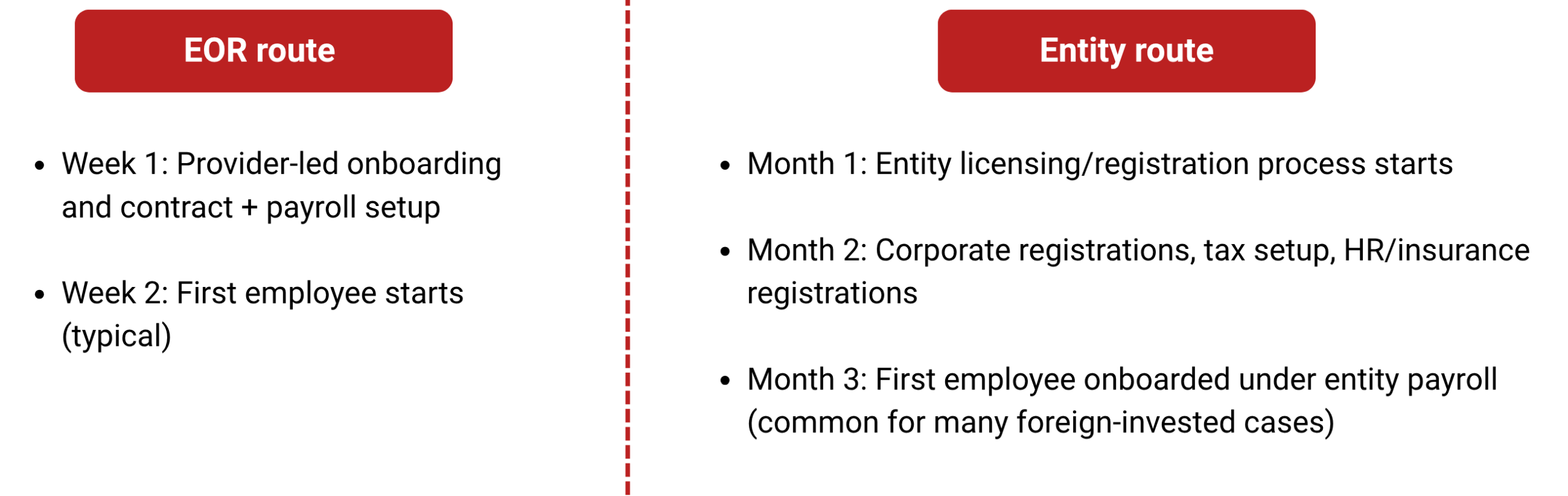
Timelines vary by sector and licensing complexity. Foreign-invested setups can take materially longer.
Vietnam Compliance Risk: What Enforcement Is Targeting (2023–2026)
Two characteristics define the landscape:
- Volume and public recovery numbers. VSS 2024 data: 20,432 units audited, >54,000 workers affected, VND 227.4 billion recovered. Hanoi social insurance offices report similar patterns.
- Scaling tax analytics. GDT’s 2025 figures show 68,765 checks and collections in the tens of trillions of VND. Investment in e-invoice data analysis has increased traceability.
Concrete risk patterns that swing the EOR vs entity decision:
- Under-registration or underpayment of compulsory insurance → backdated contributions plus remedial actions.
- Termination process failures → reinstatement, back pay, minimum two months’ compensation.
- Foreign worker governance and work-permit violations → administrative sanctions.
- General audit exposure: World Bank Vietnam Enterprise Survey notes 23% of firms interact with tax officials; senior management time on regulations is measurable.
A well-run EOR reduces operational failure modes (late filings, incorrect calculations, missed registrations) because these are the provider’s core competency. It does not eliminate business-level risks such as direction of work or corporate tax exposure—those remain with the client company.
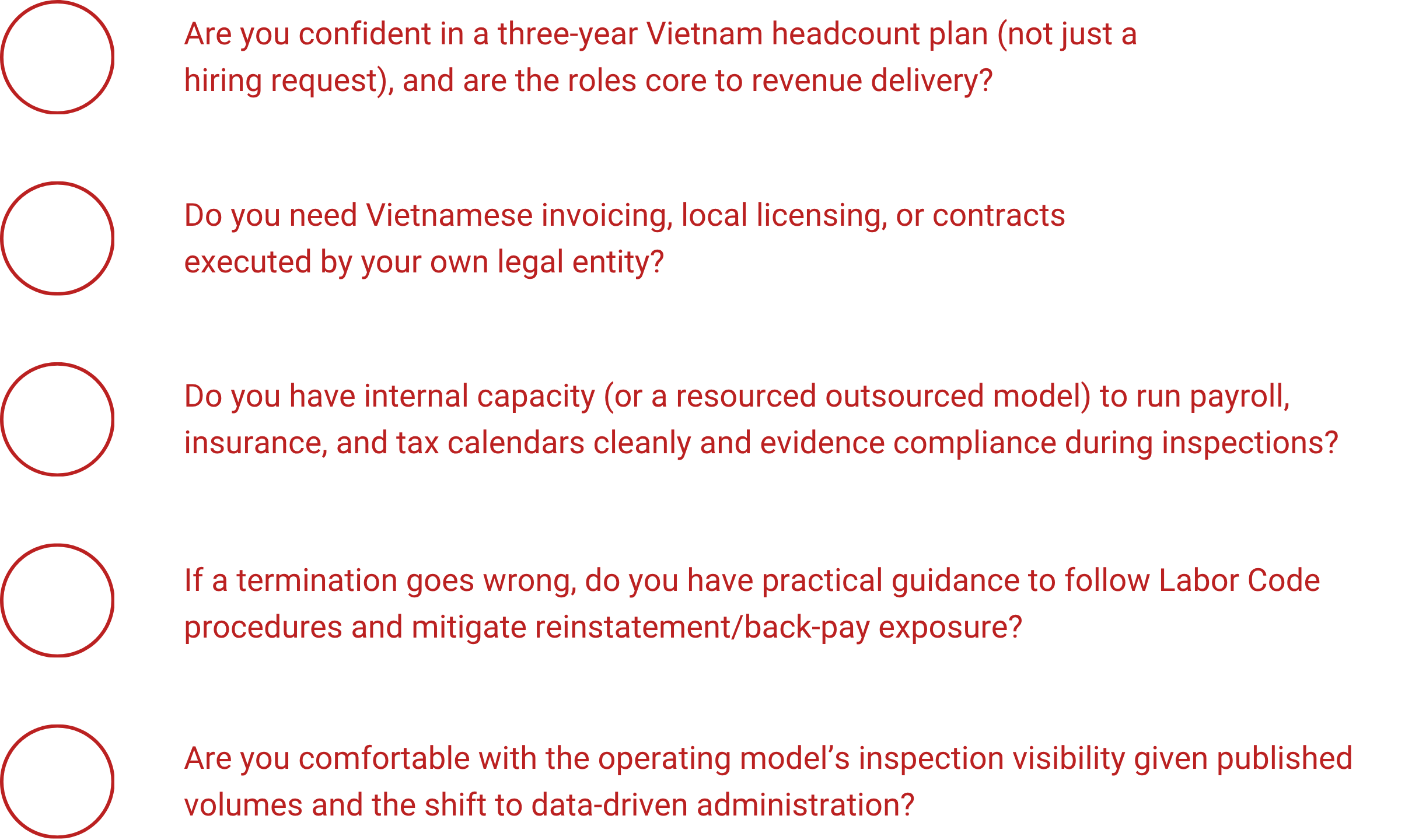
Decision Checklist for Vietnam Realities
Use this checklist rather than generic global hiring narratives:
CTA: Build Smart, Not Fast or Slow
At InCorp Vietnam we structure market entry as a phased build: hire fast with an EOR, keep compliance tight, and transition to an entity when headcount and commercial traction are proven. This approach minimizes early risk while preserving the option to own your infrastructure at scale.
If you share your 12–36 month headcount forecast, target roles, provinces, and benefits approach, we can map a tailored Vietnam build plan that aligns cost, compliance risk, and time-to-start. Many clients begin with a no-obligation modeling session using their exact numbers—often revealing that the optimal path is neither “all EOR forever” nor “entity from day one.”
Vietnam rewards companies that respect the enforcement environment while moving at market speed. The right choice is the one that matches your predictability, commercial needs, and tolerance for operational risk today—and your growth trajectory tomorrow.
Learn the Right Setup for Business
Expansion in the Vietnam
Frequently Asked Questions
How long until first compliant payroll?
- EOR: Week 1 onboarding, Week 2 first payslip. Entity: 2–3 months for full licensing, tax and insurance setup. If speed or uncertain headcount matters, EOR is the clear choice.
When should I switch from EOR to entity?
- Reassess at 12–15 employees with solid 18-month forecast. At 15 the costs are close; above 25 the entity usually wins — provided you need local invoicing and have compliance capacity.
What are the biggest hidden risks in Vietnam?
- Underpaid compulsory insurance (VSS back-claims are common), procedural termination mistakes (reinstatement + full back pay), and weak audit documentation (GDT ran 68,765 checks in 2025). EOR prevents these failures by design.
Can I convert from EOR to entity later?
- Yes — it’s the standard path. Contracts transfer seamlessly with full service continuity, accrued leave and insurance history. Most clients switch at 12–18 months once revenue is proven, with no disruption to employees or tax issues.