Living in Vietnam means choosing a city, securing the right residence status and setting a budget that reflects how you actually live. For a foreign founder or executive, the location of customers, staff and suppliers matters as much as the rent. For a family, school places and access to healthcare can determine the entire relocation plan.
This guide explains housing costs, residence options, banking, tax and the practical arrangements to make before moving. It focuses on long-term living for foreign professionals, investors and their families.
Where Should Expats Live in Vietnam?
The best city is the one that works for your business and household. A lower rent can be offset by frequent flights, long journeys to a factory or limited school choices.
| City | When it may suit you | What to check before committing |
| Ho Chi Minh City | Managing customers, professional services, commercial teams or operations across southern Vietnam | Peak-hour journeys, proximity to staff and customers, neighbourhood flooding and the full cost of a serviced apartment |
| Hanoi | Working with northern suppliers, corporate offices or public-sector stakeholders | Routes to industrial locations, seasonal air quality, school transport and winter housing comfort |
| Da Nang | Running a business that does not require daily access to the largest commercial centres, or managing central Vietnam operations | Availability of specialist staff, direct flight connections, school places and storm-related disruption |
Visit the neighbourhood during a normal working day and in the evening. Test the actual journey to your office or factory before signing a long lease. For a household with children, arrange school visits early: curriculum, language support and admission availability are more useful decision factors than a generic city ranking.
How Much Does Living in Vietnam Cost?
Housing standards, school choices and imported goods make a large difference. Use published prices as a starting point, then replace them with quotations for your preferred neighbourhood and household.
Housing and Utilities: Published Benchmarks
The figures below are rounded from Numbeo’s crowdsourced city data for October 2026. They are indicative averages, not quotations for a specific property. The utility basket relates to a larger apartment than the one-bedroom rental category, so it should not be treated as a matching package.
| Monthly expense | Hanoi | Da Nang |
| One-bedroom apartment in the city centre | VND 10.60 million | VND 13.64 million |
| One-bedroom apartment outside the centre | VND 7.25 million | VND 8.97 million |
| Basic utilities for the database’s apartment basket | VND 2.23 million | VND 2.00 million |
A coastal city is not automatically cheaper for your preferred type of home. Compare like-for-like properties: furnished versus unfurnished, serviced versus ordinary residential, and central versus suburban. Obtain current quotations for Ho Chi Minh City and any other shortlisted location using the same requirements.
Build a Budget That Includes the Costs People Miss
| Budget category | What to include |
| Home | Rent, management charges, electricity, water, internet, parking and cleaning |
| Daily Spending | Groceries, meals, local transport, subscriptions and leisure |
| Family | Tuition, school application fees, transport, lunches, uniforms and childcare |
| Health | Insurance premiums, deductibles, routine care, prescriptions and evacuation cover where needed |
| Relocation | Flights, shipping, temporary accommodation, deposits, translations and document certification |
| Business Travel | Trips to suppliers, regional meetings and travel to your home country |
Keep household costs separate from company incorporation, office rent and working capital. A founder’s personal runway and the company’s operating budget serve different purposes. If an employer pays rent or school fees, ask for the package to show who pays each bill and how benefits are treated for payroll tax.
Visas and Residence Options for Living in Vietnam
Vietnam’s e-visa can be valid for up to 90 days, for single or multiple entry. For a longer move, identify the appropriate employment, investment or family route before making commitments dependent on your continued residence.
| Your situation | Residence preparation |
| Taking employment with a Vietnamese organisation | The employer prepares the applicable work permit or exemption documentation and immigration sponsorship |
| Establishing or investing in a business | Prepare the investment and ownership evidence relevant to the investor category; the amount and nature of the investment affect eligibility |
| Moving with a spouse or child | Prepare marriage or birth records, the sponsor’s identity and residence evidence, and required translations or legalisation |
| Exploring the market before deciding | Use the appropriate entry permission for your activities, then prepare the longer-term route once the employment or investment arrangement is established |
The Vietnam temporary residence card guide sets out the categories, forms, fees and documents. Long residence does not automatically lead to permanent residence: Vietnam’s permanent-residence rules apply to specified eligible groups. A relocation plan should be based on the status you can actually obtain.
Prepare original civil-status documents before leaving your home country. Where foreign documents need consular legalisation and certified Vietnamese translations, completing that work early avoids delays when a sponsor is ready to file.
Renting a Home and Registering Your Address
Ask the landlord or authorised agent for a written lease and evidence that they can rent the property. The contract should identify the premises, parties, rent, deposit, payment schedule and termination terms. Record the furniture and condition of the property with photographs at handover.
Before paying, agree on:
- Which management, parking, cleaning and utility charges are included.
- The electricity billing method and access to the underlying meter or bill.
- Responsibility for repairs, air-conditioning maintenance and appliance replacement.
- Deposit deductions, the refund process and notice requirements.
- Whether the landlord will complete the required temporary-residence declaration for foreign occupants.
Under the foreigners’ residence rules, accommodation providers must report a foreign guest’s temporary residence within 12 hours, or 24 hours in remote areas. Ask for confirmation that the declaration has been completed and update the arrangement when you move.
For a founder working from home, also check whether the premises may be used for the proposed business purpose. A residential lease and a suitable registered business address are separate property arrangements.
Healthcare and Insurance
Select healthcare providers before you need urgent treatment. Identify a nearby facility for routine care, a hospital able to handle emergencies and the insurer’s assistance number. Ask whether your chosen provider accepts direct settlement or requires you to pay and claim reimbursement.
When comparing insurance, review inpatient and outpatient cover, pre-existing conditions, maternity needs, emergency evacuation, geographic coverage and policy exclusions. A low premium is less useful if the policy excludes the care your household is likely to need.
Banking and Moving Money
For a personal account, prepare your passport, evidence of lawful stay, local contact information and documents the chosen bank requires for your customer profile. Requirements vary by institution and account type. Compare online banking access, international transfer support, foreign-currency services and the ability to update your identity records after a passport or residence-card renewal.
Have salary paid through a traceable account and retain your employment contract, payslips, bank statements and tax records. These documents help establish the lawful source of income when remitting money abroad. Our guide to transferring money from Vietnam explains the documents for personal income, company profits and other business payments.
If you own a company, use its designated business and investment accounts for company transactions. Record money you contribute as capital or a loan under the relevant arrangement; avoid mixing it with household spending.
Tax Matters for Foreign Residents
Tax residence depends on more than the date shown on a visa. PwC’s Vietnam tax summary explains the 183-day test: presence for that period in a calendar year or in the period of 12 consecutive months from arrival can establish residence. Registered residence and certain rental arrangements can also be relevant, including whether you can demonstrate residence elsewhere under the applicable rules.
Keep a travel-day record, copies of leases and details of income paid both inside and outside Vietnam. Before finalising an employment package, identify which entity pays salary and bonuses, how housing is provided and who handles withholding and annual tax finalisation. A regional role with overseas payroll needs particular attention because the place of payment alone does not settle the tax treatment.
Everyday Practicalities and Challenges
Traffic and commuting can affect daily life more than the distance shown on a map. Try your intended route at the times you will actually travel. If you plan to drive, confirm that your licence is recognised for the vehicle category and that your insurance covers you; do not assume a home-country licence alone is sufficient.
Air quality, heavy rain and storms should also influence housing choices. Check drainage, building access, backup power and the landlord’s arrangements for outages. For remote work, test the apartment’s internet connection rather than relying on an advertised building package.
Learning basic Vietnamese helps with deliveries, building management and day-to-day services. For contracts, immigration papers and financial transactions, use clear written records and appropriate translation support.
Moving to Vietnam: An Action Checklist
Before You Travel
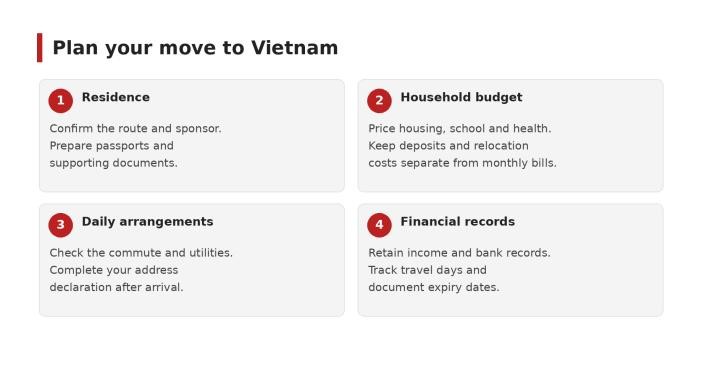
Confirm your residence route and sponsor; gather passports and civil-status records; arrange healthcare cover; request school and housing quotations; and agree the employment or investment arrangements in writing.
When You Arrive
Complete the accommodation declaration, set up communications and banking, inspect the home before handover and retain copies of official receipts and applications. Give your employer the information needed to complete payroll and immigration administration.
Once You Are Settled
Track document expiry dates, keep travel and income records, update your address when moving and review insurance after changes to your family or employment. Maintain a shared record of responsibilities with your employer or company administrator so renewals are not missed.
Conclusion
A successful move to Vietnam starts with a realistic household budget and a residence route that fits your work or investment plans. Choose the city around daily needs, prepare documents early and keep clear records for banking and tax. InCorp Vietnam can help organise the immigration and business arrangements that support your relocation.
Learn the Right Setup for Business
Expansion in the Vietnam
Frequently Asked Questions
Is Vietnam affordable for expats?
- It can be, but rent, private schooling, insurance and frequent international travel can dominate the budget. Use local quotations for your household instead of a single countrywide monthly figure.
Which city is best for a foreign entrepreneur?
- Ho Chi Minh City, Hanoi and Da Nang serve different needs. Start with customers, suppliers, staffing and travel requirements, then compare suitable neighbourhoods and family arrangements.
Can I live in Vietnam long term on an e-visa?
- An e-visa is a time-limited entry permission. For an ongoing move, prepare the employment, investment or qualifying family basis relevant to your circumstances and apply for the appropriate residence status.
Does renting an apartment make me a tax resident?
- A lease can be relevant to the residence test, but the assessment also involves presence and other residence evidence. Review the whole position before assuming that fewer days in Vietnam mean non-resident treatment.
What should I arrange first when relocating with children?
- Confirm the family's residence eligibility, school availability and healthcare needs before committing to a neighbourhood. Those decisions determine the required documents, travel timing and realistic household budget.