Vietnam’s health product market has been booming since it opened to foreign imports in the 1990s. Currently in Vietnam over 4,000 companies are offering more than 10,000 health products. Foreign brands are dominating this sector but knowing the registration process for general health supplements requires careful attention to local regulations and procedures.
For companies looking to enter Vietnam’s general health supplement market, understanding the regulations set by the Vietnam Food Administration (VFA) is crucial. This blog will walk you through the key definitions, procedures, and regulations you need to know to register your health supplements in Vietnam. This will be helpful for the manufacturer, distributor, or investor to take the first step to bring your products to Vietnamese consumers.
Need help with Health Supplements Registration in Vietnam? Check out InCorp Vietnam’s Product Registration Services now!
1. What Are Health Supplements?
In Vietnam’s evolving regulatory landscape, a “health supplement” is not just a simple vitamin pill. It is a legally defined and strictly regulated sub-category of functional foods, designed to supplement the daily diet with concentrated nutrients or bioactive substances to maintain, enhance, or improve bodily functions and reduce disease risk.
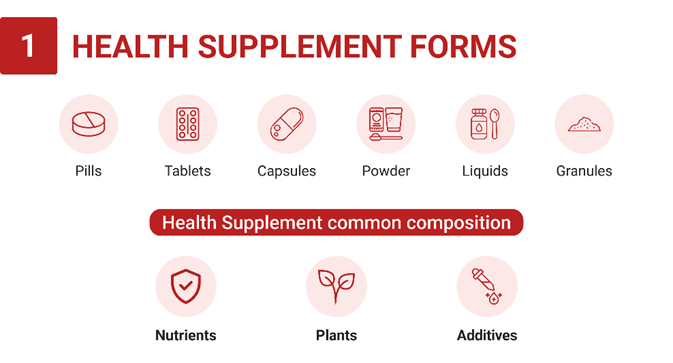
According to the law, health supplements (Thực phẩm bảo vệ sức khỏe) are products presented in measured dosage forms (like capsules, tablets, or powders) and contain one or more of the following:
- Vitamins, minerals, amino acids, fatty acids, enzymes, probiotics.
- Natural-sourced substances from animals, minerals, or plants (e.g., extracts, concentrates).
- Synthetic versions of the above.
Key Insight: This definition immediately excludes conventional foods. If your product is in a capsule or sachet and makes a “support” or “improve” claim, it almost certainly falls under this category, triggering specific rules for Good Manufacturing Practice (GMP) certification, pre-market registration, and advertising pre-approval.
2. How to Register Health Supplements in Vietnam?
Vietnam’s health supplement market is a land of golden opportunity—but the gateway is now guarded by a new set of rules. With the market surging to become Southeast Asia’s fastest-growing and new regulations like Decree 46/2026 fundamentally reshaping the entry process, success demands more than just a great product.
Here is the step-by-step guide:
📝 Step 1: Navigate the New Pre-Market Registration System
Vietnam has introduced a new framework via Decree 46/2026/ND-CP and Resolution 66.13/2026/NQ-CP, replacing the old self-declaration model. Your first critical task is to determine the correct pathway for your product:
For health supplements, you must follow the “Granting of Circulation Number” (full registration) route.
Step 2: Prepare the Comprehensive Registration Dossier
The registration dossier is extensive. According to Form No. 03 specified for health supplements, it must include at least the following key components:
- Product Declaration (Form No. 02): Contains detailed product specifications, quality and safety indicators, and draft labels.
- Certificate of Free Sale (CFS) from the country of origin.
- GMP Certificate: A valid Good Manufacturing Practice certificate for the manufacturing facility is mandatory.
- Stability Study Report: This must include long-term and accelerated testing data to scientifically determine the product’s shelf life.
- Scientific Evidence: Documented proof supporting all health claims made for the product.
- Letter of Authorization: A new requirement authorizing your local entity (e.g., importer) to conduct the registration on your behalf.
Important Note: Authorities have set a principal approval timeline of 90 days for reviewing registration dossiers. The draft rules also state you will have only one opportunity to correct a deficient dossier within 60 days of notice. Accuracy and completeness are paramount to avoid months-long delays.
Step 3: Ensure Facility & Production Compliance
Good Manufacturing Practice (GMP) is now a legal requirement for all health supplement production facilities under Decree 46/2026. Key points include:
- The person in charge of technical expertise must hold at least a university degree in relevant fields (e.g., pharmacy, food technology).
- The facility must establish and maintain a documented GMP system covering the entire production, distribution, and storage process.
- All production personnel must be trained in GMP and food safety.
- If manufacturing locally in Vietnam, the factory must obtain a Certificate of Food Safety Compliance before operating.
Step 4: Finalize Compliant Labels & Advertising
- Labeling: Follow Decree 43/2017/ND-CP on goods labeling (amended by Decree 111/2021). Key rules include: all mandatory information must be in Vietnamese (a supplemental label is acceptable), and you must include the disclaimer: “This product is not a medicine and is not a substitute for medicine”.
- Advertising: This is a critical and controlled step. All advertising for health supplements now requires prior approval from the Ministry of Health before any campaign launch. Claims must strictly match the registered product information and must never imply therapeutic effects.
Step 5: Plan for Import & Customs Clearance
The new risk-based inspection system under Decree 46 means your first shipments will face thorough checks. Be prepared for:
- Document Checks: Ensure the approved Circulation Number, CFS, commercial invoice, and packing list are perfect.
- Potential Physical Inspection & Sampling: Authorities may take samples for laboratory testing against safety criteria.
- Delays: Initial implementation caused significant bottlenecks. While the government has ordered 24/7 staffing and faster clearance for compliant shipments, you should still build buffer time into your supply chain.
3. Navigating New Rules: Key Considerations for Importing Health Supplements into Vietnam in 2026
For investors and brands, Vietnam’s health supplement market continues to be one of Southeast Asia’s most attractive opportunities. However, the regulatory gateway has been fundamentally reshaped in early 2026. A new legal framework has replaced the old rules, moving from a model of self-declaration to one of stringent pre-market review and ongoing oversight.
Understanding these changes is not merely about compliance—it’s a strategic imperative that affects your time-to-market, cost structure, and long-term viability. This guide breaks down the three most critical areas where the rules have tightened and what you must do to succeed.
3.1. Product Labeling and Claims: Beyond the Basics
Gone are the days when simple nutritional information and a standard disclaimer were sufficient. Under Decree No. 46/2026/ND-CP, labeling is now a cornerstone of product registration and market surveillance.
- The New Foundation: While the core requirement to state “This product is not a medicine and is not a substitute for medicine” remains, the entire label must now perfectly reflect the details in your approved registration dossier. Any health claim on the package—such as “supports immune function” or “aids digestion”—must be backed by the scientific dossier you submitted and cannot deviate from the officially approved wording.
- The Digital Shift and Traceability: A significant trend is the move towards e-labeling. For products with limited physical space, regulations now allow for certain mandatory information to be provided electronically via QR code or website, provided the physical label directs consumers clearly. More importantly, there is a strong push for full supply chain traceability. Investors must implement systems that maintain batch-level records from production to point of sale, as this data can be audited by authorities.
The Investor Takeaway: Your product label is now a direct extension of your legal registration. Work backward from the stringent registration requirements to design your label, and invest in traceability systems from day one.
3.2. Advertising Regulations: Pre-Approval is Now Mandatory
This is one of the most significant operational changes. Previously, advertising content could be subject to post-market review. Now, prior approval is a non-negotiable prerequisite.
- The Pre-Approval Requirement: Under the new framework, all advertising content for health supplements—across TV, print, digital banners, social media, and influencer campaigns—must be reviewed and approved by the Ministry of Health (MoH) before launch. This is governed by the comprehensive Decree No. 342/2025/NĐ-CP on advertising, which took effect in February 2026.
- Strict Boundaries on Claims: The scrutiny is intense. Advertisements must strictly avoid:
- Any imagery or language implying diagnostic, therapeutic, or curative effects (e.g., showing medical professionals, hospitals, or symbols like the red cross).
- Comparative claims that disparage other products.
- Absolute guarantees of results (e.g., “cures completely,” “prevents disease X”).
- Claims that could mislead consumers about the product’s nature as a food, not a drug.
The Investor Takeaway: Factor the advertising pre-approval timeline into your entire marketing and product launch schedule. Marketing campaigns can no longer be launched agilely; they require a fixed compliance step that can take several weeks.
3.3. Ingredient and Import Checks: Facing Risk-Based Scrutiny
The process of getting your product from the port to the shelf has become more complex and strategic. The principle of “trust but verify” has been replaced with a sophisticated, risk-based inspection model.
- Risk-Based Customs Inspections: Decree 46/2026 introduces a risk-based inspection system for imported goods. Authorities assign risk levels based on multiple factors, including:
- Product Type: Health supplements are inherently classified as higher risk.
- Country of Origin: The regulatory reputation of the exporting country matters.
- Importer’s Compliance History: Your own track record is your greatest asset or liability. First-time importers or those with past violations will face the highest level of scrutiny.
- Beyond the Ingredient List: A thorough check is no longer just about whether an ingredient is permitted. It’s about proving its safety and quality at every step. Customs may now subject shipments to documentary reviews, physical inspections, and mandatory sampling for laboratory testing against Vietnamese standards for contaminants, heavy metals, and microbiological safety.
The Investor Takeaway: Your first shipment will set the tone. Ensure all documents—especially the Certificate of Free Sale (CFS), GMP certificate of the factory, and your product’s Circulation Number—are impeccable. Building a clean compliance history is a strategic investment that will speed up future imports.
How InCorp Vietnam Can Assist With Health Supplements Registration?
Vietnam’s health supplement market is expanding, but navigating regulatory requirements can be challenging. Compliance ensures product safety, prevents penalties, and secures legal approval. The process demands extensive documentation, adherence to safety standards, and government approvals, which can be complex for new entrants.
InCorp Vietnam simplifies this process by handling documentation, securing safety licenses, and ensuring regulatory compliance. Our experts manage translations, liaise with government agencies, and act as your local representative, eliminating delays and complications. Partner with InCorp Vietnam for a seamless market entry and focus on business growth while we handle compliance. Contact us today for expert assistance!

clients worldwide

professional staff

incorporated entities in 10 years

compliance transactions yearly
Learn the Right Setup for Business
Expansion in the Vietnam
Frequently Asked Questions
How long does the health supplement registration process take?
- On average, it takes 30 to 60 working days for the Ministry of Health to review and approval health supplement registration, assuming the submitted dossier is complete and meets all legal requirements. Delays may occur if documentation is incorrect, incomplete, or if additional clarifications are requested.
What is considered a health supplement under Vietnam regulations
- A health supplement is a functional food in measured dosage forms that supports bodily functions or reduces disease risk and is regulated separately from conventional foods.
Is GMP mandatory for health supplement manufacturers?
- Yes. All health supplement manufacturing facilities must hold a valid GMP certificate under Decree 46/2026.
Can health supplements be advertised freely after registration?
- No. All health supplement advertising must receive prior approval from the Ministry of Health, and claims must strictly match the approved registration dossier.