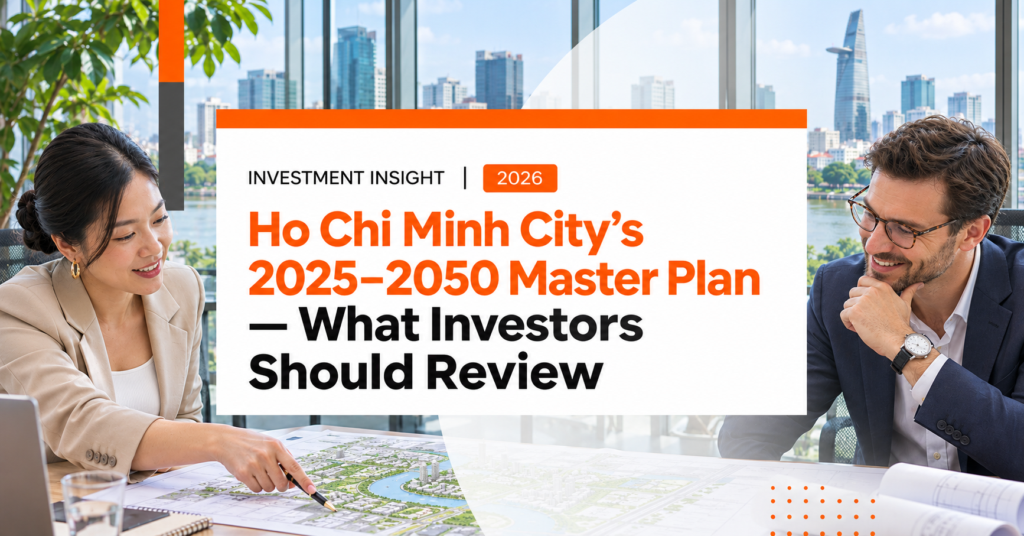
Ho Chi Minh City’s first master plan since its 2025 merger with Binh Duong and Ba Ria–Vung Tau gives foreign investors a starting point for choosing where to set up or expand. The plan identifies five growth areas with distinct priorities, from financial services in the central core to manufacturing and logistics in the north and port-led development in the south.
For businesses comparing factory, warehouse or office locations, the investment decision comes down to what each site can support by the planned opening date. Investors should confirm permitted land use, utility capacity and access to workers, suppliers and transport before committing capital.
Where Will Ho Chi Minh City Focus Development?
The five growth areas give investors a way to match their operating requirements with the city’s long-term development priorities.
| Growth area | Where the plan focuses | What investors should assess |
| Central financial and services core | Saigon, Cho Lon, Thu Thiem and the central stretch of the Saigon River. Priorities include international finance, professional services and creative industries. | Office availability, occupancy costs and access to clients, staff and public transport for a regional headquarters or services operation. |
| Eastern innovation area | Thu Duc, Thuan An, Di An and Tan Uyen, with links to Long Thanh Airport. Priorities include high-tech industries, AI, semiconductors, R&D and higher education. | Technical talent, suitable R&D facilities and proximity to universities, research partners and technology suppliers. |
| Northern industrial and logistics area | Thu Dau Mot, Ben Cat and Bau Bang. Priorities include advanced manufacturing, supporting industries, logistics and regional distribution. | Factory and warehouse availability, power and wastewater capacity, supplier proximity and freight access. |
| Southern port, free trade and energy area | Chau Duc, Phu My, Long Son, Ba Ria and the Can Gio port area. Priorities include international ports, free trade, maritime services, logistics and energy. | Trucking costs to operating terminals, including those in the Cai Mep–Thi Vai cluster, and the boundaries, operating rules and eligibility criteria of any planned free trade zone relevant to the project. |
| Western urban, education and healthcare area | The corridor from Binh Hung to Hoc Mon. Priorities include urban development, education and specialised healthcare. | Local demand, access for students or patients, workforce availability and site suitability for the proposed facility. |
The plan also identifies five satellite centres: Con Dao, Vung Tau–Long Hai–Ho Tram, Hoc Mon–Cu Chi, Bau Bang and Bac Tan Uyen. These centres are intended to bring jobs, services and infrastructure closer to residents. A separate framework of 10 development management zones guides the distribution of housing, employment and infrastructure across the city. The plan also calls for protection of the Saigon and Dong Nai river corridors and ecologically sensitive areas such as Can Gio.
Planning to invest and expand to Ho Chi Minh city? Speak to our expert at Company Incorporation | Ascentium Vietnam
How Could Transport Plans Affect Site Selection?
Metro Lines 1 and 2 and Ring Roads 3 and 4 are among the corridors the city intends to use to connect major employment and development areas. The plan also supports transit-oriented development, clustering housing, offices and services around stations and transport hubs.
The implications differ by operation. A manufacturer in the north should compare access to suppliers and skilled workers with the cost of moving goods to port. An exporter evaluating a southern warehouse should test trucking times to the terminals it would use. For an office or mixed-use development near a proposed station, investors should check both the expected opening date and the land uses allowed at the site.
Use operating routes to build the base case. Then estimate what a new connection would save and what a delay would cost. This gives investors a clearer view of whether the site can support operations from day one.
What Should Investors Verify Before Signing a Lease or Committing Capital?
- Confirm permitted land use. Review the planning documents that apply to the specific parcel and identify the approvals needed for the proposed factory, warehouse, office or development.
- Check utilities and road access. Confirm when the site can provide the required power, water and wastewater treatment. Verify that access roads can handle the expected vehicle types and traffic volumes.
- Verify infrastructure milestones. For any road, rail or port link the project depends on, check funding, land clearance, construction progress and the expected opening date against the operating schedule.
- Confirm free trade zone conditions. Where the investment case depends on a planned zone, verify its boundaries, operating rules and eligibility requirements before budgeting for potential benefits.
- Compare operating costs across shortlisted sites. Include rent, labour, utilities and freight. Businesses expanding at an existing site should also check whether planned transport corridors or zoning changes could affect the space available for expansion.
The city issued Plan No. 622/KH-UBND on 10 November 2026 for the public release of the master plan. Investors can consult the published planning documents and drawings as they shortlist sites and identify what to verify at parcel level.
How Ascentium Vietnam Can Help
Ascentium Vietnam supports foreign investors assessing where to establish or expand operations in Vietnam. Our team can help compare locations, review infrastructure dependencies and identify the approvals to confirm before committing to a site.
Planning to invest and expand to Ho Chi Minh city? Speak to our expert at Company Incorporation | Ascentium Vietnam
Learn the Right Setup for Business
Expansion in the Vietnam
FAQs for InCorporation
What does the Ho Chi Minh City Master Plan 2025–2050 cover?
- The plan sets out long-term development priorities for the expanded city following its 2025 merger with Binh Duong and Ba Ria–Vung Tau. It covers economic development, transport infrastructure, urban services and environmental protection through 2050.
What are the five growth areas in the Ho Chi Minh City Master Plan?
- The central core focuses on finance and international services. The east prioritises technology and innovation, while the north focuses on manufacturing and logistics. The south prioritises ports, free trade and energy, and the west focuses on urban development, education and healthcare.
Which areas should manufacturers and logistics companies consider?
- Manufacturers can start by comparing sites in the northern industrial corridor around Thu Dau Mot, Ben Cat and Bau Bang. Exporters and logistics operators can also evaluate southern locations with access to the Cai Mep–Thi Vai port cluster. Compare sites based on utility capacity, workforce access and actual trucking costs.
How should investors factor planned metro lines and ring roads into site selection?
- Use transport routes already in service to estimate your initial operating costs. If a planned road or station is important to the site, verify its expected opening date and calculate how a delay could affect freight costs or employee commutes.
What should foreign investors verify before signing a lease in Ho Chi Minh City?
- Check the permitted use of the specific parcel, the approvals your project requires, and whether utilities and access roads can support operations by your opening date. If your investment depends on a planned free trade zone, confirm its boundaries, operating rules and eligibility requirements before budgeting for potential benefits.