Vietnam’s booming economy presents enormous opportunities for market entry, but foreign investors often find themselves at a tough crossroads. For example, Vietnam attracted over US$31.5 billion in FDI during the first 10 months of 2025, thanks to its young workforce, strategic location, and free-trade agreements. However, sealing a deal and obtaining a license is only part of the journey. Many companies struggle after the setup phase; navigating Vietnam’s complex, fast-changing regulations and finding the right local support requires more than an initial market entry plan. In practice, every element of the market entry process – from accounting to payroll – must be aligned under one coherent plan to avoid gaps in execution.
Pitfalls of a Fragmented Market Entry Process
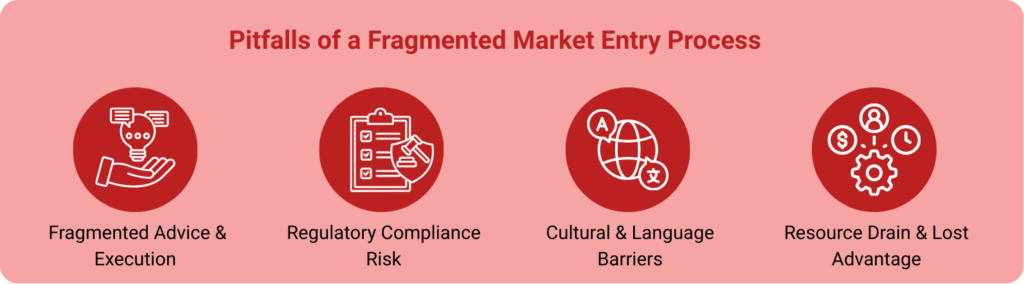
Before even choosing vendors, many foreign firms already fall into the trap of a fragmented market entry strategy. Market research, legal structuring, tax registration, and operational setup are often handled by different providers or split internally across teams, with no single owner overseeing the full picture. On paper, this may look efficient. In practice, it creates misalignment and delays that quietly undermine the entire market entry process.
One common issue is the disconnect between advice and execution. A consultant may recommend one market structure during the research phase, while a separate legal firm sets up an entity that does not fully support that strategy. Without a unified roadmap, decisions made early in the market entry can contradict later operational realities, forcing companies to pause, rework, or restart key steps.
Regulatory compliance risk is another major consequence of fragmentation. Vietnam applies strict tax and reporting deadlines, from monthly VAT filings to quarterly corporate income tax reports and annual financial statements. When responsibilities are split across multiple vendors or managed remotely without local coordination, deadlines are easily missed or filings are submitted incorrectly. The result is not just administrative inconvenience, but real financial exposure, including penalties of the tax due, unexpected audits, and reputational damage with local authorities that can slow or even halt market entry progress.
Cultural and language barriers further compound the problem. All official filings, licenses, and communications with authorities must be conducted in Vietnamese. Without consistent bilingual support, foreign teams often misunderstand regulatory guidance or fail to communicate effectively with regulators. These small misunderstandings can escalate into prolonged back-and-forth, rejected submissions, or stalled approvals, adding weeks or months to a market entry timeline.
Over time, this fragmented approach also becomes a significant drain on internal resources. Management time is consumed coordinating vendors, clarifying responsibilities, and resolving conflicts between advisors. Companies often pay multiple consulting fees without seeing tangible progress, while competitors that commit earlier to a structured, end-to-end market entry approach begin operating, learning, and adapting locally. As a result, any initial first-mover advantage quietly disappears.
This is why many foreign SMEs remain stuck in prolonged “exploration mode” instead of transitioning into full operations. A fragmented market entry process rarely fails in one dramatic moment. Instead, it loses momentum through missed deadlines, duplicated costs, and slow decision-making, until expansion plans quietly stall.
What is a one-stop operating partner?

To overcome the risks of fragmentation, many foreign investors in Vietnam are increasingly working with one-stop operating partners. These are local firms that bring all essential post-entry services under one roof, allowing investors to move from initial licensing to stable operations with a single, coordinated advisor rather than a patchwork of disconnected vendors.
In practical terms, a one-stop operating partner supports the full market entry journey and the operational phases that follow. In Vietnam, this model has emerged in response to the reality that foreign-invested enterprises often struggle to align market entry decisions with legal structure, tax compliance, and day-to-day operations when these functions are handled separately. Instead of managing multiple advisors across different stages, investors work with one operating partner who oversees the entire lifecycle.
At InCorp Vietnam, this approach means integrating market entry advisory with incorporation, licensing, accounting, tax, payroll, and corporate secretarial services under a single engagement. Market entry strategy is developed with a clear understanding of how the business will be structured, taxed, and operated in practice. Entity setup and licensing are handled with downstream compliance requirements in mind, reducing the need for restructuring or corrective filings later.
Once operations begin, the same team continues to support accounting and tax compliance, payroll, human resources, and ongoing corporate governance. Because all functions sit within one operating framework, changes in business direction, staffing, or regulatory requirements can be addressed holistically rather than in isolation. This continuity helps foreign investors avoid common post-entry issues such as misaligned tax treatment, duplicated advisory costs, or compliance gaps caused by handovers between vendors.
For foreign companies entering Vietnam, the value of a one-stop operating partner is not only convenience, but operational clarity. Instead of repeatedly re-explaining their business to different providers at each stage of market entry, investors gain a long-term operating partner who understands their structure, risk profile, and growth objectives from the outset and supports them as the business scales.
Launch confidently in Vietnam with one-stop support — connect with InCorp Vietnam today.
Why a One-Stop Partner Matters After Market Entry
Securing an investment license is only the starting point. For most foreign investors, the real challenge begins after market entry, when daily operations, compliance obligations, and growth decisions all start to overlap. This is where a one-stop operating partner becomes critical, not as an administrative convenience, but as a way to turn the post-entry phase into a structured, manageable, and strategic process.
In Vietnam, compliance risk tends to accumulate quietly over time. Tax, accounting, and reporting rules are strict and frequently updated, and many foreign-invested enterprises only realize the consequences a few years in, when penalties, back taxes, or audits begin to surface. A one-stop operating partner reduces this risk by centralizing responsibility for all filings and statutory obligations. Monthly VAT declarations, quarterly corporate income tax filings, annual financial statements, and payroll reporting are tracked within one system, by one accountable team. This coordination significantly lowers the likelihood of missed deadlines, inconsistent filings, or misinterpretation of local requirements.
Beyond risk reduction, the operational impact is equally important. Managing separate accountants, legal advisors, payroll providers, and HR consultants quickly becomes time-consuming and costly, especially for small and mid-sized foreign investors. Each vendor requires onboarding, coordination, and repeated explanations of the business model. By contrast, a one-stop partner consolidates these functions into a single engagement, freeing management time and often reducing total advisory costs. Instead of internal teams being pulled into administrative firefighting, leadership can focus on sales, partnerships, production, and strategic execution.
Local expertise is another decisive factor. Vietnam’s regulatory environment is highly procedural, language-dependent, and shaped by informal practices as much as written rules. A seasoned local partner understands how authorities interpret regulations in practice, not just on paper. They can communicate directly in Vietnamese, anticipate documentation requirements, and navigate cultural nuances that often slow down foreign-led operations. When new regulations emerge, such as changes to digital tax IDs, e-invoicing, or labor compliance, a one-stop partner can interpret and implement them immediately, rather than leaving foreign teams to decipher fragmented guidance.
Just as importantly, a one-stop model brings structure to the market entry and post-entry process. Instead of a loose collection of tasks handled reactively, operations are treated as a defined program with timelines, responsibilities, and clear deliverables. This structured approach helps companies reach faster decision points, maintain budget control, and reduce execution risk. In practice, it prevents the common post-entry scenario where unresolved questions, overlapping responsibilities, and unchecked to-do lists slow momentum just as the business should be scaling.
At InCorp Vietnam, this post-entry support is designed to go beyond routine compliance. By integrating accounting, tax, payroll, HR, and corporate secretarial services with ongoing advisory, the operating model allows compliance to support growth rather than distract from it. Management teams are able to focus on refining their market entry strategy, expanding operations, and pursuing new opportunities, confident that regulatory obligations are being handled correctly in the background.
Over time, the relationship also becomes more strategic. A one-stop operating partner is well positioned to advise on tax incentives, operational restructuring, workforce planning, and risk management as the business evolves. This turns compliance from a defensive necessity into a source of long-term stability and competitive advantage. When handled correctly from day one, post-entry operations lay the foundation for sustainable growth in Vietnam, allowing foreign investors to move forward with clarity, confidence, and control.
Simplify your Vietnam market entry and operations — book a consultation with InCorp Vietnam now.
Choosing the Right One-Stop Partner
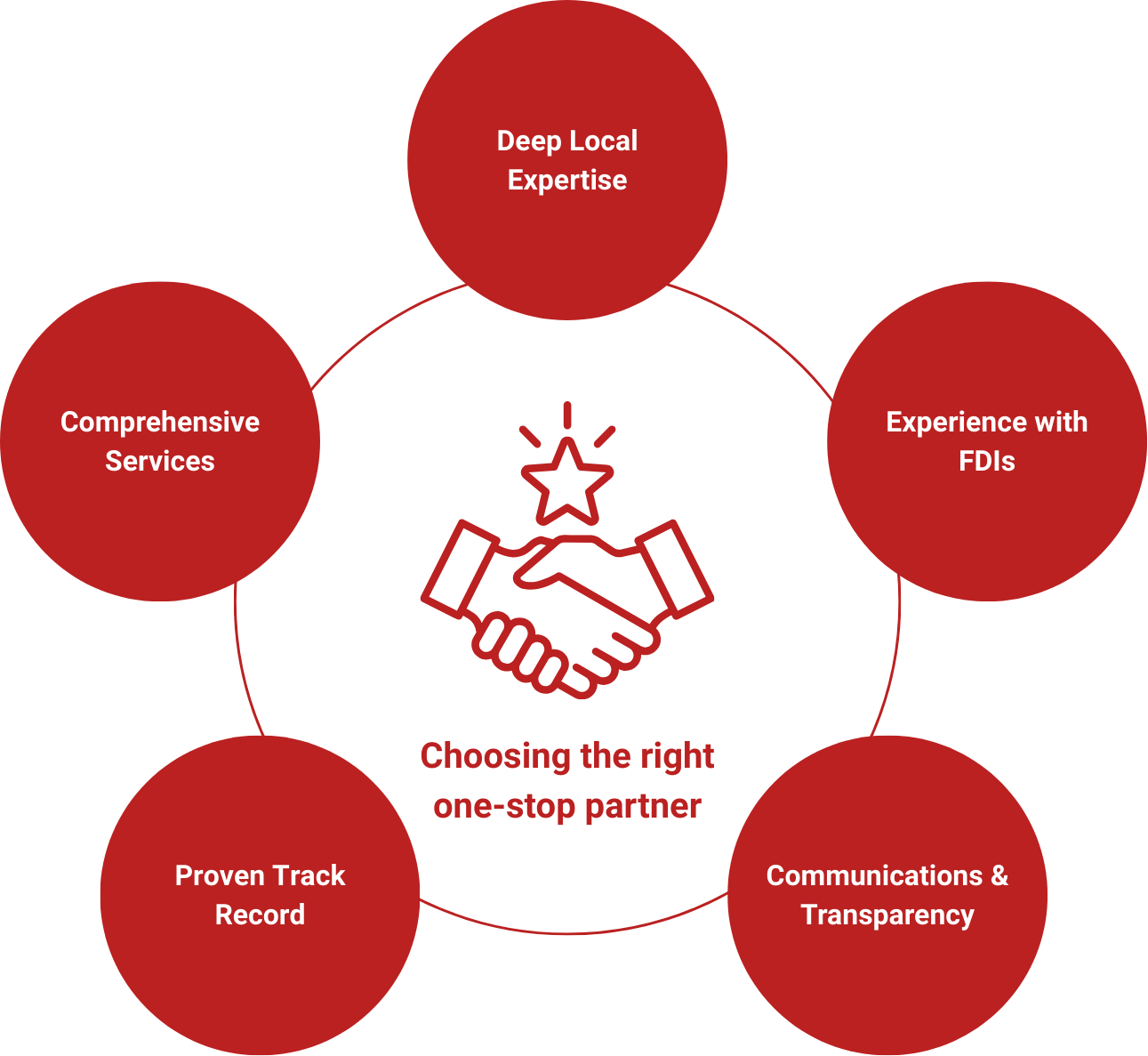
Not all one-stop operating partners deliver the same value, and choosing the wrong one can simply recreate the fragmentation you are trying to avoid. The first thing to assess is whether the provider genuinely offers comprehensive coverage across the full operating lifecycle. This goes beyond incorporation alone and should include accounting, tax compliance, HR, payroll, corporate secretarial, and ongoing regulatory support. If critical functions such as payroll processing, licensing, or tax filings sit outside their scope, you will still be forced to coordinate multiple vendors, undermining the purpose of a one-stop model.
Equally important is deep local expertise. Vietnam’s regulatory environment is highly localized, language-driven, and shaped by administrative practice as much as written law. A capable partner should have a strong on-the-ground team with bilingual professionals who can work directly with authorities and industry stakeholders. This local presence allows them to navigate regulatory changes efficiently, clarify ambiguous requirements, and resolve issues before they escalate. At InCorp Vietnam, this local capability is reflected in teams that operate fully in Vietnamese while translating regulatory complexity into clear, practical guidance for foreign investors.
Experience with foreign-invested enterprises is another key differentiator. Providers that regularly support FDIs understand sector-specific licensing requirements, foreign ownership restrictions, incentive structures, and the operational realities of overseas management teams. They are familiar with common pitfalls in market entry and post-entry operations and have established processes to execute these tasks efficiently, rather than learning on the job.
A proven track record also matters. References, case studies, and long-standing client relationships offer insight into how a partner performs beyond initial setup. Successful launches, stable ongoing operations, and retained clients are strong indicators that a firm can deliver consistently across different stages of growth. This is particularly important for foreign SMEs, where early mistakes can be costly and difficult to unwind.
Finally, communication and transparency should not be underestimated. The right one-stop partner does not simply react to questions but proactively keeps clients informed through regular updates, clear reporting, and structured check-ins. Transparent pricing, defined scopes of work, and open dialogue help prevent surprises and build trust over time. A partner who listens, adapts, and aligns their support with your business priorities is far more likely to add long-term value than one who simply executes tasks in isolation.
Choosing the right one-stop operating partner is therefore less about finding the lowest-cost provider and more about selecting a team that can support your Vietnam market entry and operations with clarity, continuity, and confidence.
Learn the Right Setup for Business
Expansion in the Vietnam
Frequently Asked Questions
How is a one-stop partner different from a market entry consultant?
- A market entry consultant focuses on setup. A one-stop partner supports both entry and ongoing operations.
Are one-stop partners only for large companies?
- No. They are especially useful for SMEs without in-house compliance teams.
Can a one-stop partner reduce compliance risk in Vietnam?
- Yes. Centralized management of filings and deadlines lowers the risk of penalties and audits.
When should a one-stop partner be engaged?
- Ideally before or at the start of market entry to avoid misalignment later.