Vietnam’s foreign direct investment (FDI) landscape opened 2026 on a positive note. Disbursed capital hit USD 1.68 billion in January, an 11.3% increase from the previous year and the strongest January performance in five years. Manufacturing dominated, contributing 76-82% of realized inflows, while new projects rose 15.7% in value. Singapore, South Korea, China, and Japan led investments amid global supply chain diversification. Yet these figures mask a critical reality: many FDIs struggle once licenses are secured. The real test begins in daily operations, where operational continuity determines whether initial capital translates into profitable, scalable activity.
Operational continuity refers to the uninterrupted alignment of market entry choices with everyday business execution. It ensures that decisions on entity structure, hiring, suppliers, and compliance support seamless daily workflows rather than creating rework or downtime. In Vietnam’s fast-evolving context, operational continuity becomes the practical difference between stalled momentum and steady growth. Without it, even well-funded projects face hidden frictions that erode competitiveness.
Speak with InCorp Vietnam to structure your market entry and compliance framework
Common Post-Entry Challenges Without Operational Continuity
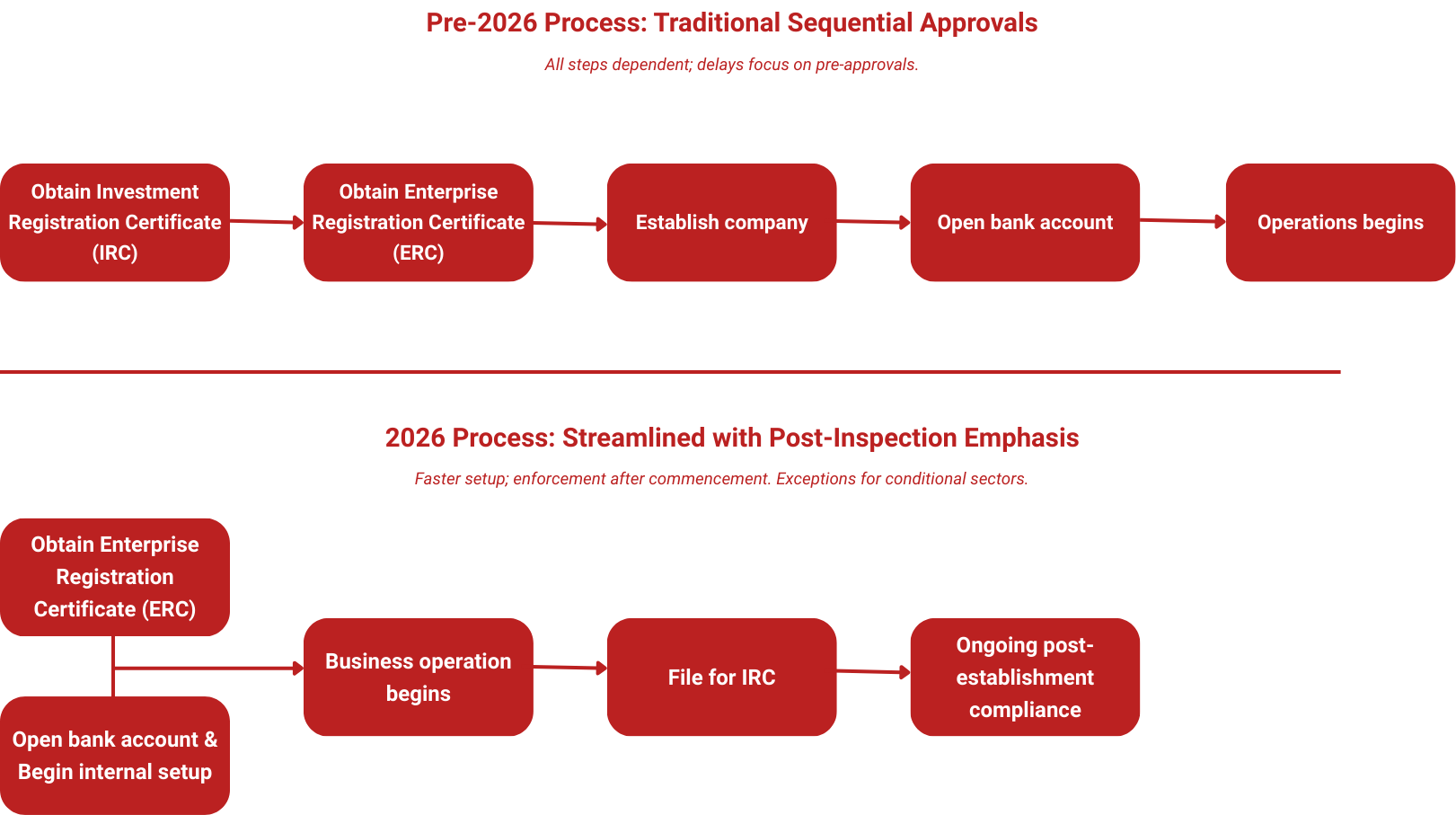
Vietnam’s regulatory environment in 2026 emphasizes post-inspection enforcement under the amended Investment Law effective March 1. Foreign investors can now establish companies and open bank accounts before obtaining an Investment Registration Certificate, accelerating entry. However, this shift places greater responsibility on internal systems once operations begin. Many FDIs discover too late that fragmented planning leads to mismatches in payroll, customs declarations, or tax filings.
Labor shortages remain acute, particularly for skilled roles in manufacturing and tech hubs like Bac Ninh or Ho Chi Minh City. Without operational continuity, recruitment surges overwhelm systems, delaying social insurance registration (required within 30 days of hiring) and triggering fines of VND 50-75 million for mid-sized teams. Supply chain issues compound the problem. Monsoon disruptions or customs delays can halt production when import norms and material tracking are not integrated from the outset.
New February 2026 customs rules require electronic consultations, separate norms for re-imported goods, and detailed destruction documentation for scrap materials. FDIs without operational continuity often face supervision delays or penalties ranging from VND 10 million to VND 400 million for non-compliance in areas like gold trading or unauthorized transactions. These are not theoretical risks; they directly interrupt cash flow and daily output.
Environmental and data-protection obligations add layers. The Personal Data Protection Law (effective since January 2026) and carbon-trading pilots demand ongoing inventories and reporting. When operational continuity is absent, these obligations surface as reactive crises rather than managed routines, draining management time and exposing companies to audits.
Historical patterns confirm the pattern. Several large manufacturing projects in past years lost months — and market share — because capital contribution deadlines (90 days) or initial hiring structures were not linked to ongoing operational plans. In 2026, with stricter enforcement, the cost of such disconnects is higher.
How Operational Continuity Delivers Practical Advantages
Operational continuity turns potential weaknesses into strengths. FDIs that embed it early report faster ramp-up times, often 20-30% quicker than peers, because processes like ERP integration with local e-invoicing or supplier contracts are tested before full launch. This alignment reduces duplicated efforts and advisory overlap that plague fragmented setups.
In labor management, operational continuity links entry-phase recruitment to structured training programs. Companies maintain consistent payroll and benefits from month one, cutting turnover (typically 15-20% in new FDI operations) and avoiding repeated onboarding costs. One practical outcome: social insurance and personal income tax withholding run smoothly, eliminating quarterly reconciliation headaches.
For supply chains, operational continuity means mapping dual sourcing and customs workflows during entry. Under 2026 rules, enterprises with high compliance scores access electronic value consultations, speeding clearances. Those with operational continuity maintain steady production even during seasonal disruptions, preserving customer commitments and cash flow.
Compliance becomes proactive rather than punitive. A shared digital calendar tracking monthly VAT (due by the 20th), quarterly corporate income tax, annual audits, and PDPL assessments ensures nothing falls between cracks. When regulations update — such as quarterly PIT filing options or expanded fast-track procedures in industrial parks — operational continuity allows immediate adaptation without halting operations.
Cost control improves measurably. Operational continuity often lowers total advisory and administrative expenses by consolidating oversight, while avoiding penalties that can reach hundreds of millions of VND. Management focuses on sales, product development, and partnerships instead of firefighting.
Sector-specific gains are clear. In manufacturing, operational continuity supports just-in-time inventory aligned with local supplier norms. In tech and semiconductors, it ensures data flows comply with cross-border rules while maintaining R&D continuity. In export-oriented services, it keeps licensing renewals and reporting on schedule, unlocking incentives for high-tech or green projects.
Turn regulatory complexity into operational strength.
Partner with InCorp Vietnam for integrated market entry and compliance support.
Actionable Steps to Build Operational Continuity
Achieving operational continuity requires deliberate, practical actions rather than abstract planning. Here is a proven sequence drawn from successful FDI experiences in Vietnam:
- Conduct a Full Continuity Audit During Entry Map every process — from capital contribution timelines to first payroll run and customs declaration flows. Identify dependencies: Does the chosen legal structure support planned hiring? Will imported machinery meet new destruction documentation rules? Complete this audit before signing leases or supplier contracts.
- Develop a Living Compliance and Operations Calendar Include all deadlines: 30-day social insurance registration, monthly VAT, quarterly CIT advances, annual financial statements (due March 31), and PDPL data inventories. Assign internal owners and set automated reminders. Review and update quarterly to incorporate 2026 regulatory changes.
- Integrate Supply Chain and Logistics Planning Negotiate contracts with built-in contingency clauses for customs delays. Establish material norms and tracking systems that satisfy electronic declaration requirements. Test re-import and scrap destruction procedures in a pilot phase to ensure operational continuity under real conditions.
- Design Phased Workforce Integration Link recruitment to structured onboarding that covers local labor contracts, benefits in kind (taxable under PIT rules), and cultural training. Roll out payroll and insurance systems in parallel with the first hires rather than after. This maintains operational continuity in human capital from week one.
- Set Measurable KPIs and Conduct Regular Reviews Track metrics such as 95% on-time supplier deliveries, zero missed filing deadlines, and employee retention above 85% in the first six months. Hold monthly operational reviews to adjust for emerging issues like provincial administrative variations or new carbon-trading obligations.
- Leverage Industrial Park Advantages Locate in zones offering fast-track procedures to minimize approval layers. Prepare compliance commitment documents early so operational continuity is not interrupted by later inspections.
- Build Internal Capacity for Post-Inspection Reality Train teams on documentation standards for customs, tax, and data protection. Maintain a single source of truth for records so auditors receive consistent evidence quickly. This reduces response times and demonstrates substance to authorities.
These steps are not theoretical. FDIs following them typically reach stable production within three to four months instead of six to nine.
Illustrative Outcomes from Real FDI Patterns
Manufacturing FDIs that maintained operational continuity during 2025-2026 expansions scaled production lines without major halts, capitalizing on EV battery and semiconductor opportunities. They integrated local suppliers early, met customs norms seamlessly, and avoided the 90-day capital contribution penalties that affected less-prepared projects.
In contrast, operations that treated entry as an isolated event often encountered cascading issues: mismatched payroll data delayed tax filings, leading to interest charges; untested logistics flows caused inventory shortages during peak export seasons. These cases underscore that operational continuity is not a luxury but a practical necessity for long-term viability in Vietnam.
The Long-Term Strategic Value
Operational continuity creates compounding advantages. It builds credibility with local authorities, unlocking faster approvals for expansions or incentives. It attracts and retains talent by demonstrating stable, well-managed operations. Most importantly, it positions FDIs to capture Vietnam’s growth — projected digital economy expansion, renewable energy push, and deepening trade agreements — without repeated resets.
In 2026 and beyond, Vietnam rewards investors who treat market entry as the start of a continuous operational journey rather than a one-off event. Those who embed operational continuity from the beginning convert regulatory complexity into competitive strength, turning daily operations into a reliable engine for sustainable success.
Build Operational Continuity with InCorp Vietnam
At InCorp Vietnam, we help foreign investors move beyond market entry and build true operational continuity. Our integrated approach connects incorporation, tax, accounting, HR & payroll, customs advisory, and ongoing compliance into one structured operating framework. This ensures your Vietnam entity does not just open successfully, but runs smoothly, remains audit-ready, and scales with confidence in a fast-evolving regulatory environment.
Learn the Right Setup for Business
Expansion in the Vietnam
Frequently Asked Questions
What is operational continuity for FDIs in Vietnam?
- Operational continuity ensures daily operations, payroll, customs, tax, and compliance systems work seamlessly after market entry, preventing costly disruptions.
Why is operational continuity more important in 2026?
- Vietnam applies stricter post-inspection enforcement. Without operational continuity, companies face higher risks of fines, delayed clearances, and compliance penalties.
How does operational continuity protect cash flow?
- It prevents missed filings, production downtime, and supply chain bottlenecks, helping businesses maintain steady revenue and avoid unnecessary penalties.
When should FDIs implement operational continuity?
- From day one of market entry. Early integration of compliance, workforce planning, and logistics systems ensures stable operations within the first 3–4 months.