Vietnam posted a strong close to 2025: GDP rose 8.02% year-on-year, while the construction sub-sector expanded 9.62%. Total social investment reached VND 4,150.5 trillion, and registered FDI hit US$38.42 billion (US$27.62 billion disbursed). These are not abstract macro indicators—today they are feeding a bigger pipeline of tenders, project starts, and capacity expansion across infrastructure and construction.
Yet 2025 is also a “rules-and-execution” year. Vietnam accelerated the effective date of its landmark land and real-estate reforms to 1 August 2024, implemented a new national bidding regime from 1 January 2024 with detailed guiding decrees in early 2024, and introduced a revised power-development plan and market mechanisms in 2025. For infrastructure and construction participants, opportunity is rising, but so is the penalty for weak legal readiness and slow land clearance.
The Year in Numbers: Unprecedented Scale and Investment
The numbers from 2025 tell a story of ambition realized. The government’s commitment to growth was evident in its financial allocations and the sheer volume of projects executed.
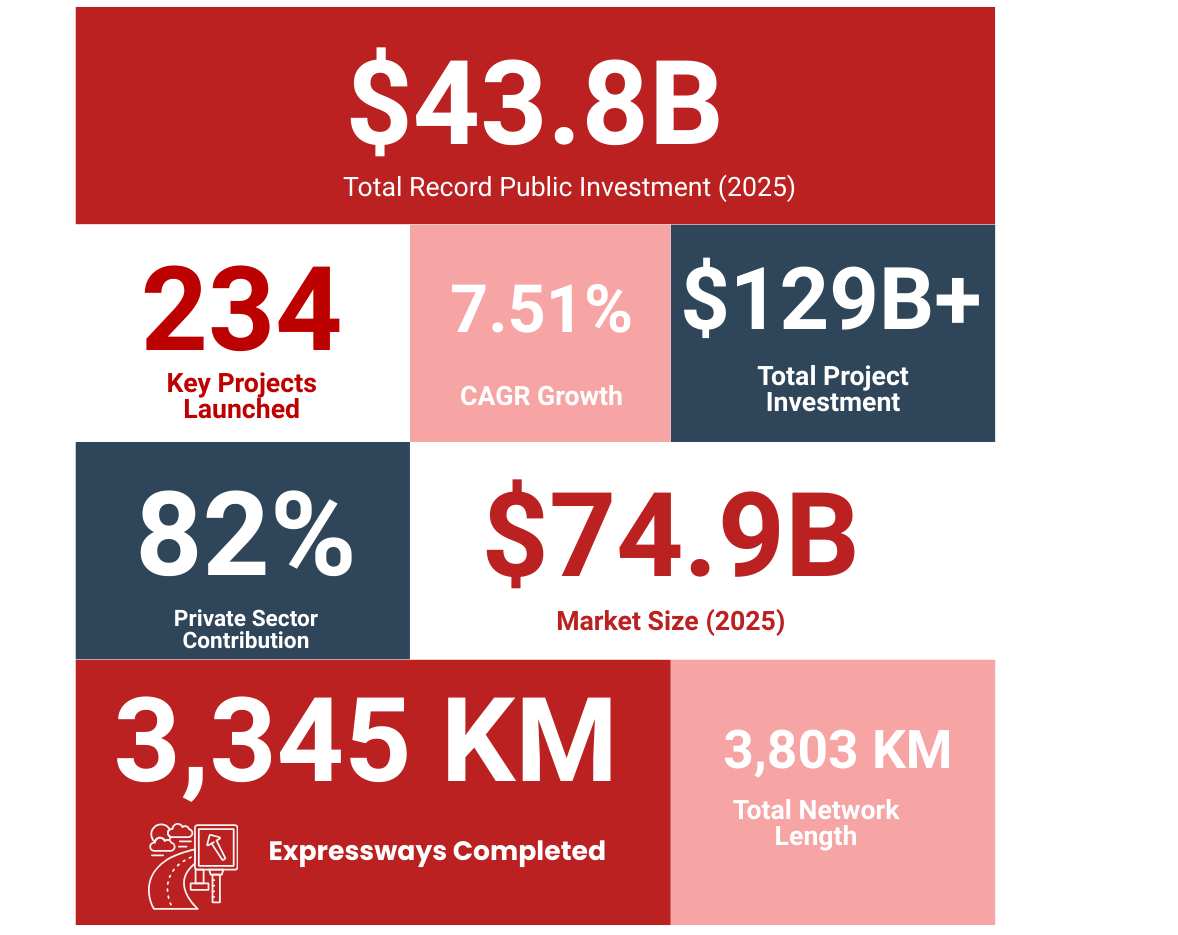
- Record Public Investment: Vietnam allocated approximately 1.15 quadrillion VND (nearly $43.8 billion USD) for development investment in 2025, the highest ever recorded. This capital was strategically funneled into national-scale projects, expressways, and inter-regional links .
- A Monumental Project Launch: In a symbolic and practical display of momentum, the country simultaneously launched and inaugurated 234 key infrastructure projects across 34 provinces and cities on December 19, 2025. The total investment for these projects alone exceeded 3.4 quadrillion VND (over $129 billion USD) , with a significant 82% of this capital coming from non-state sources, highlighting the vibrant role of private investment in the infrastructure and construction boom .
- Market Size and Growth: The Vietnam infrastructure and construction market was valued at a staggering USD 74.88 billion in 2025. This upward trajectory is projected to continue, with forecasts predicting the market to reach USD 107.53 billion by 2030, growing at a compound annual growth rate (CAGR) of 7.51% .
- Expressway Milestone: By the end of 2025, Vietnam had completed 3,345 km of expressways. Including interchanges and access roads, the total operational network reached 3,803 km, far surpassing the target of 3,000 km and fundamentally transforming national connectivity.
Entering Vietnam’s infrastructure and construction market in 2026? InCorp Vietnam supports investors from market entry, licensing, and project setup to accounting, tax, HR & payroll, and ongoing regulatory compliance—so you can execute with confidence.
What changed in 2024–2025: the regulation checklist
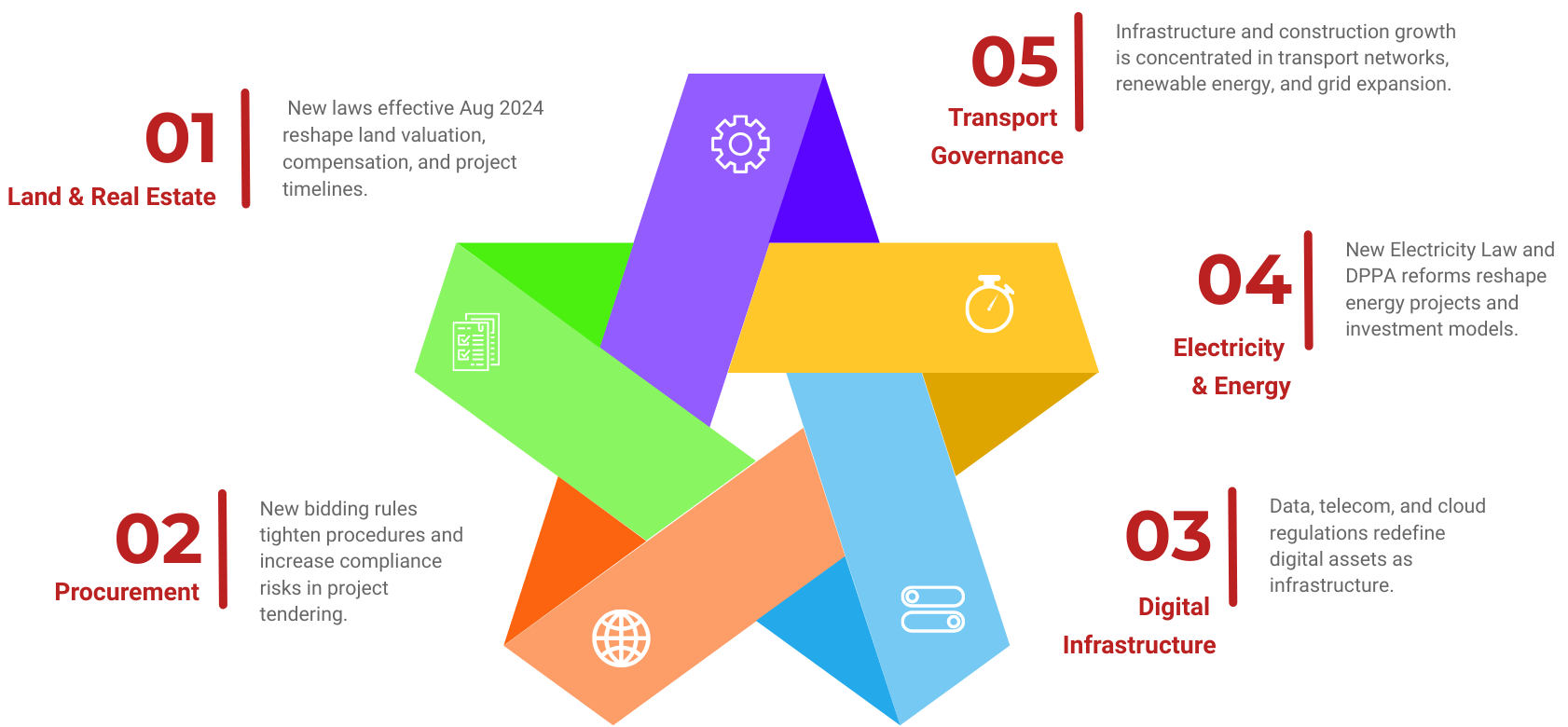
If you are investing or bidding in infrastructure and construction in Vietnam, 2024–2025 shifts can be grouped into five practical “checkpoints.”
Checkpoint one is land and real estate. A 2024 amending law moved the effective date of key reforms (Land Law 2024, Housing Law 2023, Real Estate Business Law 2023) forward to 1 August 2024. This matters for project delivery because land valuation, compensation, and resettlement rules shape the critical path for linear assets (roads, rail, transmission) and for large multi-phase sites (airports, industrial zones).
Checkpoint two is procurement. The Bidding Law 2023 took effect from 1 January 2024, and Decrees 24/2024 (contractor selection) and 23/2024 (investor selection) took effect on 27 February 2024. In parallel, Vietnam issued additional investor-selection rules for projects using land via Decree 115/2024 (effective 16 September 2024). For infrastructure and construction, the headline is predictable: tighter procedure, heavier documentation discipline, and higher value-at-risk if tender strategies are not aligned with what is in force.
Checkpoint three is transport governance. Vietnam’s Law on Road (2024) takes effect from 1 January 2025 (with selected provisions earlier from 1 October 2024). It supports a broader trend: clearer road governance and a system-scale approach to expressway and logistics connectivity.
Checkpoint four is electricity investment and market reform. The new Electricity Law (2024) takes effect from 1 February 2025, and a March 2025 decree updated the direct electricity trading model (DPPA) and repealed the 2024 DPPA decree. If you are building renewables, grid assets, or energy-intensive industrial facilities, these reforms are increasingly central to infrastructure and construction strategy, not a side issue for lawyers.
Checkpoint five is digital. The Telecommunications Law (2023) took effect from 1 July 2024, and government communications indicate that regulation of data center services and cloud computing services takes effect from 1 January 2025. Separately, the Law on Data takes effect from 1 July 2025. These dates matter to infrastructure and construction because data centers and network assets are now regulated as “infrastructure services,” not only as real-estate projects.
From bidding compliance to land procedures and financial structuring, InCorp Vietnam helps you navigate Vietnam’s evolving regulations and accelerate project execution across infrastructure and construction.
Transport pipeline: the 2025 megaproject stack
Vietnam’s transport agenda is increasingly defined by a short list of national-scale flagships.
Long Thanh International Airport Phase 1 (Dong Nai) is a top-tier aviation build with an adjusted total investment of VND 109,717.499 billion and an implementation period of 2020–2026, with a goal of basic completion in 2025. It is interface-heavy and MEP-intensive, with demanding systems integration.
Ho Chi Minh City Ring Road 3 is a logistics belt project approved with a preliminary total investment of VND 75,378 billion. The official schedule targets preparation and implementation from 2022, basic completion in 2025, and operation from 2026. For infrastructure and construction suppliers, Ring Road 3 is a barometer of land clearance effectiveness and inter-provincial coordination.
Hanoi Capital Region Ring Road 4 has a preliminary total investment of VND 85,813 billion and embeds a large PPP/BOT component, with investor-arranged capital of VND 29,447 billion for the PPP sub-project. The official schedule targets basic completion in 2026 and operation from 2027. That PPP element makes risk allocation, traffic forecasts, and long-term VND liquidity decisive.
Two rail megaprojects reshape the long-term pipeline. The National Assembly approved the investment policy for the North–South high-speed railway: a ~1,541 km line, design speed 350 km/h, 23 passenger stations and five freight stations, with a preliminary total investment of VND 1,713,548 billion. Feasibility study work starts in 2025 and the project aims for basic completion by 2035. In parallel, the Lao Cai – Hanoi – Hai Phong rail corridor has a preliminary total investment of VND 203,231 billion, with a main line of ~390.9 km plus ~27.9 km of branch lines, and a policy target of completion no later than 2030.
Energy pipeline: PDP8 adjustment and a grid build-out measured in US$ billions
Energy is the fastest-scaling component of Vietnam’s infrastructure and construction story because it combines generation, transmission, storage, and industrial demand.
In April 2025, Vietnam approved the adjustment of Power Development Plan VIII (PDP8). The revised plan sets domestic power plant capacity in 2030 at 183,291–236,363 MW and outlines material growth in solar (46,459–73,416 MW), onshore wind (26,066–38,029 MW), offshore wind (6,000–17,032 MW, expected to operate in 2030–2035), and storage (10,000–16,300 MW). Those targets translate into a full ecosystem opportunity: generation, grid, storage, ports, fabrication yards, and specialized project management.
The plan quantifies capital needs. For 2026–2030, total investment for generation plus transmission is about US$136.3 billion (US$118.2 billion for generation and US$18.1 billion for transmission). It also specifies grid volumes for 2025–2030, including very large expansions of 500 kV and 220 kV substations and thousands of kilometers of new lines. This is “industrial-scale” infrastructure and construction, and the bottleneck is often not engineering—it is coordinated permitting, land access for rights-of-way, and synchronized commissioning.
A second 2025 milestone is DPPA. The March 2025 decree states that it takes effect from its signing date and repeals the prior DPPA decree. For infrastructure and construction, DPPA can improve project bankability for renewables supplying industrial offtakers, creating a clearer revenue logic than pure merchant exposure—if contract standardization and grid-connection governance mature.
Urban, water, and digital: the projects that keep cities livable
If transport and electricity are the “spines,” then urban rail, water security, and digital infrastructure are the systems that prevent growth from choking itself.
Ho Chi Minh City’s Metro Line 1 (Ben Thanh–Suoi Tien) entered official operation in late 2024 with total investment of VND 43,757 billion and substantial Japanese ODA financing. It matters in 2025 because it changes the reference point for future metro development: O&M planning, ridership development, and transit-oriented urban planning—core components of urban infrastructure and construction.
Water security projects are also in the active pipeline. A representative example is the nationally important Ka Pét reservoir in Binh Thuan, with total investment of over VND 874 billion (split between central and local budgets). Water projects are smaller in ticket size than rail or power, but they often have outsized risk sensitivity to environmental approvals and land/forest conversion rules.
Digital infrastructure is rising in parallel with stronger regulation. With telecom, data, and data-center rules stepping into force in 2024–2025, building data centers and network assets is increasingly a compliance-heavy form of infrastructure and construction: energy efficiency, redundancy, cybersecurity obligations, and data governance all move closer to the engineering core.
Where the money comes from: public investment, PPP, FDI, and ODA
Vietnam’s medium-term public investment plan for 2021–2025 set state-budget capital at VND 2,870,000 billion. In 2025, the Ministry of Finance reported public investment financing plans in the high hundreds of trillions of VND, with disbursement around 50% by the end of September—showing both the scale of demand and the persistence of bottlenecks.
Large transport resolutions explicitly allow ODA and concessional loans as part of capital mobilization. On the energy side, PDP8’s US$136.3 billion requirement for 2026–2030 implicitly requires a blended approach: domestic credit, SOE balance sheets, private capital, and international finance. A new ODA management decree taking effect 10 September 2025 aims to simplify procedures and expand access pathways, but deal-by-deal structuring still matters.
Actionable moves for 2025
For investors, the most practical “edge” in infrastructure and construction in 2025 is legal scheduling: build an effective-date matrix (land, bidding, electricity, telecom/data, ODA), and tie transaction milestones to what is actually in force. Stress-test land handover timing, grid connection timing, and inflation assumptions before fixing EPC price and debt sizing.
For contractors, win rates will increasingly depend on documentation quality and interface management. Invest in multidisciplinary design coordination (BIM), a strong claims and change-order system, and compliance reporting that meets public procurement expectations. Developers and EPCs that can deliver ESG-aligned packages will be advantaged on ODA-funded and international-financed work.
Conclusion: A Solid Foundation for the Future
The year 2025 will be remembered as the moment Vietnam’s infrastructure and construction industry matured. It was a year of superlatives—record investment, a historic wave of project launches, and the passage of forward-thinking legislation.
For stakeholders in the infrastructure and construction sector, the message is clear: Vietnam is open for business, but the rules have changed. Success will no longer come from just showing up. It will require a mastery of new technologies like BIM, a firm commitment to green and sustainable practices, strict adherence to an evolving legal framework, and strategic management of financial and labor resources. The foundations laid in 2025 are not just concrete and steel; they are the foundations of a modern, transparent, and sustainable infrastructure and construction industry poised to lead Vietnam into a new era of development.
Learn the Right Setup for Business
Expansion in the Vietnam
Frequently Asked Questions
What are the key opportunities in Vietnam’s infrastructure and construction sector?
- Opportunities are strongest in transport (expressways, airports, rail), energy (renewables, grid expansion), and digital infrastructure (data centers). These sectors are supported by strong government investment and rising private participation.
What are the main regulatory risks investors should consider?
- Key risks include delays in land acquisition, changes in bidding procedures, evolving electricity market rules, and new regulations on data and telecom infrastructure. Compliance planning is critical from the early stages.
How important is land clearance in project timelines?
- Land clearance is often the biggest source of delay in infrastructure and construction projects in Vietnam. New land laws aim to improve transparency, but practical execution still requires careful planning and local coordination.