Vietnam Resolution No. 19-NQ/TW, issued on 28 July 2026, sets a longer-term direction centred on productivity, technology, innovation, green development, and stronger domestic capabilities. Vietnam is preparing to move beyond a growth model built largely on capital, natural resources, and low-cost labour.
For foreign investors, the resolution is an important policy signal. It does not immediately amend tax rates, investment procedures, or licensing requirements. However, it may influence future laws, incentives, sector programmes, provincial priorities, and the criteria used to assess investment projects.
Companies entering or expanding in Vietnam should therefore consider not only whether a project is commercially viable, but also how it contributes to the type of higher-value economy Vietnam intends to build.
Interested in investing in Vietnam? Explore our Business Intelligence services
What Is Resolution 19-NQ/TW?
Vietnam Resolution 19 outlines Vietnam’s new national development model through 2030, with further milestones for 2035 and 2045. Its objective is to create growth through higher productivity, science and technology, digitalisation, skilled people, sustainability, and greater economic resilience.
The resolution describes this model as self-reliant, innovative, human-centred, sustainable, and internationally integrated. For foreign-invested enterprises, the key message is that investment quality and economic contribution may become increasingly important alongside registered capital and employment numbers.
Priority areas include advanced industry, technology and R&D, digital transformation, green development, infrastructure, domestic supply chains, and workforce upgrading.
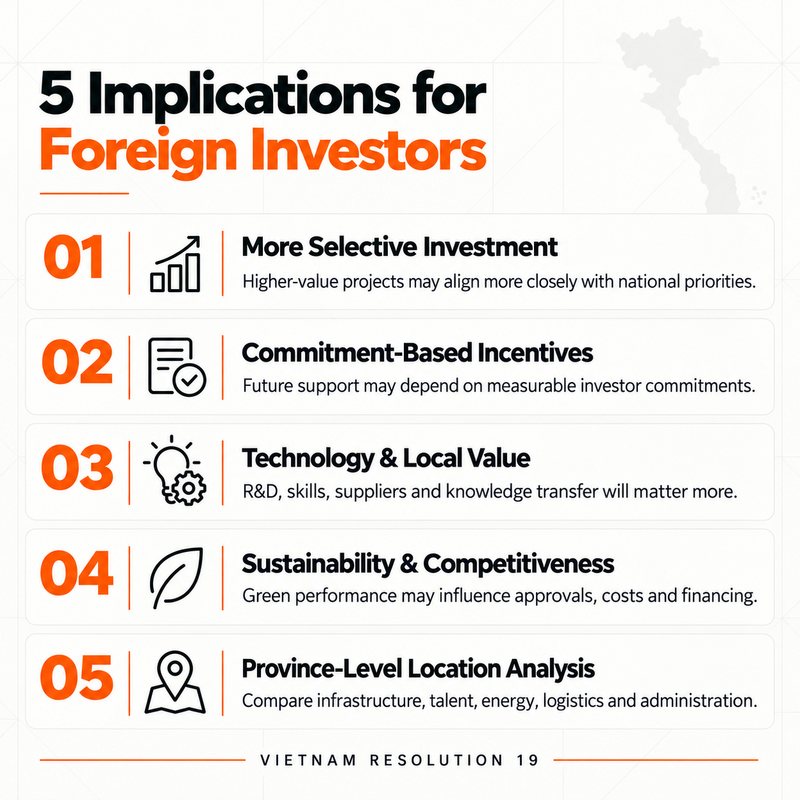
Five Implications for Foreign Investors From Vietnam Resolution 19
1. Investment Attraction May Become More Selective
Vietnam will continue to seek foreign capital, technology, management expertise, and access to international markets. Nevertheless, projects involving advanced technology, skilled jobs, R&D, environmental improvements, or strong local supply-chain links may align more closely with national priorities than projects based mainly on low labour costs or resource-intensive production.
Labour-intensive manufacturing will remain important, but investors may increasingly need to demonstrate contributions to productivity, workforce development, technology adoption, and domestic value creation.
2. Incentives May Be Linked More Closely to Commitments
Resolution 19 does not create a new incentive regime. Any tax, grant, land, or other support will require separate legal or implementing measures. Future support may, however, place greater weight on measurable commitments involving R&D, technology transfer, technical training, energy efficiency, domestic procurement, or advanced production.
Investors should ensure that a project remains viable under current rules and treat unconfirmed incentives as potential upside rather than guaranteed income.
3. Technology and Local Value Creation Will Matter More
The policy direction creates opportunities in advanced manufacturing, semiconductors, artificial intelligence, automation, data infrastructure, medical technology, and industrial R&D. Traditional manufacturers can also improve their alignment by digitising production, adopting automation, and establishing engineering or product-development functions in Vietnam.
Projects may be more compelling when they create wider benefits through local R&D, university partnerships, supplier development, technical assistance, workforce training, domestic procurement, or participation in industry clusters.
4. Sustainability May Influence Competitiveness
Green development is becoming more than an environmental-compliance issue. It may affect approvals, operating costs, financing, supply-chain eligibility, and relationships with authorities. Investors should assess energy reliability, renewable-energy options, logistics efficiency, waste management, emissions, and environmental infrastructure throughout the project’s life cycle.
5. Location Decisions Will Require Provincial Analysis
Implementation will vary across Vietnam because provinces differ in infrastructure, skills, industrial clusters, land, energy, logistics, and administrative capacity. Advanced manufacturers may prioritise proximity to universities, technical talent, specialised suppliers, testing facilities, ports, and customers. Energy-intensive projects should verify actual grid capacity, while digital and R&D operations should assess data infrastructure and specialist talent
Read Related: Setting Up a Manufacturing Company in Vietnam 2026: The Ultimate Strategic Guide
Which Investors May Be Best Positioned?
Based on Vietnam Resolution 19, the strongest strategic alignment may be found among:
- Advanced manufacturers introducing automation, skilled employment, and higher-value production;
- Technology and R&D investors supporting innovation and knowledge transfer;
- Green technology, energy, and environmental-infrastructure businesses;
- Infrastructure investors in transport, logistics, energy, digital systems, and urban development;
- Global component manufacturers that deepen Vietnam’s domestic supply chains; and
- Training and professional-service providers supporting workforce upgrading and digital adoption.
Strategic alignment does not eliminate conventional risks. Even a priority project may face constraints involving land, licensing, talent, infrastructure, tax, or implementation. Policy attractiveness must therefore be tested against project-level commercial and regulatory feasibility.
Interested in investing in Vietnam? Explore our InCorporation Services
What Does Vietnam Resolution 19 Means for Existing Foreign-Invested Enterprises
Resolution 19 is also relevant to companies already operating in Vietnam. As wages rise and policy priorities shift, existing investors should review whether their operating models remain competitive. Potential responses include automating labour-intensive processes, adding engineering or R&D functions, improving resource efficiency, developing local suppliers, strengthening technical training, and reassessing whether the current province can support expansion.
Companies should also check whether their investment registration, business lines, capital structure, land arrangements, and licences provide enough flexibility for new activities. Adding an R&D centre, expanding production, or introducing a new product may require amendments or additional approvals.
Interested in investing in Vietnam? Explore our InCorporation Services
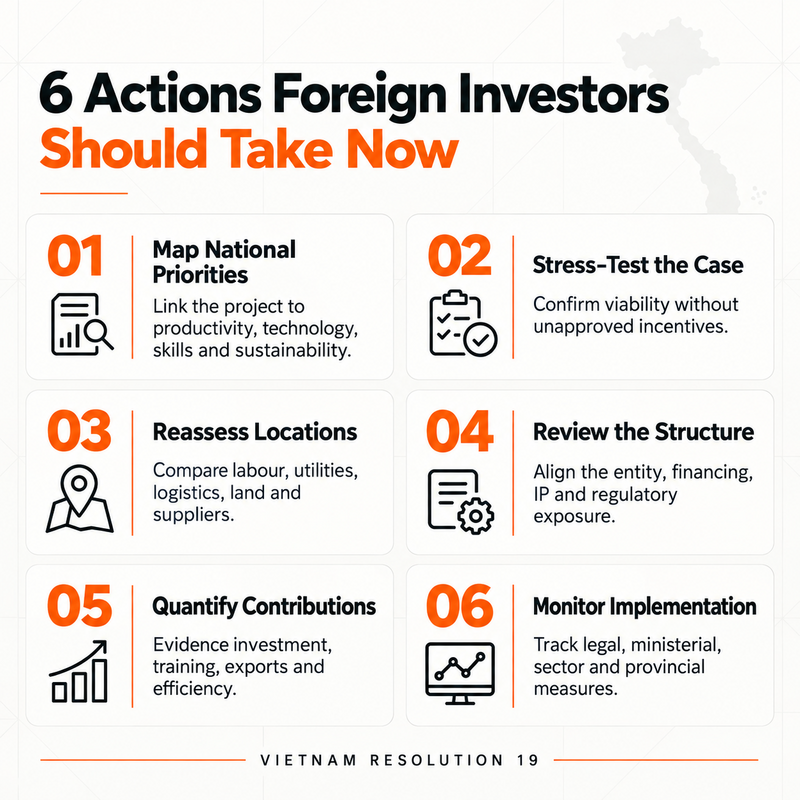
What Foreign Investors Should Do Now
1. Map the project against national priorities. Show how it contributes to productivity, technology, skills, supply chains, infrastructure, or environmental improvement.
2. Stress-test the investment case. Confirm that the project remains viable without incentives that have not been enacted or approved.
3. Reassess location options. Compare provinces on labour, utilities, logistics, land, suppliers, clusters, and administrative execution.
4. Review the operating and entity structure. Ensure it supports planned activities, financing, intellectual property, incentives, and regulatory exposure.
5. Quantify the project’s contribution. Prepare evidence on investment, technology, training, local procurement, exports, energy efficiency, and environmental performance.
6. Monitor implementing measures. Track legal amendments, ministry programmes, sector strategies, budgets, and provincial implementation plans.
How Ascentium Vietnam (formely InCorp Vietnam) Can Support Your Investment Strategy
InCorp Vietnam, now officially Ascentium Vietnam, helps foreign investors turn policy direction into practical decisions. Our teams can support market and location assessments, entity structuring, incorporation, licensing, tax analysis, legal compliance, HR and payroll, and ongoing operations.
Through our Business Intelligence services, investors can compare provinces, evaluate industrial locations, assess suppliers, identify regulatory and infrastructure risks, and build a clearer investment case before committing capital.
Ascentium Vietnam (formerly InCorp Vietnam) is a trusted partner for foreign investors, providing comprehensive corporate advisory and outsourcing solutions across Vietnam and Asia. As part of Ascentium Group, we focus on providing transparent and reliable services to overseas clients in Vietnam and A
Planning to enter, expand, or restructure in Vietnam? Contact our experts for a consultation at vietnam@ascentium.com.
Conclusion
Resolution 19 signals Vietnam’s shift towards a more productive, technology-led, green, and resilient economy. Its immediate effect is strategic rather than regulatory, but it provides a clear indication of where policy and investment support may move next.
Foreign investors should align long-term plans with national priorities while continuing to base decisions on current law, confirmed incentives, and detailed project due diligence. Companies that can demonstrate measurable contributions to technology, skills, sustainability, and domestic value creation are likely to be better positioned as Vietnam’s development model evolves.
Learn the Right Setup for Business
Expansion in the Vietnam
Frequently Asked Questions
1. What is Vietnam Resolution 19-NQ/TW?
- Resolution 19-NQ/TW outlines Vietnam’s new development model through 2030, with longer-term milestones for 2035 and 2045. It prioritises productivity, technology, innovation, sustainability, skilled employment, and stronger domestic capabilities.
2. Does Resolution 19 introduce new regulations for foreign investors?
- No. Resolution 19 is a strategic policy direction rather than an immediately enforceable regulation. It does not directly change tax rates, licensing procedures, or investment requirements, but it may shape future laws, incentives, and investment-selection criteria.
3. How could Resolution 19 affect foreign investment incentives?
- Future incentives may become more closely linked to measurable commitments, including R&D, technology transfer, employee training, domestic procurement, energy efficiency, and environmental performance. Investors should not rely on potential incentives until detailed rules are issued.
4. Which foreign investors may benefit most from Resolution 19?
- Projects involving advanced manufacturing, technology, R&D, semiconductors, digital infrastructure, renewable energy, sustainable production, skilled employment, and domestic supply-chain development may align most closely with Vietnam’s priorities.
5. What should foreign investors do now?
- Investors should assess their projects against national priorities, test commercial viability without unconfirmed incentives, compare provincial locations, review their entity structures, quantify their economic contributions, and monitor implementing regulations.