Vietnam Standard Industrial Classification (VSIC) codes describe the economic activities a company registers. Choosing them correctly helps foreign investors align their company registration, investment project, contracts and operating licences.
The current classification is issued under Decision 36/2025/QD-TTg, effective from 15 November 2025.
Key Takeaways
- Register business activities at the four-digit level, with a more detailed description where needed.
- Select codes from the current classification and read their inclusion and exclusion notes.
- Map each proposed revenue stream to an activity; a broad label such as “technology company” is too vague.
- Foreign investment conditions may concern ownership, permitted services, the investment structure, qualifications or a Vietnamese partner.
- Existing companies add or change activities through a notification to the provincial business registration authority.
What Is a VSIC Code?
VSIC classifies economic activities into progressively more detailed categories. The current system has five levels: sections, divisions, groups, classes and subclasses. Enterprise registration uses the class level, represented by four digits.
A company can register more than one activity. Its business-line list should cover the activities it will actually undertake, including supporting services offered to customers. Buying computers for the company's own staff, for example, does not mean it operates a computer retail business. Selling computers to customers does.
The code describes the activity. The detailed wording identifies the actual scope. A software developer might specify the types of development services it provides; a wholesaler should identify the goods it intends to trade.
How Do You Choose the Right Business Codes?
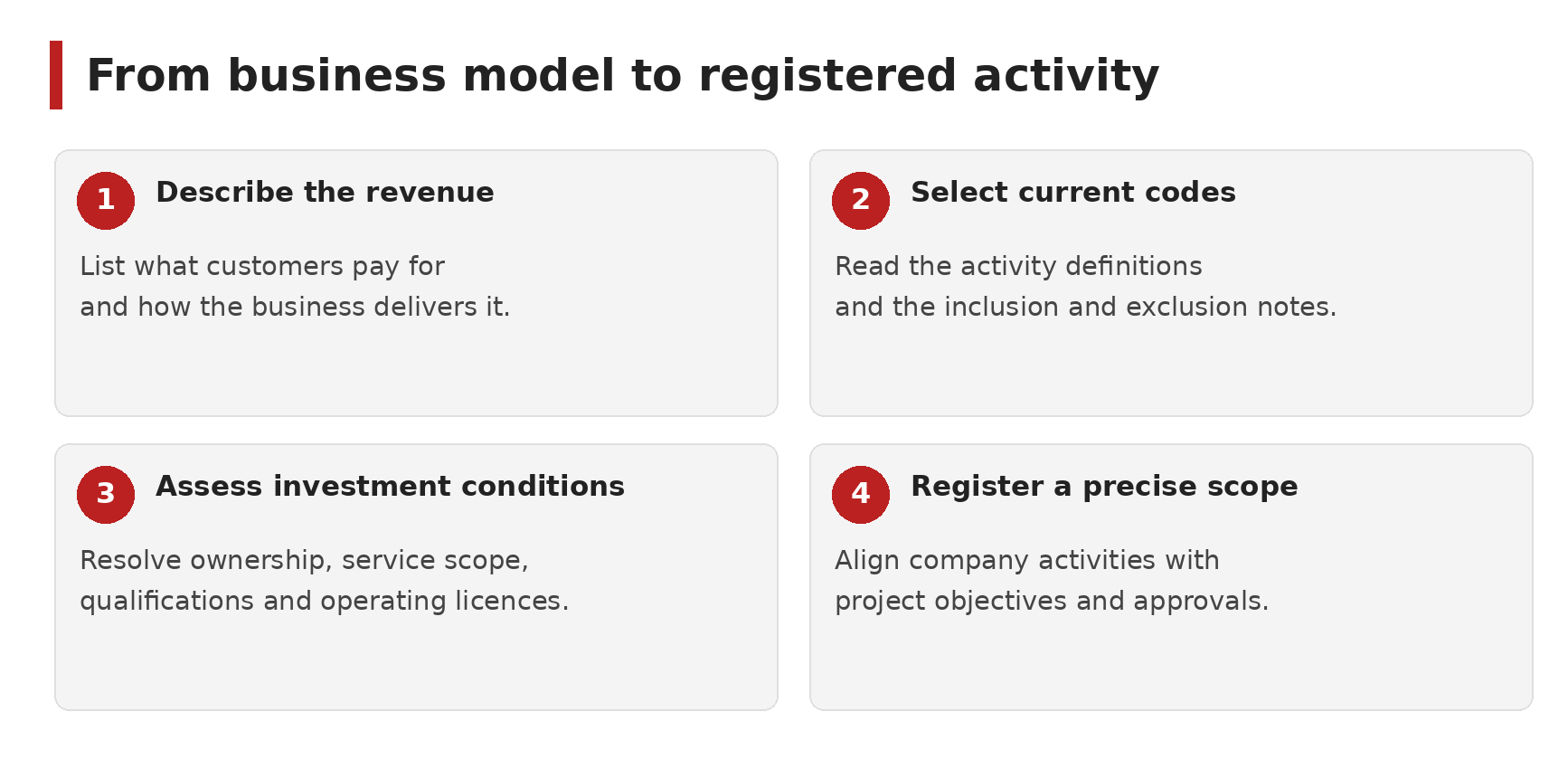
Step One: Describe What Customers Will Pay For
Start with the proposed contracts and invoices. Write a plain-language description of each deliverable: developing software for clients, licensing a software product, giving management advice, manufacturing goods, or selling imported products.
Separate activities that generate different types of revenue. A company building a client's application, publishing its own software and selling hardware may need several codes. This exercise also helps define the objectives in the Investment Registration Certificate.
Step Two: Read Both the Code List and Its Detailed Notes
Decision 36 contains a classification list and explanatory notes. Search the list for the activity, then read the included and excluded services in the detailed description. The exclusion notes often point to the correct alternative code.
For software businesses, developing a product, publishing it and operating a digital platform can fall under different categories. Avoid choosing a familiar old code because its previous English translation seems close.
Step Three: Record the Four-Digit Code and Detailed Scope
The enterprise registration rule requires selection of a level-four business line. A business may write a more specific description beneath it, provided that the detail fits the selected class. Where specialist legislation defines the activity, the description should use that legally defined scope.
|
Illustrative activity |
Current four-digit code |
What to clarify in the description |
|---|---|---|
|
Other computer programming |
6219 |
Client software development and related programming; distinguish game development and software publishing |
|
Computer consultancy and computer infrastructure management |
6220 |
Consultancy, systems planning or infrastructure management actually supplied |
|
Business and other management consultancy |
7020 |
Management advice; exclude separately regulated legal, audit or other professional services unless licensed |
|
Advertising |
7310 |
Advertising services offered, media involved and the applicable foreign investment arrangement |
These are starting examples, not a ready-made registration package. A company should select only the activities matching its operating model. A business entering IT services can use InCorp's IT company setup guide alongside this classification process.
Step Four: Apply the Foreign Investment Conditions
Foreign investors must assess the actual activity against domestic law and the applicable treaty commitment. Under Article 8 of the Investment Law, market-access conditions can address foreign ownership, investment form, scope of activities, investor capacity, partners and other statutory conditions.
In practical terms, the review must answer the following questions:
- Ownership: Can the proposed company be wholly foreign-owned, or is a foreign shareholding limit imposed for the activity?
- Structure: Is a joint venture or another specific business arrangement required?
- Service scope: Are all the proposed services open to foreign investors, or only a defined subset?
- Investor and personnel qualifications: Does the business require professional qualifications, experience or sector-specific financial capacity?
- Operating approval: What licence, facility or staffing requirement must be satisfied before supplying the service?
An advertising agency, for example, needs the relevant foreign investment analysis even though advertising appears in the VSIC list. A code's presence in the classification does not itself answer the ownership question.
How Do You Register Activities for a New Company?
Include the code and detailed business-line description in the enterprise registration application. Keep the wording consistent with the charter, investment project objectives where relevant and any specialist licence application.
For a typical foreign-owned limited liability company, the establishment dossier also includes the company charter, owner or member identification documents, authorised representative details for corporate investors, the member list where applicable and the beneficial-owner information required by the current registration rules. Foreign corporate documents need the required legalisation and Vietnamese translations. The precise company structure determines which owner and member documents are submitted.
The Enterprise Registration Certificate is not a printed catalogue of all business lines. The registered activity information is maintained in the national enterprise registration database.
Under Article 19 of the Investment Law, foreign investors may establish the enterprise before completing IRC issuance or modification procedures, while satisfying market-access conditions at establishment. The project approval and licensing work must therefore be planned alongside company registration rather than treated as an automatic fixed sequence.
How Do Existing Companies Add or Change Business Activities?
The company sends the notification dossier to the provincial business registration authority where its head office is located. Under Article 49 of Decree 168, the core documents are:
|
Document |
Who prepares or approves it? |
|---|---|
|
Notice of changes to enterprise registration information |
Signed for the company by the prescribed representative |
|
Resolution or decision approving the change |
Owner for a single-member LLC; Members' Council for a multi-member LLC; General Meeting of Shareholders for a joint-stock company |
|
Authorisation for filing, where applicable |
Company authorises the individual or service organisation submitting the dossier |
The authority reviews dossier validity and applicable foreign market-access conditions within three working days. It updates the activity information or issues a written request for corrections. The company can request confirmation of the amended registration information.
If the new activity changes the investment project's objectives or a sector licence's scope, prepare the corresponding amendment as well. For example, adding goods distribution to an existing service business may require a separate assessment of distribution rights and retail licensing.
Common Classification Mistakes
Using an obsolete code: compare the old activity with the current description and conversion guidance. A renamed or split category may require more than a simple number substitution.
Registering every possible activity: this can introduce unnecessary restricted sectors and unclear licensing expectations. Start with the genuine business plan and add activities when expansion becomes concrete.
Confusing goods and services classifications: a VSIC code describes an economic activity. An HS code classifies traded goods for customs. A CPC code may be used when interpreting international service commitments. Each serves a different purpose.
Ignoring the detailed scope: registration wording should accurately capture how the company earns revenue. A generic consultancy description is unsuitable for a business actually operating a regulated professional service.
FAQs
How Many Digits Should a Registered Business Code Have?
Enterprise registration uses a four-digit class. More detailed activity wording may be added below that class where it is consistent with the classification.
Can One Company Register Several Business Activities?
Yes. It can register multiple activities, provided the proposed scope is lawful and the applicable investment and operating conditions are met.
Should Existing Companies Use the Old VSIC List?
New selections and amendments should use the current classification. Existing registered activities should be mapped carefully when preparing an update, particularly where a category has been divided or renamed.
Do VSIC Codes Determine Foreign Ownership Limits?
The code helps identify the activity, but the ownership conditions come from investment law, specialist legislation and applicable treaties. The actual services or goods must be analysed.
Does Changing a Business Code Change the IRC Automatically?
No. An enterprise registration update and an investment-project amendment are separate filings. A changed project objective must be reflected in the relevant project records.
Conclusion
The right VSIC selection starts with what the business will sell and how it will deliver it. Foreign investors should match those activities to current codes, write a precise scope and identify the associated market-access and operating conditions. That creates a clearer registration dossier and a more reliable basis for future expansion.