
Vietnam’s monthly minimum wage ranges from VND 3,700,000 to VND 5,310,000 under Decree 293/2025/ND-CP, effective 1 January 2026. The applicable rate depends on the employer’s operating location. Businesses reviewing payroll or planning to hire should check the local wage rates before setting employment terms.
This guide explains the current monthly and hourly rates, how to identify the correct region, and how minimum pay differs from average earnings and the full cost of employment. For support implementing the changes, explore InCorp Vietnam’s payroll outsourcing services.
Regional Classifications
Vietnam’s minimum-wage regions are geographic wage categories, rather than separate administrative provinces. Region I has the highest minimum wage and includes major urban and industrial areas, such as central Hanoi and Ho Chi Minh City. Region II includes designated urban areas in Da Nang and Hue. Region III includes smaller urban centres such as Cao Bang, Dien Bien Phu and Son La. Region IV covers predominantly rural localities, including areas outside the designated urban centres in Cao Bang, Dien Bien and Lai Chau provinces
Current Monthly and Hourly Minimum Wages
| Wage region | Monthly minimum in VND | Hourly minimum in VND |
| Region I | VND 5,310,000 | VND 25,500 |
| Region II | VND 4,730,000 | VND 22,700 |
| Region III | VND 4,140,000 | VND 20,000 |
| Region IV | VND 3,700,000 | VND 17,800 |
How Much Has the Minimum Wage Increased
The new decree replaces Decree 74/2024/ND-CP. The comparison below shows the change in each regional monthly minimum wage rate; an employee’s actual adjustment depends on their existing pay and employment terms.
| Region | Previous monthly minimum wage rate | 2026 monthly minimum wage rate | Increase in VND |
| Region I | 4,960,000 | 5,310,000 | 350,000 |
| Region II | 4,410,000 | 4,730,000 | 320,000 |
| Region III | 3,860,000 | 4,140,000 | 280,000 |
| Region IV | 3,450,000 | 3,700,000 | 250,000 |
All table amounts are in Vietnamese dong. The increase ranges from VND 250,000 to VND 350,000 per month
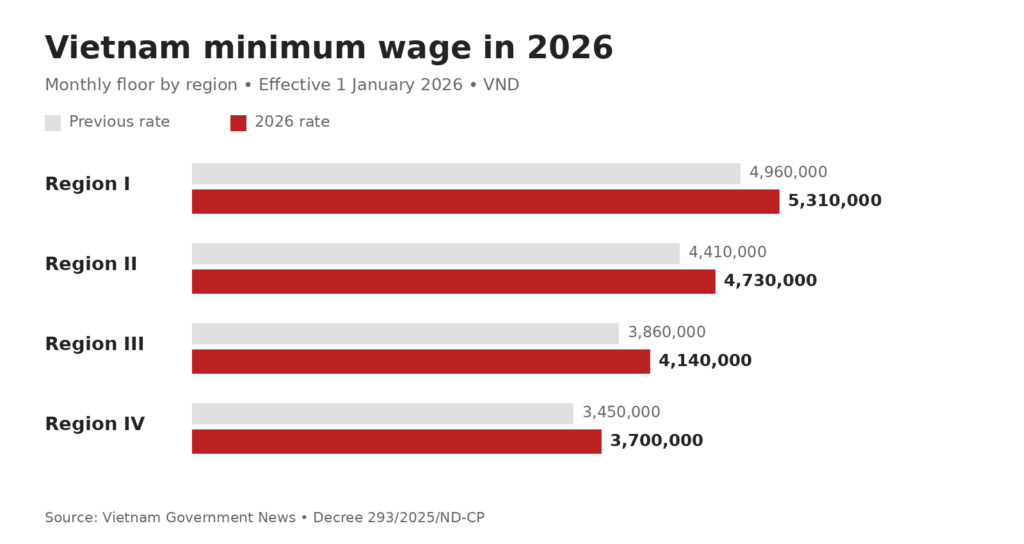
For workforce planning, review salary bands just above the new minimum as well. If entry-level pay rises while experienced staff remain at existing rates, the difference between grades can narrow. Any adjustment beyond legal and contractual obligations should follow a documented compensation decision.
How the Minimum Wage Applies to Different Pay Arrangements
For monthly-paid employees, the minimum wage rate covers the job or position wage for completing normal working time and agreed work. Hourly-paid employees must receive at least the prescribed hourly rate. Weekly, daily, piece-rate and task-based pay must meet the applicable minimum when converted.
Use the published hourly rate directly. Dividing the monthly minimum wage rate by a standard calendar assumption can produce a different figure and should not replace the statutory hourly amount.
Review Existing Employment Commitments
The decree requires a review of contracts, collective agreements and pay policies. More favourable agreed terms continue unless the parties agree otherwise. It also prohibits cutting statutory overtime, night-work and other protected entitlements to offset the change. A legacy training premium may therefore remain relevant to a particular contract, even though it should not be presented as a universal new surcharge.
Average Income in Vietnam and What It Means for Hiring
Vietnam’s National Statistics Office reports average monthly worker income of VND 9.0 million in the second quarter of 2026, up 8.7% year on year. These survey results offer context for recruitment budgets, but do not set a salary for a particular job.
| Worker group | Period | Average monthly income |
| All employed workers | First half of 2026 | VND 9.0 million |
| Urban workers | First half of 2026 | VND 10.6 million |
| Rural workers | First half of 2026 | VND 7.9 million |
| Wage and salary earners | First half of 2026 | VND 10.0 million |
Source: National Statistics Office labour and employment release.
An employer recruiting an accountant, production supervisor or software engineer should compare similar roles by location, seniority, language requirements and working hours. National averages can help test the overall budget, but using them as a fixed offer can leave important skill differences unpriced.
Budgeting for the Full Cost of Employment
Start with the agreed salary for each role and then assess the costs attached to the employment arrangement. Employer insurance contributions, overtime, benefits, recruitment and payroll administration can all affect the budget. Check the applicable contribution bases and employee coverage separately instead of applying a single assumed uplift to every worker.
For an existing team, prepare a payroll comparison showing the current contractual wage, applicable legal floor, required adjustment and any related cost changes. Flag employees whose pay needs correction separately from those receiving discretionary increases. This makes the budget easier to approve and the reason for each adjustment easier to explain.
A Practical Payroll Review for Employers
- Confirm the operating address and wage region for every workplace.
- Compare the relevant monthly or hourly floor with each employee’s pay arrangement.
- Review contracts and collective agreements for more favourable terms and protected benefits.
- Update payroll settings and check any contribution calculations affected by revised pay.
- Reconcile the payroll output against approved changes and retain a clear audit trail.
Assign responsibility for checking employment terms, updating payroll and approving the final payment file. A documented handover is especially useful when HR and finance work in different offices or when payroll is managed by an external provider.
How InCorp Vietnam Can Support Your Payroll
InCorp Vietnam’s HR and payroll services cover payroll, insurance and personal income tax administration. Businesses establishing a local operation can discuss their employment setup alongside the payroll process. Where hiring before forming a local entity is appropriate, employer of record services offer another arrangement to assess.
Contact InCorp Vietnam to review your workforce locations, employment terms and payroll requirements.
Learn the Right Setup for Business
Expansion in the Vietnam
Frequently Asked Questions
What is the minimum wage in Vietnam in 2026?
- The monthly minimum ranges from VND 3,700,000 in Region IV to VND 5,310,000 in Region I. The employer's operating location determines which regional floor applies.
Does Vietnam have an hourly minimum wage?
- Yes. The hourly floors are VND 25,500, VND 22,700, VND 20,000 and VND 17,800 for Regions I, II, III and IV respectively. Use the official hourly figures for employees paid by the hour.
When did the new minimum wage take effect?
- The current rates took effect on 1 January 2026 under the new minimum wage decree. They replace the previous regional rates.
Must every employee receive the same percentage raise?
- No. The reported 7.2% average increase describes the change in regional minimum floors. Review whether the employee’s pay meets the relevant floor and whether their contract, collective agreement or company policy requires an additional adjustment.
Can employers cut benefits to cover the wage increase?
- Employers must preserve statutory entitlements and review existing agreements. The decree expressly protects overtime and night-work pay and other statutory benefits. Do not offset an increase by removing protected payments.