Vietnam’s new electronic invoicing framework took effect on 1 July 2026 under Decree No. 254/2026/ND-CP and Circular No. 91/2026/TT-BTC. The rules replace the previous framework for electronic invoices and electronic documents, expand coverage across digital and consumer-facing business models, and strengthen the tax authority’s use of transaction data for compliance monitoring.
Businesses should treat the changes as more than an accounting update. Invoice issuance, sales data, customer information, tax reporting, ERP and point-of-sale systems, and internal approval controls now need to operate as one consistent compliance process.
What Has Changed Under Vietnam’s New E Invoicing Framework and Rules
Decree 254 and Circular 91 establish a new framework for administering electronic invoices and electronic documents under the 2025 Law on Tax Administration. The rules respond to the growing volume and complexity of digital transactions, e-commerce, platform-based business and direct-to-consumer sales.
The principal direction is clear: tax authorities are seeking faster, more consistent and more verifiable transaction data. For businesses, this means invoice information must match the underlying commercial transaction, accounting records and tax declarations. A process that produces a technically valid invoice but inconsistent source data may still create compliance risk.
Which Businesses Must Use Which New Electronic Invoicing Rules Are Applied To
The applicable invoice method depends on the taxpayer’s activities, technology infrastructure, sales channels and tax-risk profile.
| Entity or activity | Applicable electronic invoice method |
| Economic organizations, other organizations, business households and business individuals in general | Tax-authority-coded electronic invoices, except where another method applies or the taxpayer is classified as high tax risk. |
| Enterprises in specified sectors, including electricity, petroleum, telecommunications, finance, insurance, healthcare, e-commerce, supermarkets and transport | Non-coded electronic invoices may be used when the enterprise meets the required IT, accounting, invoicing-software and data-transmission conditions, unless classified as high tax risk. |
| Organizations and individuals selling directly to consumers in specified retail, hospitality, passenger transport, entertainment and personal-service activities | Electronic invoices generated from cash registers connected to the tax authority’s data system, unless another eligible invoice method has already been registered. |
| Business households and individuals with annual revenue exceeding VND 1 billion, or selling assets subject to ownership or use registration | Mandatory use of tax-authority-coded electronic invoices or electronic invoices generated from connected cash registers. |
Businesses should confirm their classification before configuring invoicing software. A company may operate several sales models at the same time, and different transaction streams may require different invoice types or issuance processes.
Read More: A Complete Guide To Electronic Invoicing Compliance in Vietnam
Main Types of Electronic Invoice
- VAT invoices. Generally used by organizations applying the VAT deduction method, including qualifying domestic sales, exports, international transport and transactions involving non-tariff zones.
- Sales invoices. Generally used by organizations, households and individuals applying the direct VAT method, as well as qualifying entities in non-tariff zones.
- E-commerce invoices. Available to qualifying exporters of goods or services that can transmit the required invoice data to the tax authority.
- Specialized invoices and invoice-equivalent documents. These include documents for public assets, national reserve goods, tickets, cards, transport documents, internal warehouse transfers and agency sales.
When Must an New Electronic Invoice Be Issued
Invoice timing remains one of the most important operational risks. The correct issuance point varies by transaction and may apply regardless of whether payment has been received.
| Transaction | General issuance point |
| Sale of goods | When ownership or use rights are transferred to the buyer, regardless of payment status. |
| Exported goods | Determined by the seller, but no later than the next working day after customs clearance. |
| Services | When the service is completed; if payment is collected before or during delivery, generally when payment is collected, excluding qualifying contract deposits. |
| Staged delivery or instalments | A separate invoice for each delivery or handover. |
| Construction and installation | When completed work is accepted or handed over, regardless of payment status. |
| Progress-based real estate or infrastructure sales before ownership transfer | When payment is collected or according to the contractual payment schedule. |
| High-volume recurring services requiring reconciliation | Upon completion of reconciliation, subject to the applicable statutory deadline for the sector. |
Several sectors have specific timing rules, including telecommunications, banking, securities, insurance, logistics, air transport, petroleum retail, taxi services, healthcare, electronic road toll collection and casino operations. Businesses in these sectors should map the statutory timing rule directly into their billing and reconciliation systems.
Read More: Navigating Vietnam’s Tax Landscape: Expert Accounting Outsourcing Strategies in 2025
How New Electronic Invoice Registration Works? How The Rules Are Applied?
Circular 91 moves the registration and amendment procedure into a more automated, identity-verified process.
- Submit the registration. Taxpayers submit Form No. 01/DKTD-HDDT through an electronic invoice service provider. Eligible taxpayers using free services or a direct connection may register through the Tax Administration Information System or National Public Service Portal.
- Complete automatic verification. Within one working day, the system cross-checks taxpayer information, including biometric information of the legal representative or business household owner, against national identification systems.
- Correct mismatches. A registration may be rejected automatically when information does not match, with the inconsistent information identified for correction and resubmission.
- Confirm the request. Where the information matches, the taxpayer receives a confirmation request by email or phone and must respond within the prescribed period.
- Receive acceptance or further review. A taxpayer not classified as high risk should generally receive an acceptance notice by the following working day. High-risk or irregular cases may be asked to explain or provide additional documents.
Need support reviewing your e-invoicing processes in Vietnam? Contact Ascentium Vietnam at vietnam@ascentium.com or visit ascentium.com/vietnam.
Key Compliance Risks and Enforcement Measures
Circular No. 91/2026/TT-BTC strengthens risk-based monitoring of electronic invoices. Businesses may face additional scrutiny if their owners or legal representatives are linked to invoice fraud, suspicious transactions, inactive tax codes, unsuitable registered addresses, or previous tax and invoice violations. High-risk classification may result in additional information requests, delayed registration or restrictions on invoice use.
From 1 July 2026, incorrectly issued invoices should be handled through notification, adjustment or replacement rather than cancellation and reissuance. Non-material errors may only require notification, while errors affecting tax codes, amounts, tax rates, tax values or goods generally require an adjustment or replacement invoice.
New electronic invoice use may also be suspended for tax-code termination, non-operation at the registered address, tax-debt enforcement, illegal invoicing, unresolved identity mismatches or high-risk classification. Use may resume once the underlying issue has been resolved.
Consumers who report a seller’s failure to issue or deliver an invoice may receive up to 10 percent of the administrative fine, capped at VND 10 million per case. Businesses should therefore maintain accurate registration information, strengthen invoice controls and ensure employees understand the correct issuance and correction procedures.
Read More: How to Claim Tax Relief Via VAT Refund in Vietnam?
What FDIs Should Take Action From New Electronic Invoicing Rules?
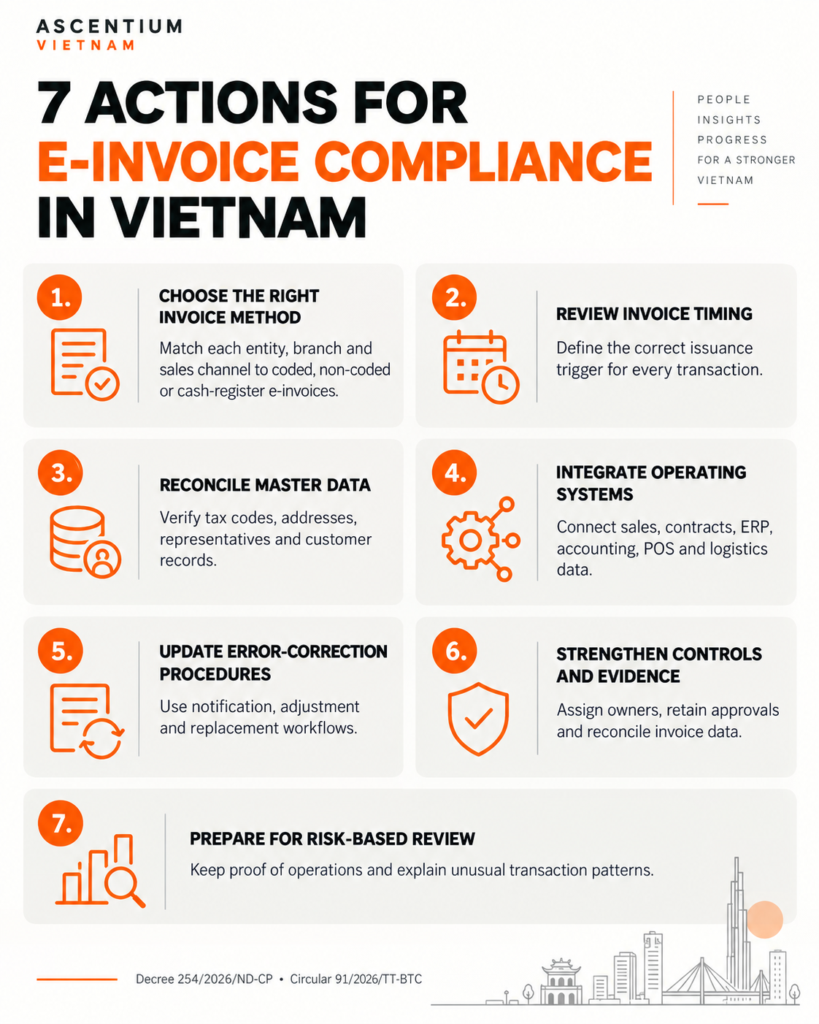
- Identify the correct invoice method for each business stream. Map legal entities, branches, sales channels and transaction types against coded, non-coded and cash-register-generated invoice requirements.
- Review invoice timing rules. Document the triggering event for each transaction type and configure billing systems so invoices are not issued too early or too late.
- Reconcile master data. Confirm that tax codes, legal representative details, registered addresses, customer records and identity information are accurate across corporate, tax and invoicing systems.
- Integrate operational systems. Test data flows between sales platforms, contracts, ERP, accounting, point-of-sale, logistics and e-invoicing software.
- Update error-correction procedures. Replace legacy cancellation practices with documented notification, adjustment and replacement workflows under Circular 91.
- Strengthen controls and evidence. Assign responsibilities across sales, finance, tax and IT teams, maintain approval records and establish periodic invoice-data reconciliations.
- Prepare for risk-based review. Keep evidence of actual operations at the registered address and be ready to explain unusual transaction patterns or taxpayer-risk indicators.
How Ascentium Vietnam Can Support New Electronic Invoice Compliance
InCorp Vietnam, now officially Ascentium Vietnam, supports foreign-invested and local businesses in reviewing the tax, accounting and operational impact of Vietnam’s electronic invoicing requirements.
Our teams can help businesses assess the applicable invoice method, review invoice timing and correction procedures, reconcile invoice data with accounting and tax records, strengthen internal controls, and coordinate tax, accounting, ERP and operational requirements. Where a business operates through several legal entities or sales channels, we can also help identify gaps between commercial processes and statutory invoicing obligations.
Need support reviewing your e-invoicing processes in Vietnam? Contact Ascentium Vietnam at vietnam@ascentium.com or visit ascentium.com/vietnam.
Conclusion
Vietnam’s new electronic invoicing rules strengthen the connection between transaction data, taxpayer identity, tax-risk monitoring and day-to-day business operations. The immediate task for companies is not simply to update invoice templates, but to confirm that the correct data is captured, approved, transmitted and reconciled at the correct time.
Businesses that review their invoice methods, system integrations, master data and error-handling procedures early will be better placed to avoid interruptions, delayed registrations and downstream tax or accounting issues.