VAT refunds in Vietnam can have a significant effect on working capital, particularly for exporters and foreign-invested businesses during the investment stage. In practice, however, accumulating input VAT is only the first step. Whether a business can obtain a refund, and how long the process takes, depends on the type of claim, the business’s risk classification and the quality of the supporting records.
Vietnam introduced several relevant changes in 2026. These include removing a refund condition linked to supplier compliance and introducing a new tax administration framework under Decree No. 252/2026/ND-CP and Circular No. 89/2026/TT-BTC, both effective from 1 July 2026.
The changes should make the process more manageable for compliant businesses, but they do not remove the need for careful preparation. This article explains the main eligibility rules, current processing timelines and practical issues businesses should consider before submitting a claim.
Who Can Claim a VAT Refund in Vietnam?
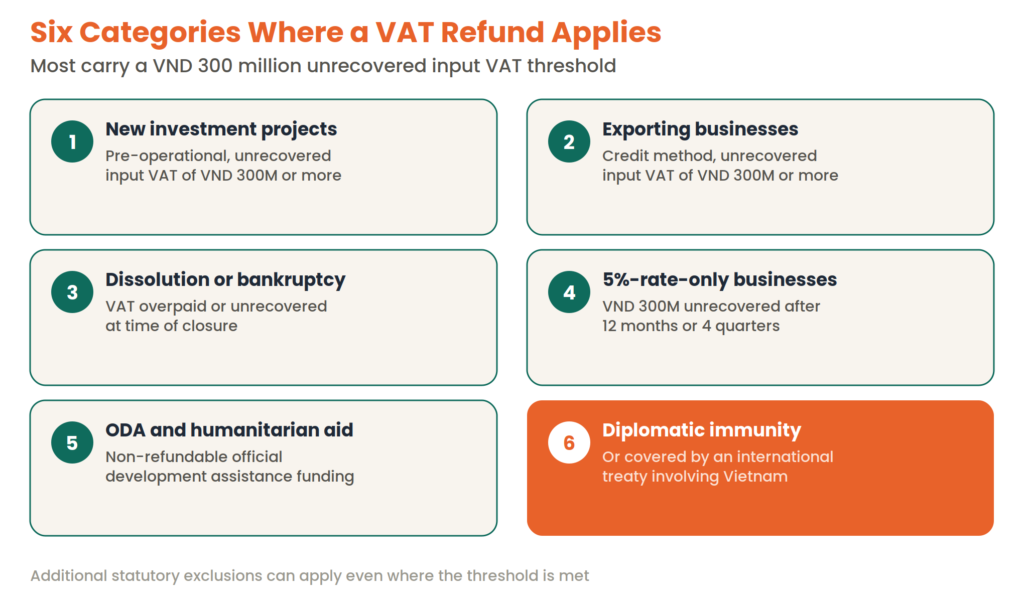
A business cannot request a refund simply because it has a large amount of uncredited input VAT. It must first identify the legal basis for the claim. For most foreign-invested businesses, the main refund routes are exports and investment projects. Other cases include businesses supplying goods or services subject to the 5% VAT rate, businesses undergoing dissolution or bankruptcy, and certain ODA, humanitarian aid and treaty-based arrangements.
Principal Refund Categories
| Refund category | General requirement | Important limitation |
| Exported goods and services | Uncredited input VAT of at least VND 300 million in a month or quarter | The refund generally cannot exceed 10% of export revenue for the refund period |
| Investment projects | At least VND 300 million of eligible input VAT remains after offsetting against VAT payable from existing operations | The project must meet the relevant investment and operating conditions |
| Goods and services subject to 5% VAT | At least VND 300 million remains uncredited after 12 consecutive months or four consecutive quarters | Allocation may be required if the business has activities subject to different VAT rates |
| Dissolution or bankruptcy | The business applies the credit method and has overpaid or uncredited VAT | The claim is generally subject to inspection before refund |
The conditions and calculation method differ between categories, so the VND 300 million threshold should not be treated as a standalone test. It is also worth noting that a change of corporate form, such as a merger, acquisition, equity transfer or de-merger, generally removes eligibility for an accumulated VAT balance outright, dissolution and bankruptcy are the exceptions. A business planning a restructuring transaction should review any outstanding VAT position before the transaction is registered, since the balance is not recoverable once ownership changes.
Export refund claims
An exporter may generally claim a refund where its eligible uncredited input VAT reaches VND 300 million or more in a month or quarter. Where a business has both export and domestic revenue, it should separately account for input VAT relating to exports; if separate accounting is not possible, the export-related input VAT must be allocated according to the proportion of export revenue to total taxable revenue for the relevant refund period.
The refundable amount is generally capped at 10% of export revenue for that period. Eligible input VAT exceeding the cap may be carried forward when calculating a later refund. Certain transactions remain outside the ordinary export refund rules, including goods imported into Vietnam and subsequently exported to another country without processing or manufacturing taking place domestically. Businesses using trading, processing or re-export structures should review the transaction flow before treating the related input VAT as refundable.
Investment project refund claims
A business applying the credit method may claim input VAT incurred during the investment stage of a new or expanded investment project, subject to the relevant conditions. Input VAT from the project must first be offset against VAT payable from the business’s existing operations, where applicable; a refund may then be available if at least VND 300 million remains uncredited.
The project must also satisfy applicable investment conditions. Refunds may be restricted where, for example, the investor has not contributed sufficient charter capital or has not met the requirements for a conditional business line. Timing matters too: if a project, project stage or investment item has been completed without a refund claim being made, the business generally has one year from the relevant completion date to submit the claim.ilities, medical equipment, healthcare technology and partnerships between healthcare providers and hospitality operators.
Identifying the correct refund category, and confirming a specific claim does not fall into an exclusion such as a recent restructuring or an import-for-re-export structure, is the step most likely to be skipped under time pressure. Ascentium Vietnam’s VAT refund team can confirm eligibility against the current rules before a business commits to preparing a dossier.
How VAT Refund Claims Are Processed
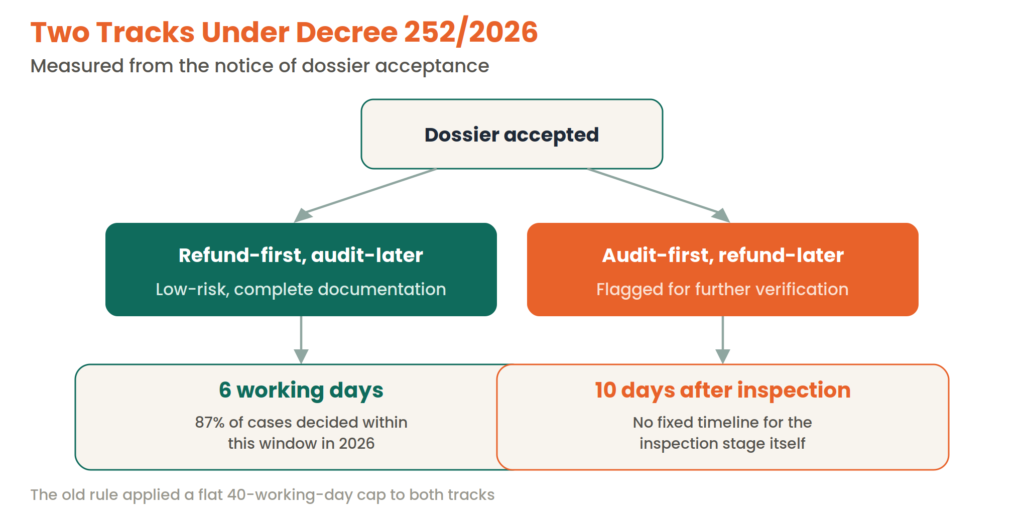
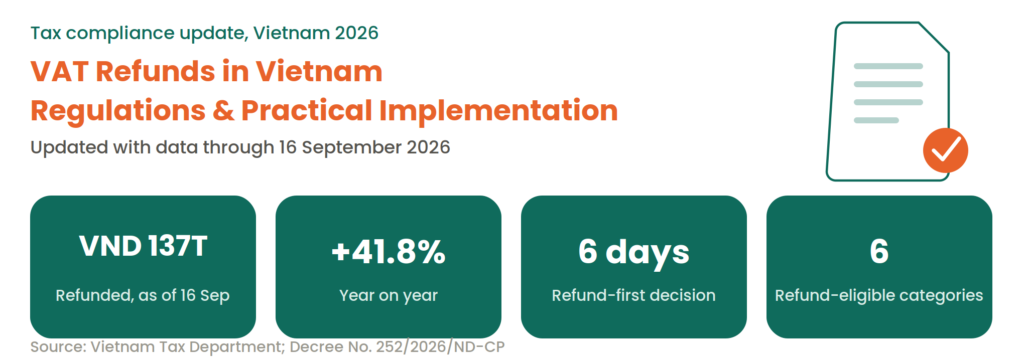
Under the framework effective from 1 July 2026, the tax authority classifies refund dossiers using compliance and risk-management criteria. A business does not select its own processing track; classification may take account of its compliance history, the nature of the claim, available tax data and any inconsistencies identified during the review.
Two Processing Tracks
| Processing track | General treatment | Decision period |
| Refund before inspection | The claim is processed before a detailed post-refund examination | Up to six working days from the tax authority’s notice of receipt |
| Inspection before refund | The claim is examined before a refund decision is issued | Up to ten working days after the tax authority issues its examination conclusion or related decision |
The six-working-day period does not necessarily mean payment happens automatically. Within this window, the tax authority may approve the refund, reject part or all of the claim, request further action, or transfer the dossier to the inspection-before-refund track. For claims requiring pre-refund inspection, the ten-working-day period only begins after the examination has concluded, so the examination itself drives the overall timetable. Under the 2025 Law on Tax Administration, an on-site tax examination generally must not exceed 20 days from the announcement of the examination decision, and may be extended once for up to another 20 days; longer periods may apply where related-party transactions are involved.
Time the taxpayer spends preparing explanations or additional documents is not counted within the tax authority’s own processing period. In practice, incomplete records or slow responses extend the process even where the statutory decision periods themselves are short.
What Changed for Exporters in 2026?
Two recent changes are particularly relevant to exporters.
Removal of the supplier compliance condition
The VAT rules previously required the seller to have declared and paid the VAT relating to an invoice before the buyer could obtain a refund for that invoice, creating difficulties for compliant businesses whose claims could be delayed by matters outside their direct control. Law No. 149/2025/QH15 removed this condition from 1 January 2026, and Decree No. 359/2025/ND-CP confirms the change also applies to refund dossiers accepted before 1 January 2026 where no refund decision had yet been issued.
Businesses with older claims delayed solely because of a supplier’s VAT declaration or payment status should review the current status of those claims. The change does not mean supplier information is no longer relevant, however: tax authorities may still reconcile invoices and transaction data across the supply chain as part of their risk assessment, and inconsistencies may still lead to clarification requests or pre-refund inspection, even though supplier payment is no longer a standalone eligibility condition.
Clarification for on-the-spot exports
Law No. 90/2025/QH15 clarified the customs and VAT treatment of on-the-spot import and export transactions, which generally involve goods delivered and received within Vietnam under the instruction of a foreign trader. Qualifying on-the-spot exports may be treated as exported goods for VAT purposes, but local delivery does not automatically qualify for the 0% rate; the transaction must still meet the applicable contractual, customs, invoicing and payment requirements.
Businesses using contract manufacturing, toll-processing or similar supply-chain arrangements should review each transaction against the specific on-the-spot export rules. Documents prepared for an ordinary cross-border shipment may not be sufficient for a transaction in which the goods never leave Vietnam.
Documentation Issues That Commonly Delay Refunds
Most refund delays are not caused by uncertainty over general entitlement. They arise when the documents do not clearly support the amount claimed, or when information cannot be reconciled across different systems:
- Differences between contracts, invoices, customs declarations, accounting records and bank payment documents
- Missing or incomplete export documents, such as packing lists, bills of lading and other shipping records
- Export contracts that do not clearly identify the parties, delivery arrangements or payment terms
- On-the-spot export transactions supported by documents prepared for a conventional cross-border export
- Input VAT relating to an investment project combined with VAT from the business’s normal operations
- Incorrect allocation of input VAT between export and domestic activities
- Refund calculations that do not properly apply the VND 300 million threshold or the 10% export-revenue cap
- Delays in responding to requests from the tax authority for explanations or additional evidence
A technically eligible claim may still move to the inspection-before-refund track if the available data raises questions that cannot be resolved during the initial review.
Most of the gaps above are filing habits rather than genuine eligibility disputes, and considerably cheaper to fix before submission than after a query comes back. Ascentium Vietnam’s accounting and tax team can review a dossier against the current documentation requirements before it goes in.
What Businesses Should Do Before Filing
Businesses preparing a VAT refund claim should complete a pre-filing review rather than wait for the tax authority to identify gaps. The review should cover five areas:
1. Confirm the refund category. Identify the specific legal basis for the claim and check the conditions, exclusions and filing period applicable to that category.
2. Recalculate the amount. Confirm that domestic VAT has been offset correctly, the VND 300 million threshold has been met, and any applicable refund cap has been applied.
3. Reconcile transaction data. Check that contracts, electronic invoices, customs declarations, accounting records and payment documents all refer to the same transactions and amounts.
4. Review supporting documents. Ensure the business can produce the underlying commercial and shipping documents, rather than relying only on invoices and customs declarations.
5. Prepare for follow-up questions. Assign responsibility for responding to the tax authority and keep supporting records accessible so clarification requests can be handled promptly.
Businesses should also review any historical claims that were delayed because of the former supplier compliance condition. Depending on their status, those claims may now be capable of progressing under the amended rules.
Will Automation Make VAT Refunds Faster?
The 2025 Law on Tax Administration allows tax authorities to introduce automated refunds in stages, using available data, risk criteria and automated processing procedures. This is expected to make the process more efficient for eligible, lower-risk claims. Automation does not, however, change the underlying refund conditions or remove the need for supporting documents.
For businesses, the practical priority remains the same: maintain consistent transaction data and prepare a complete dossier that can be reviewed without extensive clarification. A digitally submitted claim will not necessarily be processed quickly if the information recorded across invoices, customs, accounting and payment systems does not match.
How Ascentium Vietnam Can Help
Ascentium Vietnam supports exporters, investment projects and other eligible businesses throughout the VAT refund process. This may include assessing eligibility, reviewing refund calculations, reconciling transaction data, preparing supporting documents, and assisting with questions raised during the tax authority’s review, alongside broader tax compliance and reporting work.
Businesses preparing a new claim or reviewing an older pending application can contact Ascentium Vietnam to discuss the current requirements and practical next steps.
Learn the Right Setup for Business
Expansion in the Vietnam
Frequently Asked Questions
Is a large uncredited input VAT balance enough to claim a refund?
- No. The business must fall within a statutory refund category and meet the conditions for that category. If it does not qualify, the input VAT is generally carried forward for future credit rather than refunded.
Does the six-working-day period guarantee that a refund will be paid?
- No. It is the period for the tax authority to process a claim classified for refund before inspection. The authority may approve the claim, reject all or part of it, request further action, or transfer it to the inspection-before-refund track. The period also excludes time spent by the taxpayer providing explanations or additional documents.
Can an older claim be reconsidered if it was delayed by a supplier's tax status?
- Potentially, yes. The supplier declaration and payment condition was removed from 1 January 2026 under Law No. 149/2025/QH15, and Decree No. 359/2025/ND-CP extends the change to dossiers accepted before that date where the tax authority had not yet issued a refund decision. The status of each claim should still be reviewed individually.
Do all on-the-spot exports qualify for 0% VAT?
- No. On-the-spot exports may qualify as exported goods, but the transaction must meet the relevant VAT and customs requirements. The contractual arrangement, customs procedures, invoices and payment evidence should be reviewed together.
Does automated processing reduce the documents a business must prepare?
- Not necessarily. Automation changes how the tax authority processes and assesses a claim, but it does not remove the legal conditions for a refund. Complete and consistent supporting records remain essential.