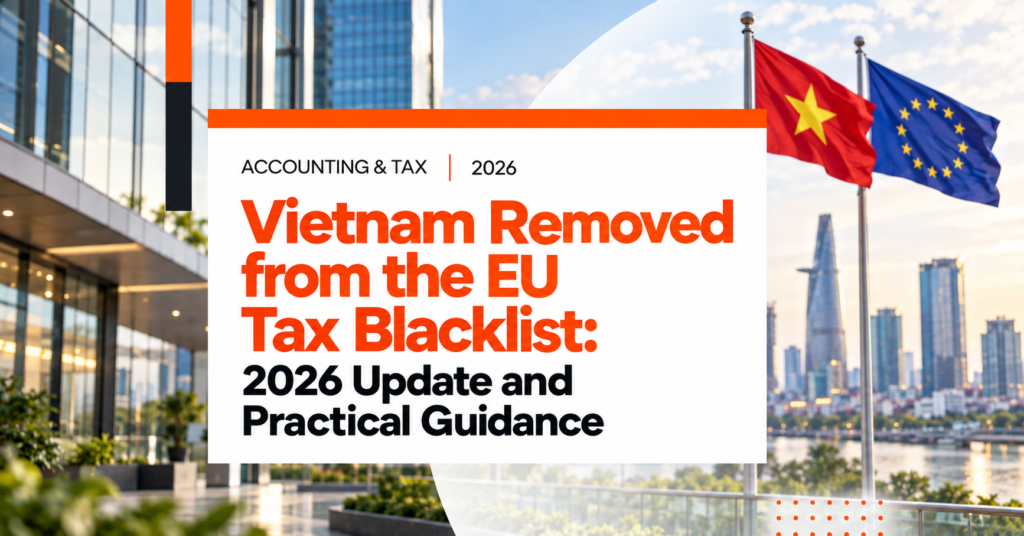
Vietnam’s removal from the EU list of non-cooperative jurisdictions for tax purposes is a positive development for businesses with operations connecting Vietnam and Europe. However, the practical implications depend on how the relevant EU Member State applies its domestic tax rules.
For foreign-invested enterprises and multinational groups, the immediate task is to identify whether Vietnam’s previous listing affected their payments, expense deductions or reporting obligations, and whether those requirements now change.
This article explains Vietnam’s updated status, the potential implications for cross-border transactions and the areas businesses should review.
What Changed in October 2026?
On 9 October 2026, the Council of the European Union removed Vietnam from Annex I, commonly referred to as the EU tax blacklist.
Vietnam had been included in February 2026 after an OECD Global Forum review found that its framework did not meet the required standards for exchanging tax information upon request. Following reforms, Vietnam was granted a new review and moved to Annex II pending its completion.
The distinction matters. Removal from Annex I recognizes progress, but Vietnam’s international tax governance commitments remain subject to assessment.
Understand how Vietnam’s updated tax status may affect your business. Speak with our Tax team about your Vietnam tax obligations
What Does Annex II Mean?
Annex II records jurisdictions cooperating with the EU to address outstanding tax governance concerns. These jurisdictions have committed to reforms, and their progress remains under monitoring.
The EU assessment framework covers tax transparency, fair taxation and the implementation of international standards against base erosion and profit shifting (BEPS). Vietnam’s inclusion in Annex II therefore signals an ongoing review process.
For businesses, the change provides a reason to reassess listing-related risks while continuing to maintain the records and controls needed for their existing tax obligations.
Will Vietnam–EU Transactions Receive Different Tax Treatment?
Potentially, but the answer must be assessed under the rules of the relevant EU Member State.
Where a company previously identified additional tax exposure because Vietnam was included in Annex I, it should check whether that exposure continues following the removal. The review should cover the legal basis of the measure, the transactions affected and the date from which any change applies.
Businesses should avoid applying a single conclusion across all European operations. A group with entities in several EU Member States may need separate assessments for each jurisdiction.
Withholding tax and cross-border payments
Review payments between Vietnam and EU entities where the previous listing was considered relevant to withholding tax or additional compliance requirements.
The assessment should identify the payment type, the parties involved, applicable domestic rules and any relevant treaty provisions. Vietnam’s removal should not be treated as sufficient evidence, on its own, to apply a lower withholding rate.
Expense deductibility
EU entities making payments to Vietnam should review any deductions previously restricted or flagged because of Vietnam’s listing.
Contracts, invoices, evidence of services and payment records should remain available to support the commercial basis of the expense. A change in listing status does not replace the documentation needed to substantiate a deduction.
Reporting and internal risk assessments
Groups should check whether Vietnam’s former status was reflected in tax reporting procedures, transaction approval requirements or internal risk registers.
Where those procedures need updating, the business should record the reason for the change and the effective date. This helps local finance teams and group tax functions apply a consistent approach.
Reviewing payments between Vietnam and the EU? Get support assessing Vietnam-side tax requirements and coordinating cross-border considerations. Explore Tax Advisory services from Ascentium Vietnam
What Tax Obligations Still Require Attention?
Businesses should continue to assess their applicable tax obligations in Vietnam and the jurisdictions where their counterparties operate.
These may include:
- Transfer pricing documentation and related-party transaction disclosures
- Country-by-Country Reporting requirements, where applicable
- Corporate income tax and withholding tax filings
- Supporting records for cross-border payments
- Responses to tax authority requests for information
The practical priority is to keep transaction information consistent across contracts, accounting records, tax filings and group reporting. Differences between these records can create questions regardless of Vietnam’s EU listing status.
What Businesses Should Do Now?
Companies with Vietnam–EU operations should complete a targeted review before changing their tax treatment or compliance procedures.
1. Identify exposure linked to the previous listing
List the transactions, entities and reporting processes where Vietnam’s Annex I status was identified as a risk. This establishes which arrangements require further assessment.
2. Check the relevant national rules
Confirm how the applicable EU Member State treats Vietnam’s removal, including whether domestic legislation or administrative guidance specifies an effective date.
3. Review transaction documentation
Check that contracts, invoices, payment records and related-party documentation support the nature and value of the transactions under review.
4. Coordinate local and group decisions
Assign responsibility for confirming the tax position and communicating any changes. Vietnam finance teams and EU counterparts should work from the same documented assessment.
5. Monitor further developments
Track Vietnam’s OECD Global Forum review and subsequent EU list updates. Further findings may affect how the group assesses its tax exposure.
How Ascentium Vietnam Can Help
Ascentium Vietnam supports foreign-invested businesses with accounting, tax compliance, transfer pricing and advisory services.
For companies reviewing Vietnam–EU arrangements, our team can help assess Vietnam-side tax obligations, review supporting documentation and coordinate with relevant advisers on cross-border considerations.
Businesses can contact our experts to discuss the implications for their operations and identify practical next steps.
Turn your review into practical next steps with integrated accounting, tax compliance and advisory support. Explore Our Solutions
Learn the Right Setup for Business
Expansion in the Vietnam
Frequently Asked Questions
Why was Vietnam removed from the EU tax blacklist?
- Vietnam was removed on 9 October 2026 following reforms to its framework for exchanging tax information upon request. The country has been granted a new OECD Global Forum review to assess whether the outstanding concerns have been addressed.
What does Vietnam’s inclusion in Annex II mean?
- Annex II covers jurisdictions cooperating with the EU to meet international tax governance standards. Vietnam remains under monitoring pending the completion of its OECD Global Forum review.
Does removal automatically change the tax treatment of Vietnam–EU transactions?
- No automatic change should be assumed. Businesses need to check the relevant EU Member State’s domestic rules, the transaction involved and applicable effective dates before adjusting withholding tax, expense deductions or reporting procedures.
Do businesses still need to comply with transfer pricing and tax reporting requirements?
- Yes. Businesses must continue to meet their applicable transfer pricing, related-party disclosure, Country-by-Country Reporting and tax filing obligations. Vietnam’s removal does not provide an exemption from these requirements.
What should businesses with Vietnam–EU operations review now?
- Businesses should identify any exposure linked to Vietnam’s previous listing, check the relevant EU Member State’s rules and review supporting transaction documents. Local finance teams and group tax advisers should coordinate any changes and monitor further EU and OECD developments.