Vietnam’s economic narrative remains one of resilience and opportunity. As we move through 2026, the country continues to build on its remarkable post-pandemic momentum. With official GDP growth hitting 7.09% in 2024 and a surprising 8.02% in 2025, the forward-looking projections from institutions like the World Bank (6.5% in 2026) and the OECD (6.2% in 2026) still point to solid, if more normalized, expansion.
For foreign investors, this sustained growth is mirrored by a maturing and rapidly modernizing legal framework. However, the rulebook for entry has been substantially rewritten over the past 18 months. If you are consulting a guide to Vietnam company formation written in early 2025, you are likely following outdated procedures.
The most fundamental shift? The sequence and process for obtaining your company’s legal identity—the Enterprise Registration Certificate (ERC) —has changed. This blog post serves as your practical, up-to-date guide to obtaining an ERC in Vietnam in 2026, cutting through the old information to focus on what you need to know now.
Why 2026 is Different: The “Must Update” Items
Before diving into the “how-to,” it’s crucial to understand the landscape. Several high-impact changes have redefined company formation:
Government Restructuring: The former Ministry of Planning and Investment (MPI) has been merged with the Ministry of Finance. This means that investment and business registration authorities, once firmly under the provincial Department of Planning and Investment (DPI), are now positioned under the provincial Department of Finance.
New Enterprise Law & Decree: The amended Enterprise Law and its implementing Decree 168/2025/ND-CP (effective July 1, 2025) have comprehensively updated the enterprise registration framework, particularly regarding digital procedures.
The “ERC-First” Sequencing (Crucial Change): The Law on Investment 2025 (No. 143/2025/QH15), which took effect on March 1, 2026, has reversed the long-standing order. Foreign investors are now explicitly permitted to establish the project company (get the Enterprise Registration Certificate) first and then proceed with the Investment Registration Certificate (IRC) procedures.
Digital-First is Mandatory: The era of using simple portal accounts is over. From 2026, online enterprise registration is fundamentally tied to a national-level electronic identification account (eID) for organizations.
A Major Tax Break: The annual business license fee (lệ phí môn bài), a standard compliance item in every older guide, has been abolished from January 1, 2026.
With these changes in mind, let’s explore the ERC in detail.
Start your business in days, not weeks. Leverage our deep knowledge of the new “ERC-First” sequencing to fast-track your market entry. [Talk to a Vietnam Specialist]
What is the Enterprise Registration Certificate (ERC)?
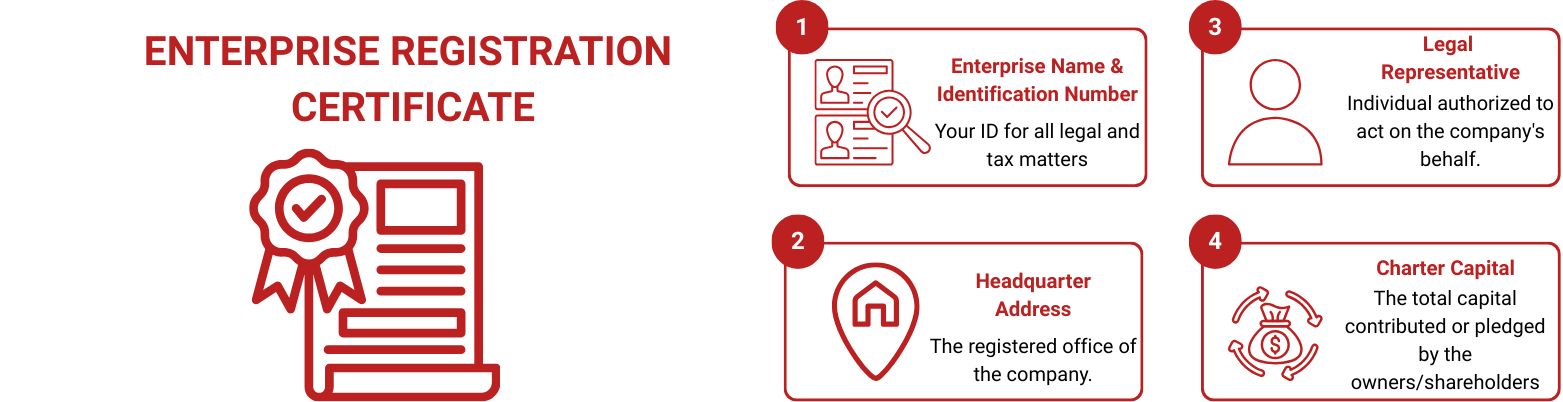
Think of the ERC as the “birth certificate” of your Vietnamese company. It is the legal document issued by the state that officially recognizes the enterprise as a legal entity. Under the Enterprise Law, the ERC contains the core identity of your business:
- Enterprise Name and Identification Number: Your unique, official ID for all legal and tax matters.
- Headquarters Address: The registered office of the company.
- Legal Representative: The individual authorized to act on the company’s behalf.
- Charter Capital: The total capital contributed or pledged by the owners/shareholders.
It is distinct from the Investment Registration Certificate (IRC) , which is tied to a specific investment project and is required for certain types of projects. In 2026, the key is understanding their new relationship.
The 2026 Sequencing: IRC vs. ERC (The Old Way is Gone)
This is the single most important update for any foreign investor. For years, the default sequence for a wholly foreign-owned company was: IRC first → ERC second. You had to get your investment project approved before you could even form the company to execute it.
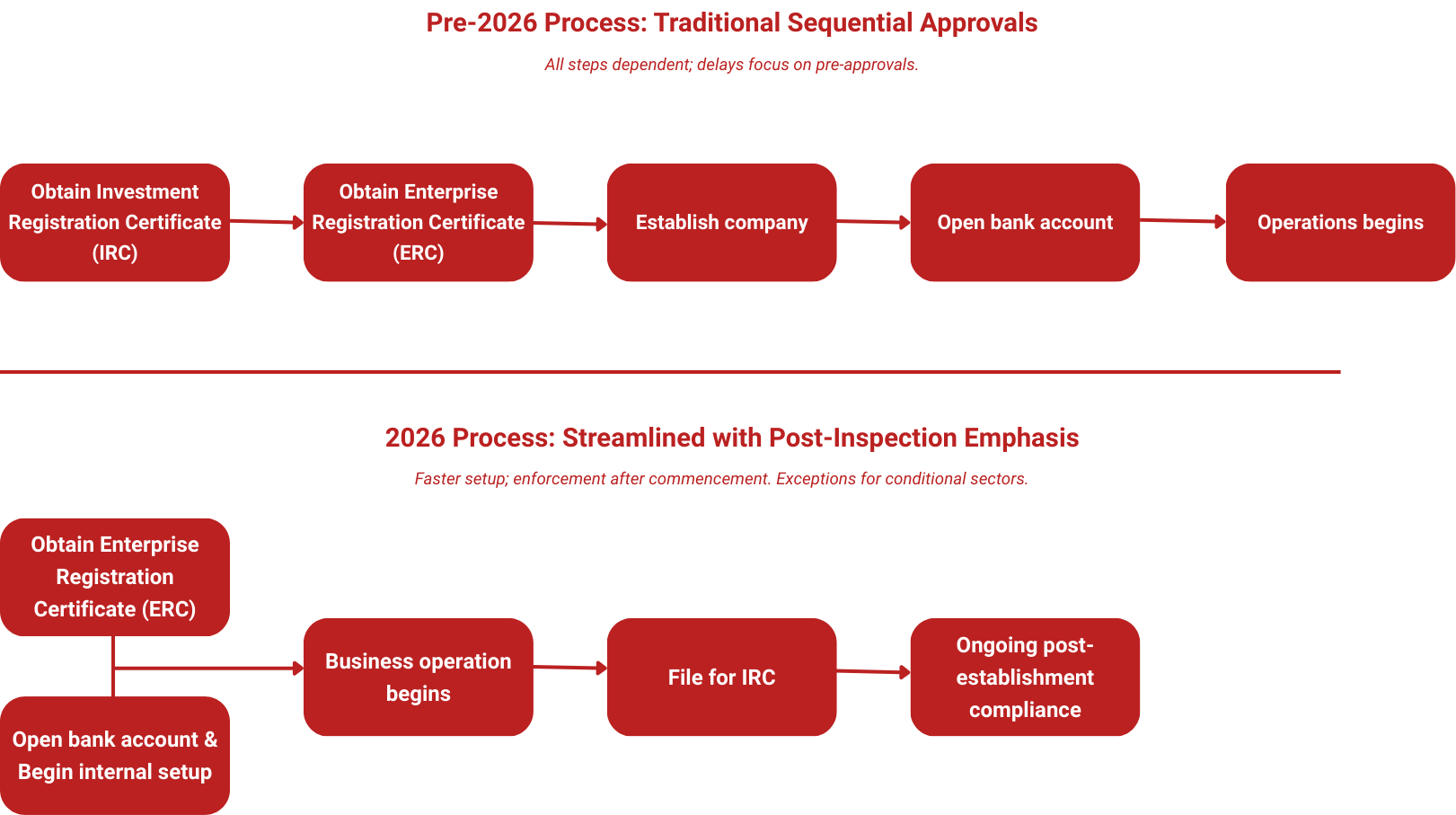
The Law on Investment 2025 has flipped this script. The law now explicitly allows foreign investors to establish the enterprise (get the Enterprise Registration Certificate – ERC) before completing the IRC procedures, provided they meet market access conditions at the time of establishment.
Why does this matter?
It provides greater flexibility. You can now legally create your corporate vehicle first, sign a lease, open a bank account in the company’s name, and prepare for operations while the investment project documentation is being finalized. This can significantly speed up your time-to-market.
However, a word of caution: This is a legally enabled option, not a mandatory one. Your strategy should depend on your specific project.
- For projects requiring an IRC (e.g., those in conditional sectors, with large-scale investments), you can now choose the “ERC-first” route. You will establish the company and then file the dossier for the IRC, which you must obtain before you can officially implement the project.
- For projects not requiring an IRC, the ERC is often the primary certificate needed.
- Always verify with local authorities or a professional advisor, as practical implementation can vary slightly.
Ready to register? Don’t get lost in the 2026 rule changes. Let our experts handle your ERC application from start to finish. [Get Your Free Consultation]
Your 2026 Enterprise Registration Certificate Application Workflow: A Step-by-Step Guide
Here is a practical, investor-facing workflow for obtaining an ERC in 2026, incorporating the new rules.
Phase 1: Preparation (Before You Click “Submit”)
This phase is critical and cannot be skipped.
1. Structure & Name Checks:
- Confirm your intended business lines are not prohibited. If they are conditional, understand the sub-licenses required post-incorporation.
- Verify foreign market access conditions for your sector. This still applies at the establishment stage.
- Prepare 2-3 preferred company names in both English and Vietnamese, following naming conventions (avoiding duplicates, prohibited terms, etc.).
2. Secure a Head Address & Legal Representative:
- You need a physical address in Vietnam for your headquarters.
- You must identify a legal representative. This person does not need to be a foreigner, but must meet the legal requirements and be ready to assume the role. This is a non-negotiable item on the ERC.
3. Obtain Organizational eID: This is your digital key. Before you can file anything online, your organization (or its legal representative) must obtain an electronic identification account. The old “business registration accounts” created on government portals were only valid until December 31, 2025. You cannot file a valid online ERC application in 2026 without a proper eID. Plan time for this step.
Phase 2: Filing the Enterprise Registration Certificate Application
Step 1: Prepare the Dossier. The core components of an ERC dossier for a Limited Liability Company (LLC) include:
- Application for enterprise registration.
- Company charter.
- List of members (for multi-member LLC) or owner’s information (for single-member LLC).
- Copies of valid identification documents for all members/owners and the legal representative (e.g., passport for individuals, Certificate of Incorporation for corporate entities).
- For corporate investors, additional documents may be required to prove the legal status of the signatory.
Step 2: Submit Online. Using the acquired organizational eID, submit the complete dossier through the National Enterprise Registration Portal.
Step 3: Await Processing. By law, the business registration authority (under the provincial Department of Finance) has three working days from receipt of a valid application to either issue the ERC, request supplementation, or reject the application.
Step 4: Receive ERC & Publish. Once granted, your company officially exists. The enterprise must then publish its registration information on the National Portal, including its ERC details and business lines.
Phase 3: Post-Enterprise Registration Certificate Issuance (Critical Compliance Steps)
Getting the ERC is a major win, but the clock starts ticking immediately on key obligations.
1. The 90-Day Capital Contribution Deadline: This is a hard rule. Under the Enterprise Law:
- For multi-member LLCs and single-member LLCs, owners must contribute the full amount of charter capital promised within 90 days of the ERC issuance date.
- For joint-stock companies, shareholders must pay for all subscribed shares within the same 90-day window.
- Failure to do so has serious consequences, including potential adjustments to charter capital and loss of ownership rights for the unpaid portion. This is not just a legal formality; it’s a banking and foreign exchange control issue that affects future profit repatriation.
2. Open a Direct Investment Capital Account (DICA): Vietnam’s foreign exchange controls (governed by the State Bank of Vietnam) require foreign direct investors to open a DICA at a licensed bank. All capital contributions and related financial flows must be routed through this account. Your 90-day capital contribution deadline will be tracked through this account.
3. Register for Taxes (and Note the License Fee is Gone!): You will need to register for taxes and obtain a tax identification number (often integrated with your Enterprise ID). However, one line item you can now completely ignore from older checklists is the annual business license fee. Under Resolution 198/2025/QH15, this fee was abolished from January 1, 2026. You do not need to file a declaration or pay this fee for 2026 onward.
4. Proceed with the IRC (If Applicable): If your project requires an IRC, now is the time to file that dossier with the relevant authority (Management Board for projects in industrial parks, or the Department of Finance for projects outside them). You must obtain this certificate before you can implement the investment project.
Practical Insights for a Smooth 2026 Formation
Digital Readiness is Non-Negotiable: Your entire formation process hinges on the organizational eID. Start this process early. It is the foundation for all future online interactions with government authorities.
The Old “License Fee” Tables are Obsolete: Do not budget for or worry about the old VND 1-3 million business license fee. It is gone. Any advice you read about it is outdated.
The “ERC-First” Route is an Option, Not a Rule: While legally possible, its viability can depend on the local Department of Finance’s interpretation and your project’s specifics. Discuss this with your legal advisor to choose the optimal path for your situation.
Engage Professional Support Early: The new laws simplify some things (like sequencing) but add complexity in others (like eID requirements). Engaging a reputable law firm or advisory firm in Vietnam is not an unnecessary expense; it’s an investment in compliance and speed. They will manage the eID process, draft compliant charters, and ensure your 90-day clock is managed correctly with the bank.
Conclusion
Vietnam in 2026 offers a compelling proposition for foreign investors: a robust economy backed by a modernizing, digital-first legal system. The Enterprise Registration Certificate remains the cornerstone of company formation, but the path to obtaining it has evolved.
By understanding the new “Enterprise Registration Certificate-first” sequencing, the mandatory shift to eID-based filing, and the critical post-issuance steps like the 90-day capital contribution, you can navigate the process with confidence. The old guides will tell you to get an IRC first and pay a business license fee. The 2026 reality is different: it’s about digital identity, strategic sequencing, and hitting the ground running with a clear compliance roadmap.

clients worldwide

professional staff

incorporated entities in 10 years

compliance transactions yearly
Learn the Right Setup for Business
Expansion in the Vietnam
Frequently Asked Questions
How to check company registration in Vietnam?
- To check company registration in Vietnam, visit the National Business Registration Portal at https://dangkykinhdoanh.gov.vn. You can search by company name, business registration number, or tax code to view key details such as legal status, registered address, and business lines.
How to register a business license in Vietnam?
- To register a business license in Vietnam, foreign investors must first obtain an Investment Registration Certificate (IRC) from the Department of Planning and Investment (DPI). After that, they must apply for an Enterprise Registration Certificate (ERC), which serves as the business license, by submitting the required documents such as company charter, list of shareholders, and legal representative information. Once the ERC is issued, the company must complete post-licensing steps, including tax registration and opening a bank account. The entire process typically takes 30–45 working days, depending on the business type.
What Is Erc Certificate
- An ERC certificate is a document issued under the Employee Retention Credit (ERC) program, confirming an employer's eligibility for tax credits provided by the IRS for retaining employees during the COVID-19 pandemic. It supports claims for refundable tax credits on qualified wages.
What is the difference between IRC and ERC in Vietnam?
- In Vietnam, the Investment Registration Certificate (IRC) and the Enterprise Registration Certificate (ERC) are two separate legal documents required for foreign investors. The IRC is issued by the Department of Planning and Investment (DPI) and grants permission for foreign investment projects, outlining investment capital, project scope, and duration. The ERC, on the other hand, registers the legal existence of the company and includes details such as the company name, address, legal representative, and business lines. Foreign-invested companies typically need to obtain the IRC before applying for the ERC.