Vietnam’s jewelry manufacturing market holds deep cultural and economic value, making it a promising destination for investment and business growth. Major global players like Pandora and Swarovski have already set up jewelry manufacturing facilities in Vietnam, alongside local giants such as PNJ, SJC, and DOJI.
For indigenous women, local textiles and jewelry manufacturing represent the essence of their culture. Many Vietnamese tribes have a strong connection to silver jewelry. Certain pieces serve as markers of tribal identity, marital status, age, and personal qualities.
Traditional jewelry in Vietnam comes in various designs and forms, including rings, hairpins, combs, bracelets, necklaces, and earrings. Each group or tribe often has a unique design for each item. Some of these heritage jewels are extremely long-lasting and can be passed down through generations.
Tribal women usually wear two types of jewelry: everyday pieces and special ritual jewels made from silver. Today, jewelry is also seen as a form of savings that can be sold when needed. Many believe silver objects ward off evil spirits.
Starting a Jewelry Business in Vietnam? Check out InCorp Vietnam’s Company Setup Services
What Makes Vietnam’s Jewelry Manufacturing Stand Out
In the past, local artists produced jewelry as small family businesses aimed at local demand. Buyers wanted simple designs for savings and investment, not fashion.
Later, manufacturers updated designs to satisfy younger generations inspired by Western aesthetics. International fashion trends helped boost demand. However, local jewelry manufacturing needed better technology because quality was sometimes poor.
Over the past ten years, Vietnam’s silver production has expanded. The demand for jewelry manufacturing output is mostly for affordable silver products. Since Vietnamese jewelry is affordable yet high in quality, many tourists buy it as gifts.
How Vietnam’s Jewelry Have Grown
Period 1975-1988
Output of consumption: 5 tons/year
The gold market was formally shut down following Vietnam’s Liberation Day. Operations and manipulation in the business were kept secret and restricted to a small region.
Period 1988-2001
Output of consumption: 10 tons/year
Decree 33/ND-CP permitted the massive importation of gold bars and gold raw materials for manufacturing and trading. Moreover, it allowed the development of state-owned Gold & Jewelry firms like VietGold, SJC, PNJ, etc., at both the federal and regional levels.
Period 2001-2012
Output of consumption: 15 tons/year
With the setting up of DOJI Group (now one of the five biggest private enterprises in Vietnam), Decree 174/ND-CP encouraged the private gold and jewelry industry to create business products conventionally, luring numerous foreign businesses to invest in Vietnamese manufacturing facilities (Design International, Pranda, Tomei, etc.).
Consumption rose, and the gold content and quality were guaranteed, which eventually led to the opening up of jewelry stores all around the nation, including PNJ, DOJI, and others.
Period 2012-2018
Decree 24/ND-CP has helped to stabilize the gold market and made it simpler for big businesses like SJC, DOJI, and PNJ to grow their manufacturing and network on a national level.
Vietnam’s Jewelry Market Value Exceeds US$1 Billion
The graph shows that the jewelry market was worth US$0.82 billion in 2014. By 2019, the market had grown to reach US$1.01 billion. However, due to the impact of the Covid-19 pandemic, the market value dropped back down to US$0.82 billion in 2020.
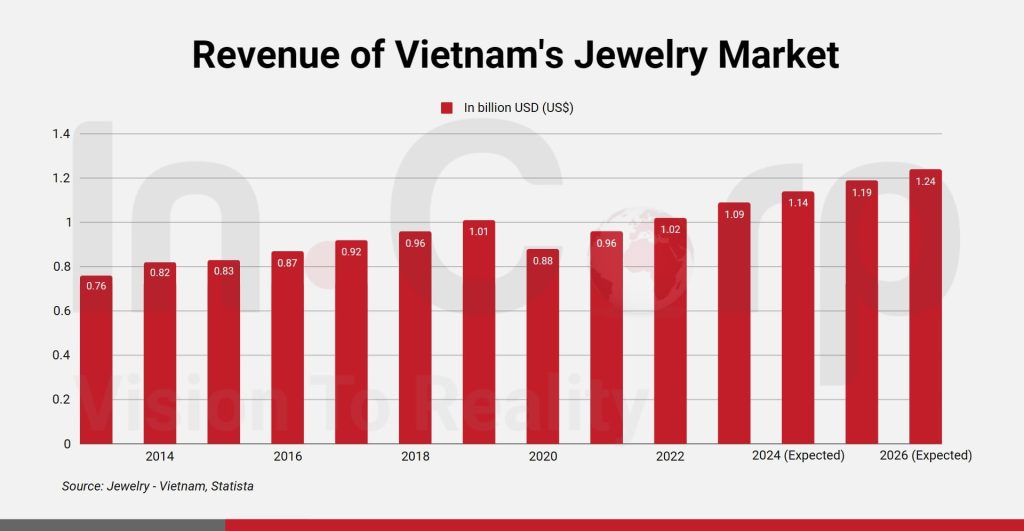
In 2022, the Jewelry segment has generally recovered and generated US$1.02 billion in revenue. Moreover, the market is anticipated to expand by 5.02% yearly (CAGR 2022-2026). It is further believed that from 2022, non-luxury jewelry will account for 84% of sales.
Recent Trends in the Jewelry Market
The number of businesses trading in jewelry was nearly 8,000 in 2015; by the end of 2022, this figure has risen to 10,000. Yet, only around ten homegrown brands have become household names.
Vietnamese enterprises are facing pressure due to the presence of well-known international high-end jewelry brands. Local companies are in a radically inferior position to foreign brands in shopping centers like Diamond, Parkson, and Zen Plaza.
Foreign jewelry brands mostly distribute their products through shopping malls and solely target the high-end market, whereas most Vietnamese companies only have tiny retail storefronts. Without enough brand awareness, they cannot establish themselves in malls. However, they are deeply aware of the domestic market and manufacture products that are more in line with consumer preferences. Hence, economists think Vietnam’s gold and jewelry business has much unrealized potential.
The COVID-19 pandemic has caused the jewelry sector to struggle during the last three years. According to statistics, the consumption of jewelry in Vietnam was 7.9 tons in 2020, down 41.45% from what it was in 2019.
Keeping in line with the global decline, the Vietnamese market is contracting, but it is doing relatively better than several other nations in Southeast Asia, including Indonesia, Singapore, and Thailand.
Supply Constraints & Gold Demand (2025-2026)
Vietnam was the only Southeast Asian country to record a drop in gold bar and coin sales in 2025 – volumes fell 14% year-on-year to 36.1 metric tons, according to the World Gold Council. The country’s gold trading contracted for the sixth straight quarter in Q4 2025, hitting a five-year low.
The reason: a shortage of gold bars and 24K gold rings pushed domestic gold prices to a premium of over US$550 per ounce above international prices. Despite strong underlying demand, physical consumption has been limited.
Encouragingly, gold jewelry manufacturing demand climbed to a record US$472 million in Q1 2026, as the bullion shortage pushed investors toward jewelry as a store of value. Geopolitical tensions will continue to drive demand for jewelry manufacturing output through 2026 and beyond.
Why Vietnamese Consumers Love Jewelry
A World Gold Council survey found that Vietnam is among the top 10 gold‑consuming markets globally and the largest in Southeast Asia. More than 80% of gold buyers in 2021 said they would buy more in the future – much higher than the 45% global average.
Investors see gold as protection against inflation and currency volatility. The country’s financial growth will further expand the gold market and boost jewelry manufacturing demand.
High appreciation for durability
According to a survey of consumers, product durability is the key consideration when it comes to making decisions related to buying jewelry. Consumers are being more careful when picking jewelry materials and are prepared to pay high prices if they believe the jewelry pieces to be durable.
By 2021, Vietnam’s per capita GDP had already surpassed US$3,700. The demand for gold and silver will rise exponentially as the number of middle-class individuals increases. Many consumers, particularly young ones, also need jewelry and accessories to express their style and personality. As a result, they have high standards for diversity, richness, and variation in designs, materials, and product categories. They are also constantly innovating and experimenting with new styles.
Price is the most significant decision-making element, accounting for approximately 23% of shopping decisions, according to a Q&Me study on fashion purchasing habits.
E-commerce to play a big role
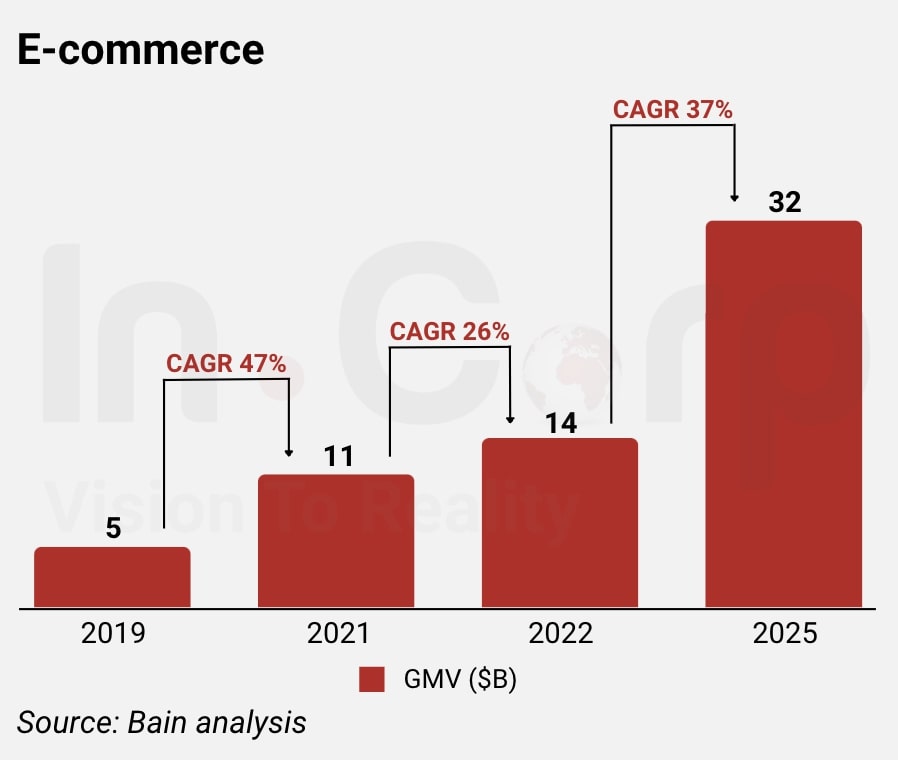
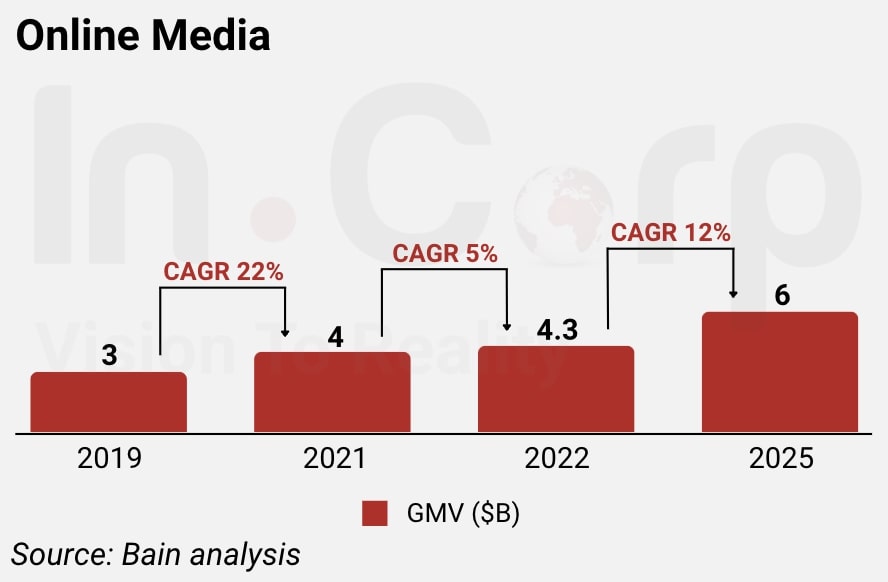
Vietnam’s digital economy has clocked US$23 billion in 2022 and is expected to double by 2025. Factors like booming e-commerce and the rise in the use of online media make Vietnam one of the fastest-growing economies in the SEA region.
Here are the past and projected compound annual growth rate (CAGR) for the e-commerce sector:
And for the value of online media:
Key Players in Jewelry Manufacturing
PNJP – The leading jewelry manufacturer in Vietnam
Phu Nhuan Jewelry Joint-Stock Company, which was founded in 1988, is one of the top jewelry makers in Vietnam and specializes in making gold and silver jewelry, as well as gemstones, fashion, and crafts. As the third-largest jewelry firm in the world and one of the Top 500 retailers in all of Asia, PNJ is dedicated to giving customers the best quality products at competitive prices.
Their factory can create up to 3 million pieces annually while maintaining a high level of quality thanks to 680 skilled staff and contemporary machinery from Germany and Italy. Its current export markets include the USA, Australia, Denmark, Germany, and France.
Website: https://export.pnj.com.vn/
Bien Bac Jewellery
Bien Bac Jewellery, one of the most prominent jewelry stores in Hoi An’s old town, opened its doors to the public in 1997. The business has constantly grown in popularity among its clients, including both locals and foreign tourists, year after year.
Bien Bac Jewellery aims to satisfy their customers’ expectations with their quick service for everything from purchasing in-store jewelry pieces, such as gold/silver bracelets and rings, to fulfilling any custom design demands, such as necklaces, earrings, pendants, bangles, and cufflinks.
Website: http://bbjewellery-hoian.com/
Handmade Buffalo Horn Jewelry
The company is a manufacturer and exporter of environmentally friendly handcrafted home decor and fashion accessories in Vietnam. The product line includes a wide variety of handmade jewelry suitable for both everyday wear and special occasions, including necklaces, bracelets, earrings, rings, pendants, hair accessories, spoons, forks, and more.
Website: https://vietnamhornjewelry.com/
Saigon Jewelry and Accessories Company (SAJA)
The company specializes in precious gems, feng shui crystals, silver jewelry with gems, and unique handmade products. On top of manufacturing, it also handles imports and wholesale, and has expanded its reach to overseas markets and its products are now available in key countries in North America, Europe, Asia-Pacific, and Australia.
Website: https://saja.trustpass.alibaba.com/
Ant Jewelry
A Vietnamese company that deals in wholesale fashion jewelry. Moreover, they manufacture and export a wide range of sterling silver and gold diamond jewelry. Their vision is to become a market leader in Vietnam that specializes in silver and platinum jewelry.
Vietnam International Jewelry Fair
The Vietnam International Jewelry Fair is a premier event in the jewelry industry, offering a platform for manufacturers, wholesalers, and retailers to showcase their latest designs and collections. With a diverse range of exhibitors from around the world, this fair is a great resource for businesses looking to connect with new manufacturers and expand their network in the industry.
Website: International Jewelry + Watch Vietnam (IJV) Official Website

clients worldwide

professional staff

incorporated entities in 10 years

compliance transactions yearly
Learn the Right Setup for Business
Expansion in the Vietnam
Frequently Asked Questions
What is a jewellery manufacturer?
- A jewellery manufacturer is a company or individual that designs, produces, and assembles jewellery items such as rings, necklaces, bracelets, and earrings. They may operate using various materials, including precious metals and gemstones, and often supply retailers, wholesalers, or consumers directly.
What is the process of jewelry manufacturing?
- The jewelry manufacturing process typically involves several key steps: designing, prototyping, casting, assembly, polishing, and finishing. It starts with a design (hand-drawn or CAD), followed by creating a wax model or 3D print for casting. The piece is then cast in metal using the lost-wax casting method, assembled if needed, and polished. Gemstones, if any, are set before the final cleaning and quality check.
What Jewelry Is Vietnam Known For
- Vietnam is known for its intricate gold jewelry, particularly 24k gold pieces, and traditional handcrafted silver jewelry. Ethnic minority groups also create distinctive jewelry using silver and natural materials, reflecting their cultural heritage.
What is a joint venture and an example?
- A joint venture (JV) is a business arrangement where two or more parties collaborate by contributing resources to form a new entity, sharing ownership, control, profits, and risks. For example, in Vietnam, a common JV structure involves a Vietnamese company partnering with a foreign investor to establish a new company to operate in sectors like telecommunications or real estate, where foreign ownership may be restricted.