In March 2026, with the new Investment Law (No. 143/2025/QH15, effective 1 March 2026) streamlining approvals and the National E-commerce Development Master Plan (2026–2030) fully underway, we turn to the practical side: how international companies can actually enter and succeed using the right market entry modes.
Whether you’re exporting FMCG, beauty products, packaged foods, health supplements, consumer electronics, or preparing for manufacturing and regulated sectors (pharma, mobility), choosing the correct market entry mode is critical.
This expanded 2026 guide delivers actionable, step-by-step advice: the three dominant market entry modes with real setup timelines and costs, detailed market research checklists, expanded feasibility steps, four pitfalls with avoidance frameworks, and five long-term levers that turn entry into compounding 15–25% annual returns. We draw on 2025 data (e-commerce at ~US$32 billion, TikTok Shop at 41% share) and fresh regulatory realities to give you a playbook you can execute next quarter. Let’s dive in.
1. Market Entry Modes: Three Practical Doors for Foreign Firms
Executives ask, “How do we get into Vietnam?” The answer balances control, speed, cost, risk, and regulation. In 2026, three modes dominate. Start simple, layer control as volumes prove out.
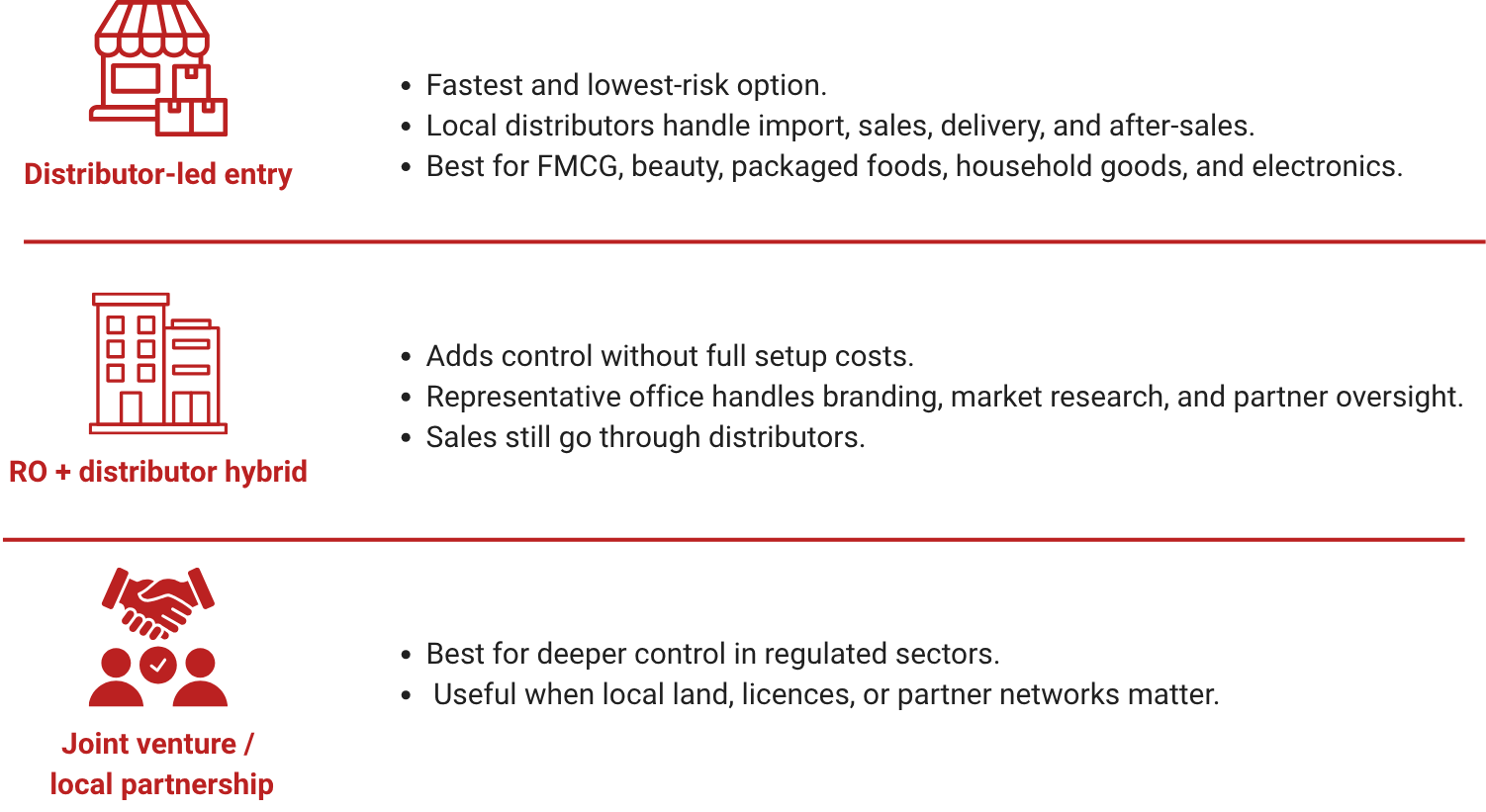
Distributor-Led Entry (Fastest, Lowest-Risk Door)
Appoint one or more Vietnamese distributors who import, stock, sell, and service on a buy-and-sell basis. They handle inventory, WinMart+ shelves, TikTok Shop/Shopee storefronts, last-mile delivery, and after-sales. You ship FOB; they clear customs and pocket the margin.
Why it works in 2026:
Traditional trade still drives 60–65% of FMCG volume (especially rural); modern trade (WinMart+, Go!, Aeon) is expanding but fragmented. WinMart+ hit 4,000 stores in 2025 and targets 1,000–1,500 new outlets in 2026, mostly rural mini-marts. E-commerce hit ~US$32 billion in 2025 (up 27% YoY) and is on track for strong double-digit growth in 2026; TikTok Shop and Shopee alone delivered US$16.3 billion (41% and 56% platform share respectively), capturing nearly 8% of total retail.
Practical execution steps:
- Shortlist 3–5 distributors via AmCham, EuroCham, or VCCI directories + trade fairs (Vietfood, Beauty Vietnam).
- Run 3-month pilot: 1–2 SKUs, defined territory, KPI dashboard (sales targets, sell-through, returns <5%).
- Contract essentials: exclusivity (or non-compete in category), payment terms (30–60 days), minimum order quantities, performance clauses (terminate with 90 days notice if <80% target), IP protection clause. Typical margins: 25–40% for beauty/FMCG; lower for electronics.
Best suited for: FMCG, beauty, packaged foods, household goods, consumer electronics. Zero local entity needed — many brands hit US$5–10M revenue in Year 1 this way.
Hybrid Entry – Representative Office + Distributor (Smart Control Layer)
Set up a Representative Office (RO) for branding, market intel, and compliance oversight while routing sales through distributors. RO cannot sell or invoice but can hire staff, run research, support marketing, and monitor partners.
2026 reality: RO setup takes ~15 working days via Department of Industry and Trade (DOIT). Documents: parent company papers (legalised), audited statements, chief rep passport, office lease. No corporate income tax (only payroll/PIT). Annual report due 30 Jan. Cost: ~US$18,000–20,000 all-in (legal + office).
Upgrade path: When volumes hit ~US$2–3M, convert RO to 100% foreign-owned LLC (total 2–4 months: Investment Registration Certificate 15–45 days + Enterprise Registration Certificate 5 days). Charter capital flexible (often US$15,000–50,000 for trading); must contribute within 90 days. Add Trading License + Retail Outlet License for direct import/distribution (easier now for CPTPP/EVFTA treaty investors).
Best suited for: Premium beauty, health supplements, higher-spec electronics. Gives you data visibility (POS reports, consumer feedback) without full overhead.
Joint Venture (JV) / Local Partnership (Deep Control for Regulated Plays)
Co-own a Vietnamese LLC (usually 49–51% local for restricted lines) or form Equity JV/Business Cooperation Contract. Ideal when you need local land, manufacturing licences, or regulatory navigation.
Practical setup: Same IRC/ERC process as WFOE but add partner due diligence and JV agreement (governance, exit rights, dividend policy). Timelines 3–6 months if conditional sector approval needed. New Investment Law 2026 clarifies transitional rules and preferential access.
Best suited for: Manufacturing (semiconductors, automation), large-scale distribution, pharma, mobility. Industrial land costs are rising 10–15% YoY — JV partners often bring ready sites.
Bottom line 2026 playbook: Begin with distributor-led for proof-of-concept (3–6 months to revenue). Layer RO hybrid once you need intel and control. Move to JV only when regulations or capex demand it. These three modes cover 95% of foreign success stories.
Validate your Vietnam entry fast. Book a free 30-minute call for a custom demand map, logistics model, and 3 vetted distributors — tailored to your category. No obligation.
2. Market Research & Feasibility: Validate Before You Commit
No mode survives without validation. Run these three gates in parallel over 8–12 weeks.
A) Demand & Channel Mapping
Map your category across traditional (wet markets, mom-and-pop ~60%+), modern (WinMart+ etc.), and e-commerce (TikTok Shop live-selling exploding for beauty/FMCG).
Practical checklist:
- Buy VECOM or NielsenIQ reports + run 200–300 consumer surveys (Google Forms + local agency ~US$3,000).
- Pilot test 1 SKU on TikTok Shop via distributor (track conversion 2–5% typical).
- Define “entry wedge”: one buyer type, one use case, one channel. Output: validated pricing (test US$1.50–3.00 pack sizes for mass market), positioning statement, non-target segments.
B) Logistics Feasibility & Cost Modelling
Warehousing + last-mile can eat 8–12% of revenue if ignored.
Model it:
- Import duties (0–20% depending on HS code; 0% under EVFTA for many).
- VAT 10%, customs clearance 3–7 days at Cat Lai/Hanoi ports.
- Warehousing: HCMC Class B ~US$0.60–1.00/m²/month; cold chain +20%.
- Last-mile: TikTok Shop/Grab integration ~US$1–2/order; rural traditional trade + distributor margin. Run Excel landed-cost model + sensitivity (fuel +10%, delay 30 days). Output: break-even volume and buffer stock policy.
C) Partner Landscape & Conflict Checks
Shortlist 5–8, then due diligence.
Checklist:
- Financials (last 3 years, credit report), references (3 clients), site visit (warehouse, sales team).
- Conflict scan: do they carry competitors? Territory overlap?
- Governance test: signed NDA + 3-month pilot with weekly reporting. Output: ranked partner scorecard + red-flag list.
A rigorous feasibility study (US$10,000–25,000 via local consultant) cuts failure risk by 70%.
3. Common Pitfalls to Avoid When Implementing Market Entry Modes
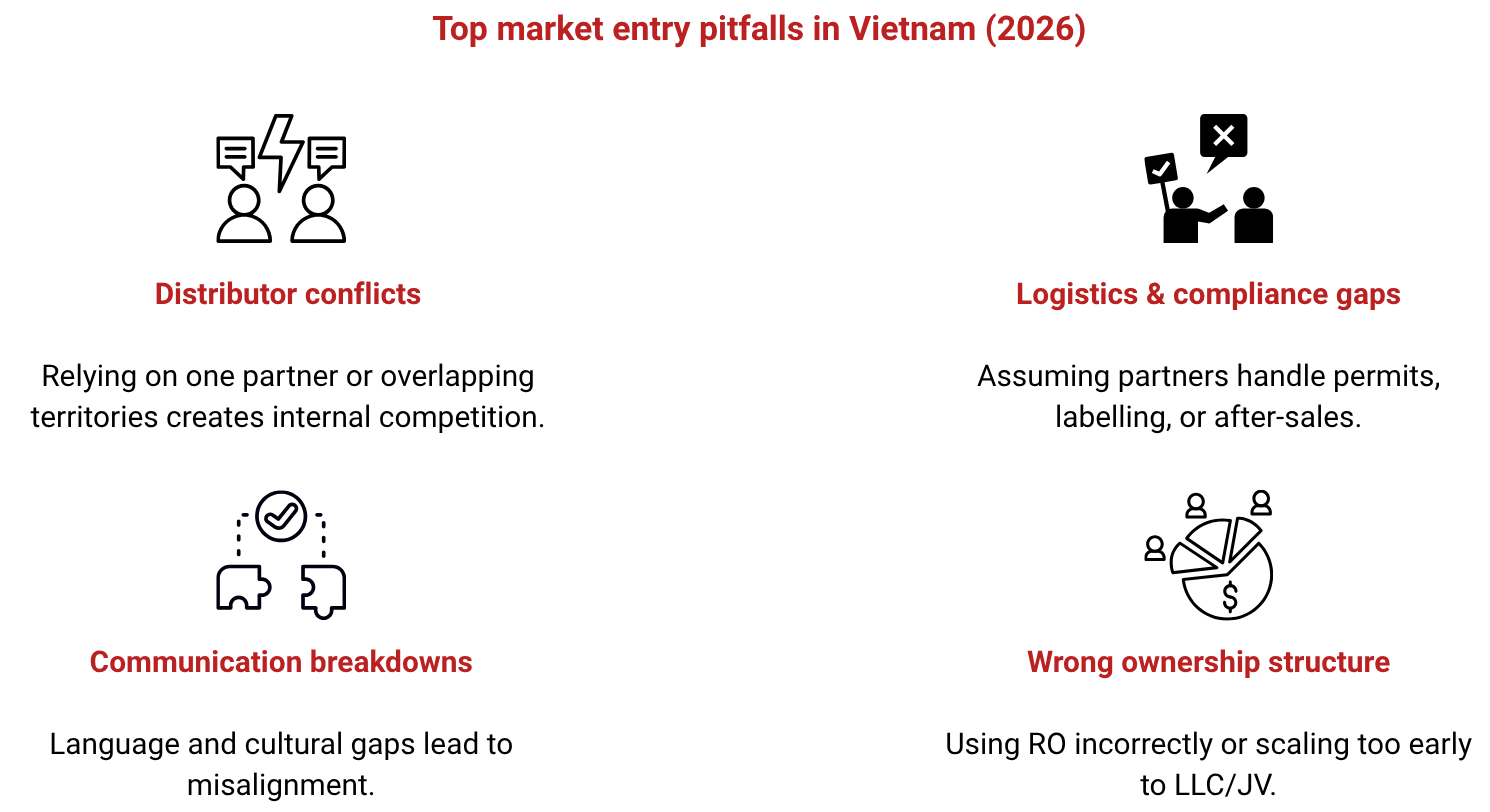
Even seasoned players stumble. Here are the top four — with 2026 avoidance frameworks.
Pitfall 1: Distributor Portfolio Conflicts (Hits Distributor & Hybrid Modes)
Relying on one partner or allowing territorial overlap leads to channel conflict and lost sales.
Why it kills: Single point of failure; hidden competition surfaces after US$500k inventory.
Avoidance: Never grant early exclusivity. Run parallel pilots with 2–3 distributors. Include KPI clauses (sell-through >80%, reporting weekly), clear territory maps, and 90-day exit rights. Conduct annual conflict audits.
Pitfall 2: Under-scoping Logistics & Compliance (Affects All Modes)
Assuming partners own all permits, labelling, cold-chain, or after-sales — then shipments stall at customs.
Real risk: Products rejected, inventory unusable, trust broken.
Avoidance: Own compliance from Day 1. Map every requirement (food safety certificate, cosmetic notification, warranty rules) before first shipment. Document responsibility split in contract. Budget 5–10% contingency for delays. Test with one small container first.
Pitfall 3: Communication Gaps
Language and cultural differences cause misaligned expectations on targets, quality, or payments.
Avoidance: Hire a bilingual key account manager. Schedule weekly video calls plus written summaries in both languages. Define escalation paths in the contract and conduct cross-cultural training for your team.
Pitfall 4: Ignoring Ownership & Structure Limits (Critical for Hybrid & JV)
Using RO for sales (illegal) or jumping to full LLC too early before demand is proven.
Avoidance: RO only for research/promotion (15-day setup, no invoicing). Trigger LLC/JV only after repeatable sales and clear need for local invoicing/hiring. Under new Investment Law 2026, confirm sector conditions upfront via DOIT pre-check. Never use nominee structures — zero legal protection.
Set up your RO, 100% LLC, or JV under the 2026 Investment Law in 15–45 days. Fixed-price quote + trusted partner intros in one call. Zero hidden fees.
4. Key Considerations for Long-Term Success with Your Market Entry Modes
Vietnam rewards patience and localisation. Five priorities:
A) Invest in Local Relationships Join AmCham/EuroCham, attend monthly mixers, host distributor dinners. One warm introduction beats 100 cold calls. Budget 5% of revenue for relationship-building in Year 2–3.
B) Build Vietnam-Specific Talent Start with 1–2 expats + local sales/marketing team (VietnamWorks recruitment). Train on brand standards but empower locals for TikTok creativity and consumer insight. Local GM by Year 3 typically lifts performance 30%.
C) Plan for Regulatory Evolution New E-commerce Law and Master Plan 2026–2030 bring stricter platform rules and taxation clarity. Schedule annual legal health-check (Q4). Priority sectors (semiconductors, AI) still enjoy 10–15% CIT incentives + land rent exemptions — factor into your 5-year model.
D) Embrace Local Innovation Adapt packaging (smaller SKUs, Vietnamese labelling), flavours (less sweet, more umami), and marketing (livestream + KOLs on TikTok). Successful brands localise 20–30% of SKUs within 18 months.
E) Choose Partners Who Can Scale Write contracts with milestone triggers: at US$5M move from 2 distributors to dedicated key-account team; at US$10M consider own warehousing. Include equity option or acquisition right for top performers.
Closing: Your 2026 Vietnam Playbook for Market Entry Modes
Vietnam’s 2026 market — retail ~US$269 billion, e-commerce surging under the new Master Plan — offers enormous opportunity. A capable distributor-led mode (or hybrid with RO) remains the fastest, safest route for most international companies in FMCG, beauty, and electronics. Joint venture modes become relevant when manufacturing or regulated control is required.
Success always starts with thorough research and feasibility before selecting your mode, rigorous partner governance, and awareness of the four pitfalls above. Vietnam’s investment promotion agencies (MPI, DOIT), business chambers, and specialist consultants are excellent starting points — they can connect you with vetted distributors and fast-track RO/LLC setup.
The companies that invest wisely in their market entry modes today — starting lean, validating fast, localising smart — will enjoy stable, compounding returns for years to come. The window is open wider than ever in 2026.
Learn the Right Setup for Business
Expansion in the Vietnam
Frequently Asked Questions
Which market entry mode should I choose for FMCG or beauty products?
- Start with Distributor-Led Entry. It requires zero local entity, leverages TikTok Shop and WinMart+ networks, and lets many brands reach US$5–10M revenue in Year 1 with minimal risk.
How long and how much does it cost to set up a Representative Office?
- Only 15 working days and ~US$18,000–20,000 all-in (legal fees + office lease). No corporate income tax, and it gives you branding, market intelligence, and compliance oversight immediately.
Do I need a Vietnamese partner right from the beginning?
- No. Pure distributor or hybrid (RO + distributor) works perfectly for trading businesses. Only consider a Joint Venture when you need local land, manufacturing licences, or operate in restricted sectors like pharma or semiconductors.
What’s the biggest mistake foreign companies make in Vietnam in 2026?
- Under-scoping logistics/compliance or rushing into full ownership before proving repeatable sales. Always own the compliance checklist yourself, test with one small shipment, and trigger any entity upgrade only after clear demand.