What is a Nominee Director, and Why Do Investors Need One?
A nominee director is typically a local Vietnamese individual (or entity) appointed to act as the legal representative or director of a company on behalf of the actual investor. In essence, the nominee’s name appears on official company documents and licenses, but they do not truly control or benefit from the business – those rights belong to the foreign or hidden investor (the beneficial owner). The nominee director fulfills statutory requirements (like the need for a resident local director) and handles formalities, while the real investor makes the strategic decisions and owns the economic interests.
Setting up a business in Vietnam? Check out InCorp Vietnam’s Incorporation Services in Vietnam
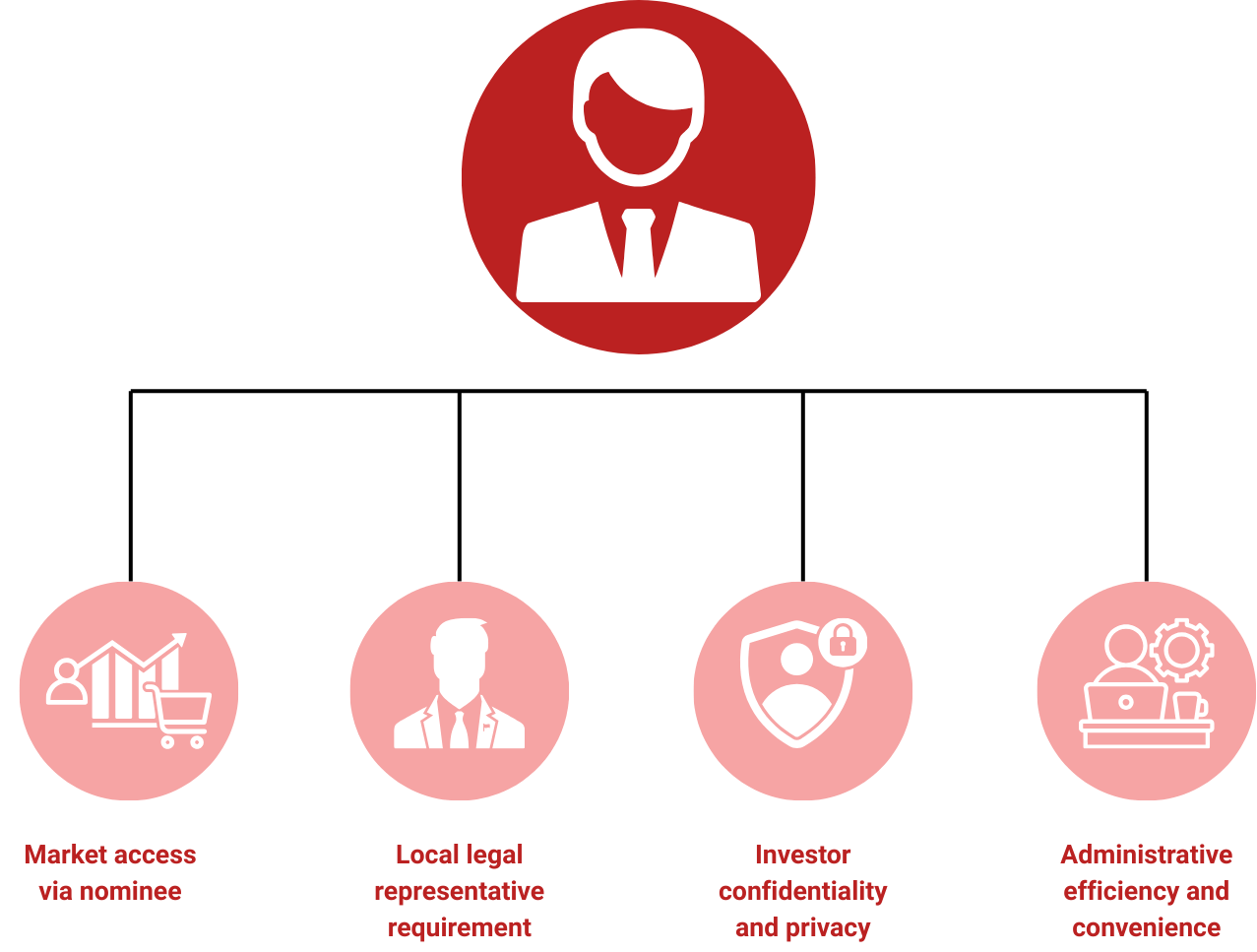
Why would an investor require a nominee director in Vietnam? There are several practical reasons:
- Market Access Restrictions: Vietnam restricts or prohibits foreign ownership in certain “conditional” business sectors (e.g. advertising, logistics, real estate, national security-related areas). By using a nominee structure, a foreign investor can access a sector that they otherwise could not, by having a Vietnamese nominee formally hold shares or directorship on their behalf. The nominee director arrangement essentially allows compliance with the letter of local ownership rules while the foreigner funds and controls the venture behind the scenes.
- Local Presence Requirements: Vietnamese law mandates that every company must have at least one legal representative who resides in Vietnam. If a foreign investor does not have a trusted person on the ground, a nominee director service provides a local resident director to satisfy this requirement and handle day-to-day local administrative duties. For instance, a nominee director can sign documents, open bank accounts, and liaise with authorities on the company’s behalf without delay.
- Confidentiality and Anonymity: Many investors prefer not to publicly disclose their involvement in a Vietnamese company. A nominee director helps shield the true investor’s identity on public records. The company’s incorporation documents and business registration will show the nominee’s name as director/shareholder, keeping the beneficial owner’s name off easily accessible registries. This can be useful to maintain privacy from competitors or the general public.
- Administrative Convenience: Using a nominee can simplify bureaucratic processes. The nominee director, being a local, is familiar with Vietnamese administrative procedures and language, which can streamline compliance (e.g. obtaining licenses, permits, submitting reports). The foreign investor can focus on funding and strategy, while the nominee handles on-the-ground paperwork under the investor’s instructions.
It’s important to note that a nominee director is usually bound by a private agreement or power of attorney to act only per the beneficial owner’s directions. Proper legal contracts (often prepared by corporate service firms or lawyers) ensure the nominee cannot act against the investor’s interests. In a well-structured nominee arrangement, the nominee serves a non-executive, figurehead role, and all real control stays with the investor (beneficial owner).
However, while nominee director arrangements offer convenience and access, they exist in a legal gray area in Vietnam. Historically, Vietnamese law did not explicitly recognize trusts or nominee ownership the way some other countries do. This means such arrangements must be handled cautiously to avoid violating any laws. Next, we will examine the recent legal updates in Vietnam that directly impact the use of nominee directors.
Recent Laws and Regulatory Updates Impacting Nominee Directors
Vietnam’s government has introduced several major legal reforms between 2023 and 2025 that tighten the rules on transparency and the use of nominees in business. These changes were driven in part by international pressure to combat money laundering and “disguised” investments, as well as Vietnam’s own efforts to ensure foreign investment compliance. Below are the key updates investors must be aware of:
Between 2023 and 2025, Vietnam introduced major legal reforms to tighten transparency and restrict disguised nominee arrangements, driven by anti–money laundering pressure and foreign investment compliance goals.
The Law on Investment 2020 already allowed authorities to revoke investment certificates if nominees are used to bypass foreign ownership caps. In recent years, enforcement has intensified, with projects terminated for using local nominees to disguise foreign control.
The Law on Anti-Money Laundering 2022, effective from 2023, formally introduced the concept of a “beneficial owner,” acknowledging risks from hidden ownership structures. However, enforcement remained limited until international pressure escalated.
In June 2023, Vietnam was placed on the FATF grey list due to weak beneficial ownership transparency. This created strong pressure for immediate reform, as grey-listing directly affects banking, cross-border transactions, and investor confidence.
As a direct response, the Amended Law on Enterprises 2025 and Decree 168/2025, effective from 1 July 2025, now require all companies to disclose their ultimate beneficial owners (UBOs). Any individual owning or controlling 25% or more of capital or voting rights, or exercising actual control through agreements, must be declared, even if hidden behind a nominee. Companies must update changes within 10 days and retain UBO records for at least five years after dissolution. Existing companies must also declare UBOs upon their next registration update. These rules directly pierce nominee director structures.
Enforcement has also strengthened. Authorities now have full access to beneficial ownership data, and banks are applying stricter due diligence on companies with nominee-style structures. Failure to declare real ownership can lead to fines, license revocation, and serious compliance consequences.
In short, nominee arrangements are no longer anonymous. While not outright illegal, any use of nominees to conceal ownership or bypass the law now carries significant legal risk for both the nominee and the real investor.
Practical Implications for Investors Under the New Nominee Director Regulations
In short, the new regulations demand that investors approach nominee director arrangements with much greater caution and transparency. Foreign investors can still invest in Vietnam confidently, but they must do so in compliance with these rules – often by seeking professional guidance. Local partners or nominees must also understand their enhanced responsibilities. In the next section, we detail the specific risks and legal exposures that arise if one continues to use nominee directors improperly under the new regime.
Under the new rules, anonymity is effectively gone. Foreign investors using nominee directors must now declare themselves as the ultimate beneficial owners to authorities. Even if the nominee’s name appears on public records, regulators and banks will know who truly controls the company. This makes “silent” ownership in restricted sectors no longer realistic.
Compliance requirements have increased for all companies. Businesses must now identify beneficial owners, update changes promptly, and submit proper declarations during incorporation and registration updates. Companies with layered ownership or old nominee structures will face heavier legal and administrative work, with real risks of fines or delays if they fail to comply.
For foreign investors in restricted sectors, the risk is significantly higher. Declaring beneficial ownership exposes any hidden foreign control and may trigger reviews under foreign ownership caps. Authorities can terminate projects deemed sham arrangements. As a result, many investors will need to shift toward joint ventures, formal approvals, or transparent fund structures instead of relying on nominees.
Local nominees are also under greater pressure. They can no longer guarantee secrecy and may face legal exposure if the arrangement is found improper. Informal nominee setups through friends or family are likely to decline, while professional corporate nominee services will operate under stricter controls.
Banks are tightening KYC and AML checks. Companies using nominees will be required to disclose beneficial owners for bank accounts and major transactions. Unclear money flows between “local” companies and foreign investors will raise red flags unless properly documented.
In summary, nominee arrangements now require full transparency and careful legal structuring. While investment in Vietnam remains viable, both foreign investors and local nominees must proceed with far greater caution under the new regime.
Risks and Legal Exposure of Using Nominee Directors Under New Regulations
Using a nominee director in Vietnam has always involved inherent risks due to the unofficial nature of the arrangement. With stricter laws now in place, these risks are significantly amplified. Both the actual investors and the nominee individuals face serious legal and financial exposure if these structures are not handled properly.
Invalid or unenforceable agreements: A major risk is that private nominee agreements may not be upheld under Vietnamese law. Courts often regard nominee arrangements as “sham transactions” created to conceal the true parties and may declare them null and void under the Civil Code. If a dispute occurs, such as a nominee refusing to return shares or attempting to seize the business, the court may void the agreement entirely. The foreign beneficial owner could then lose all legal claim to the company, as their ownership is not officially recognized. This risk existed even before recent reforms and remains fundamental.
Project termination and regulatory sanctions: If authorities determine that a nominee structure is being used to hide illegal foreign ownership, they may revoke the Investment Registration Certificate and terminate the project as a sham investment. Business operations would be forced to stop, and administrative fines may also apply for operating illegally in restricted sectors. Recent enforcement shows that regulators are increasingly targeting nominee structures, especially in conditional industries.
Loss of investment and assets: Because the nominee is the legal owner on record, they have the power to sell assets, transfer shares, or dissolve the company without the foreign investor’s consent. If trust breaks down, the investor may only pursue recovery through lengthy litigation. Courts may recognize the hidden investor only in unrestricted sectors, potentially ordering partial remedies.
However, in prohibited sectors, courts will not validate foreign ownership at all. In such cases, the investor may recover only their initial capital at best, but lose the business entirely. Under the new disclosure rules, failing to declare beneficial ownership violates the law, while declaring it in a prohibited sector exposes the project to termination. This creates a high-risk trap for investors.
Nominee misconduct or disputes: Nominees may exploit their legal position by demanding additional payments, blocking transactions, or seizing control of the company. Investors have very limited legal leverage in such disputes. Many past cases involved informal nominee arrangements through acquaintances, which often ended in extortion or business hostage situations.
Legal liability and penalties for investors: The new regime directly targets undisclosed beneficial owners. Investors who fail to report nominee arrangements now face administrative fines and potential criminal investigation if the conduct is viewed as intentional circumvention of investment laws. Serious violations may result in blacklisting, transaction blockages, or even entry restrictions into Vietnam. Reputational damage with banks and partners is also a significant consequence.
Full liability for nominee directors: Nominees remain fully responsible as legal representatives of the company. They are liable for debts, unpaid taxes, regulatory breaches, and even criminal violations. Nominees can no longer claim they were merely figureheads, as the law requires them to know and report actual controllers. If profits are informally transferred to foreign investors, tax authorities may treat those funds as the nominee’s personal income and demand back taxes and penalties.
Voidance of transactions and inability to enforce rights: If a nominee structure is declared invalid, related transactions, including property purchases and contracts, may also be voided. The beneficial owner may be left with no enforceable legal rights, even after investing substantial capital and building up the business.
In short, nominee director arrangements in Vietnam now carry heightened legal, financial, and criminal exposure. Both investors and nominees face severe consequences if these structures fail or are deemed unlawful under the tightened regulatory framework.
InCorp Vietnam’s Nominee Director Service: A Compliant Solution for Investors
Given the stricter regulatory climate, investors should not attempt DIY nominee arrangements or rely on informal agreements with friends. The safest path is to engage a professional corporate service firm that offers nominee director services in full compliance with Vietnamese law. InCorp Vietnam is one such reputable provider. By using InCorp Vietnam’s nominee director service, investors can enjoy the benefits of a nominee arrangement (local representation, convenience, privacy) while vastly reducing legal risks. Here’s how InCorp’s service addresses the concerns we’ve outlined:
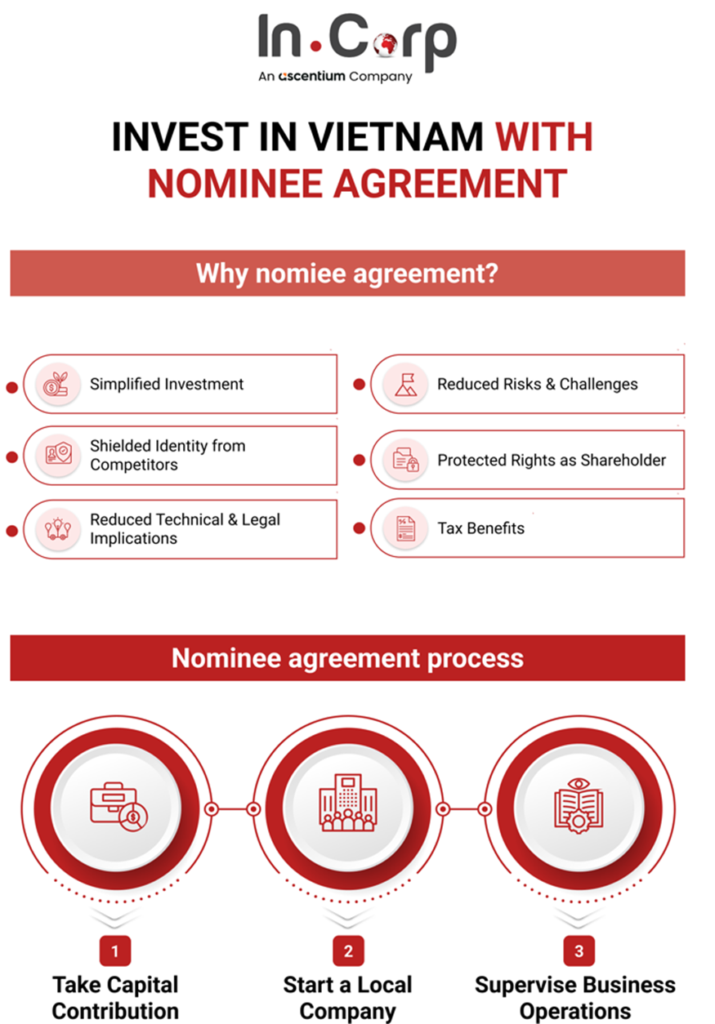
With InCorp Vietnam, nominee director arrangements are structured with full legal compliance from the start. The ultimate beneficial owner is properly declared to authorities in line with the 2025 Enterprise Law, eliminating the risk of hidden violations. InCorp also manages ongoing updates within the 10-day reporting window, ensuring the company remains fully compliant at all times.
At the same time, public confidentiality is preserved. The nominee’s name appears on public business records, while the beneficial owner’s identity is disclosed only to regulators and banks as required by law. This protects the investor’s market privacy while meeting transparency obligations. All client information is handled under strict confidentiality protocols.
Investor control is fully safeguarded through robust legal contracts. InCorp prepares legally binding nominee agreements, powers of attorney, and indemnities that ensure the nominee acts only under the investor’s written instructions. The nominee holds no ownership rights over assets and cannot make strategic decisions independently.
Risk is significantly reduced through professional accountability. InCorp’s nominees are trained professionals backed by a reputable corporate services group. Unlike informal nominee arrangements, this removes the danger of misconduct, extortion, or disappearance. Investors benefit from institutional reliability, indemnity coverage, and proven operational safeguards.
Strong local expertise ensures day-to-day compliance and administrative ease. InCorp’s nominee directors manage statutory filings, licensing communications, inspections, and government correspondence on the ground. This prevents missed deadlines, regulatory mistakes, and communication barriers with authorities and banks.
Finally, investment benefits are preserved without legal shortcuts. InCorp can structure compliant joint ventures, nominee shareholdings within legal limits, and lawful profit repatriation strategies. Investors still gain market access, local tax positioning, and licensing flexibility without violating ownership or AML rules.
In short, InCorp Vietnam transforms nominee director arrangements into a transparent, legally protected, and professionally managed solution, allowing investors to operate confidently under Vietnam’s new regulatory regime.
Learn the Right Setup for Business
Expansion in the Vietnam
Frequently Asked Questions
Is using a nominee director in Vietnam legal
- Using a nominee director is not illegal by itself, but it becomes unlawful if it is used to conceal the true owner, bypass foreign ownership restrictions, or violate AML and investment regulations.
Do I have to disclose the beneficial owner if I use a nominee director
- Yes. Under the 2025 Enterprise Law, all companies must declare their ultimate beneficial owners to the authorities, even if a nominee director is used.
Can a nominee director legally control my company
- No. A nominee director only acts as the legal representative on paper. With proper contracts, all strategic and economic control remains with the beneficial owner.
What is the safest way to use a nominee director in Vietnam
- The safest approach is to use a professional, licensed nominee director service that ensures full legal compliance, proper beneficial ownership disclosure, and strong legal protection for investor control.