More Vietnamese founders are looking at Hong Kong right now, and the reasons are pretty practical. It sits next to mainland China and the Greater Bay Area, its corporate tax rate tops out at 16.5%, and there’s no capital gains tax, no dividend withholding tax, and no VAT. If you want a holding company, an invoicing entity for international clients, or a foothold to sell into the Chinese market, Hong Kong does the job without much red tape.
But if you’re trying to set up a company in Hong Kong from Vietnam, there are really two processes running at once: the Hong Kong side, which is fast and foreigner-friendly, and the Vietnam side, which is stricter than most people expect. Miss the second one and you can end up with a perfectly legal Hong Kong company that you’re not actually allowed to fund from Vietnam. This guide walks through both. For broader context on what running the Vietnam side of things involves, see our rundown of common challenges doing business in Vietnam.
Why Hong Kong Makes Sense as a Base?
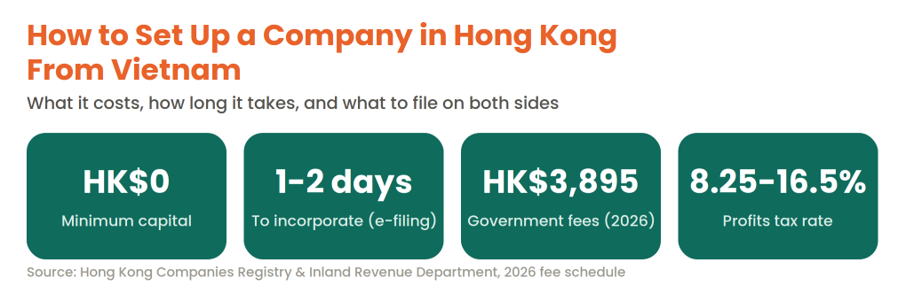
Hong Kong allows 100% foreign ownership of a private limited company, with no requirement that any director, shareholder, or manager be a Hong Kong resident. There’s no statutory minimum paid-up capital either, so a company can technically be capitalized with as little as HK$1. Combine that with the tax treatment, and it’s easy to see why Hong Kong keeps showing up on shortlists for Vietnamese exporters, e-commerce sellers, and tech companies that need an international-facing entity. If you’re weighing it against simply expanding your existing Vietnamese entity instead, our guide to company incorporation in Vietnam covers what that alternative looks like.
The tradeoff is that “no local presence required” doesn’t mean “no local obligations.” Every Hong Kong company still needs a company secretary and a registered office address inside Hong Kong, and those two requirements shape a lot of what happens next.
If you’re planning to set up a company in Hong Kong from Vietnam, it’s worth talking to the Ascentium Vietnam team before you file anything.
What You Need Before You Start?
Before you can set up a company in Hong Kong from Vietnam, gather the basics:
- Certified copies of passports or company documents for every director, shareholder, and beneficial owner, for know-your-customer checks.
- A proposed company name, checked against the Companies Registry’s name search to confirm it isn’t taken or too similar to an existing one
- At least one director and one shareholder (they can be the same person, and either can be a Vietnamese individual or a Vietnamese company)
- A Hong Kong company secretary, either a Hong Kong resident individual or a licensed Trust or Company Service Provider (TCSP) firm, since a sole director cannot also serve as company secretary
- A registered office address in Hong Kong (a PO box will not satisfy this requirement)
Read Related: Business Process Outsourcing (BPO) in Vietnam: Key Contracts and Agreements in 2026
Step 1: Incorporate the Company in Hong Kong
The actual filing happens with two government bodies. First, you submit Form NNC1 along with the Articles of Association to the Companies Registry, which issues the Certificate of Incorporation. Filed electronically through the e-Registry portal, a straightforward application can be approved within a day or two; paper filings typically take about five working days.
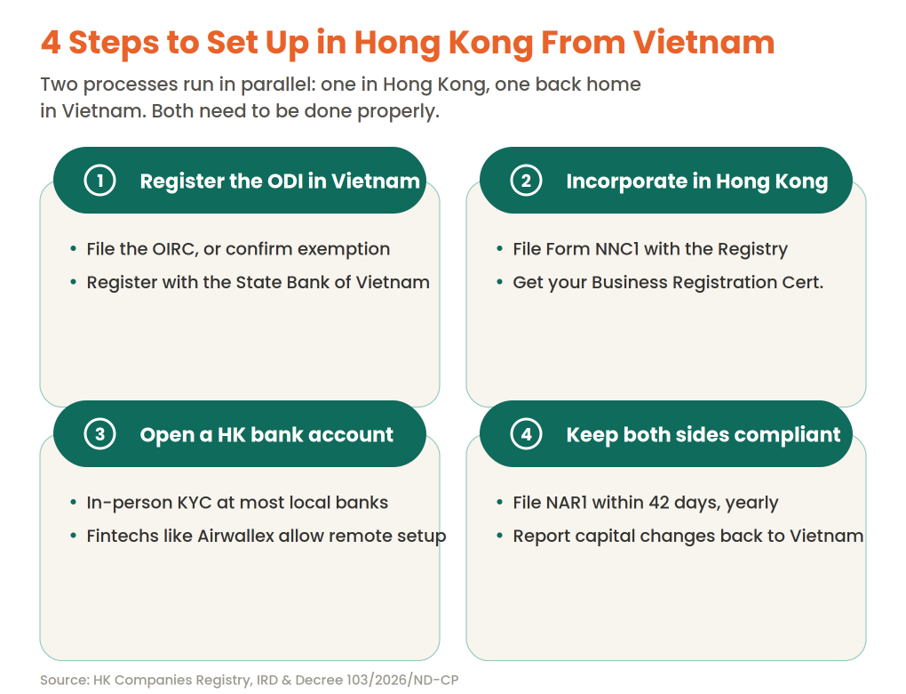
Second, within one month of incorporation you need a Business Registration Certificate from the Inland Revenue Department. In practice, most incorporation agents file both at the same time, so you walk away with both certificates together rather than waiting twice.
This is the part of the process that genuinely doesn’t require you to set foot in Hong Kong. Most Vietnamese founders complete it entirely online, working through Ascentium Vietnam (formely InCorp Vietnam), which coordinates a local Hong Kong company secretarial firm on your behalf to handle the registered office and the filings.
Need help coordinating both sides at once? Ascentium Vietnam works directly with Ascentium’s Hong Kong incorporation team, so the Hong Kong filing and the Vietnam-side registration happen in parallel instead of stalling on each other.
Step 2: Register the Outbound Investment Back in Vietnam
This is the step people skip, and it’s the one that causes the most trouble later. Any capital that a Vietnamese individual or company sends abroad to fund a foreign entity, including a Hong Kong company, falls under Vietnam’s outbound investment rules. Since April 2026, this is governed by Decree 103/2026/ND-CP, which replaced the older Decree 31/2021 framework.
In most cases, you need an Outbound Investment Registration Certificate, sometimes referred to as an OIRC, before any money leaves Vietnam. There’s a narrower path for smaller deals: projects under roughly VND 7 billion (about US$280,000) in non-conditional business sectors are now exempt from the OIRC requirement, though the project still has to be declared on Vietnam’s National Information System on Overseas Investment.
Getting the OIRC, or confirming the exemption, is only half of it. You also need to register the foreign exchange transaction with the State Bank of Vietnam and open an Overseas Investment Capital Account at a licensed Vietnamese bank. Capital sent abroad has to move through that account to be considered a lawful remittance. Skip this step and you’re not just risking paperwork headaches. Regulators can freeze future transfers, fine the investor, and in serious cases treat unauthorized capital flight as a criminal matter.
If your Hong Kong entity is genuinely small, it’s worth double-checking whether you qualify for the OIRC exemption under the new tiered approval regime introduced by Decree 103. It can save weeks of processing time, but the exemption is narrower than founders often assume, so it’s worth getting a market entry and structuring review before assuming you’re covered.
If you’re also weighing whether a Vietnamese entity makes more sense than, or alongside, a Hong Kong one, our guide to company incorporation in Vietnam walks through that process end to end.
What It Costs and How Long It Takes
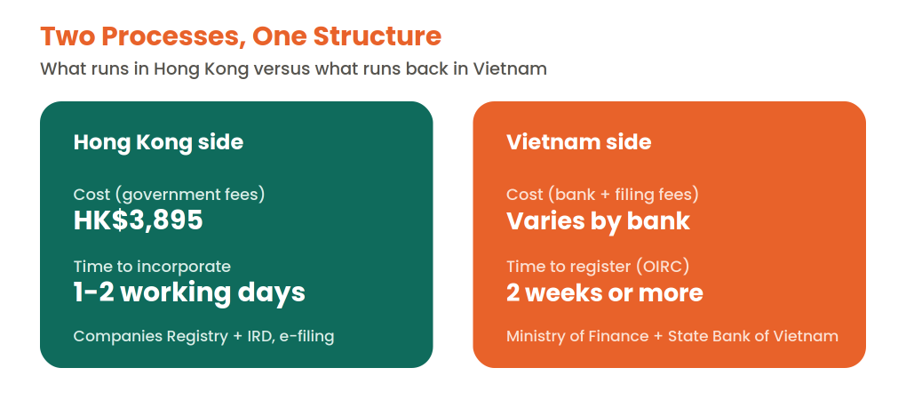
On the Hong Kong side, government fees for electronic incorporation with a one-year Business Registration Certificate currently total HK$3,895, made up of HK$1,545 for the Certificate of Incorporation and HK$2,350 for the BRC. Paper filing costs slightly more. Add a company secretarial and registered office package, and total setup costs from a service provider usually land somewhere between US$800 and US$2,000, depending on how much handholding you need. If you’re also setting up staff or payroll in Vietnam around the same time, our HR outsourcing guide for Vietnam covers the equivalent costs and timelines there.
Timing-wise, the Hong Kong incorporation itself is the fast part: a day or two once your documents are in order. The Vietnam side is the variable. If you qualify for the OIRC exemption, the process is mostly a declaration and a bank registration, often wrapped up within a couple of weeks. If you need a full OIRC, expect a longer review, since the Ministry of Finance now handles these applications under the post-April 2026 framework rather than the provincial authorities that used to be involved.
Staying Compliant After You’re Set Up
Setting up a company in Hong Kong from Vietnam is the easy half. Keeping it compliant on both ends is the part that trips people up a year or two in.
On the Hong Kong side, every company has six recurring obligations: filing the Annual Return (Form NAR1) within 42 days of each incorporation anniversary, renewing the Business Registration Certificate, filing a Profits Tax Return, maintaining audited financial statements, keeping the Significant Controllers Register current, and holding an Annual General Meeting. Only profits that actually arise in or are derived from Hong Kong are taxable, so genuinely offshore businesses can claim an exemption, but the rules around what counts as foreign-sourced income have tightened in recent years and need to be substantiated carefully.
On the Vietnam side, any changes to the outbound investment, additional capital injections, profit repatriation, or eventual closure of the Hong Kong entity generally need to be reported back to Vietnamese authorities too. Most founders handle this through the same accounting and tax team that manages their Vietnamese entity, and our 2026 guide to outsourcing accounting services in Vietnam explains how that reporting typically works alongside the ODI filing. Treating the Vietnam registration as a one-time formality is one of the more expensive mistakes founders make.
The Bottom Line on Setting Up a Company in Hong Kong From Vietnam
If you only look at the Hong Kong side, setting up a company in Hong Kong from Vietnam looks almost too easy: no minimum capital, no residency requirement, incorporation in a day or two. That’s genuinely true, and it’s why so many Vietnamese businesses use Hong Kong as their international entity of choice.
The part worth taking seriously is the Vietnam side. The outbound investment rules exist specifically to track capital leaving the country, and Decree 103/2026 has made the process more structured, not less. Getting the OIRC question right before you transfer a single dong is what separates a clean, bankable Hong Kong structure from one that causes problems the moment a bank or regulator asks where the capital came from.
How Ascentium Vietnam (formely InCorp Vietnam) Can Help?
This is exactly the kind of cross-border paperwork that’s easy to get wrong the first time, mostly because the Hong Kong side and the Vietnam side are handled by different regulators who don’t talk to each other. Ascentium Vietnam (formely InCorp Vietnam) coordinates both halves for you: it manages the outbound investment registration, State Bank filing, and ongoing accounting and tax reporting on the Vietnam side, while working directly with Ascentium Hong Kong (formely InCorp Hong Kong) incorporation team to get the entity set up on the other end, so you’re dealing with one point of contact instead of stitching two providers together yourself.
Ascentium Vietnam (formerly InCorp Vietnam) is a trusted partner for foreign investors, providing comprehensive corporate advisory and outsourcing solutions across Vietnam and Asia. As part of Ascentium Group, we focus on providing transparent and reliable services to overseas clients in Vietnam and Asia.
If you’re planning to set up a company in Hong Kong from Vietnam, it’s worth talking to the Ascentium Vietnam team before you file anything. A short structuring call upfront is a lot cheaper than fixing a compliance gap a year later.
Learn the Right Setup for Business
Expansion in the Vietnam
Frequently Asked Questions
Can a Vietnamese citizen own 100% of a Hong Kong company?
- Yes. Hong Kong places no restriction on the nationality or residency of directors or shareholders, and allows 100% foreign ownership of a private limited company.
Do I need to visit Hong Kong to incorporate a company there?
- No. Most Vietnamese founders complete the entire incorporation process online through a local company secretarial firm, without ever setting foot in Hong Kong.
Do I still need approval from Vietnam if I'm only incorporating in Hong Kong?
- Yes, if you plan to fund the Hong Kong company with capital from Vietnam. Any outbound transfer generally requires an Outbound Investment Registration Certificate (OIRC) under Decree 103/2026, unless your project qualifies for the under-VND-7-billion exemption.
How much does it cost to set up and maintain a Hong Kong company?
- Government incorporation fees total about HK$3,895 for the first year. After that, expect annual costs for the Business Registration Certificate renewal, the Annual Return filing, and company secretarial and registered office services.