Vietnam’s dynamic economy and welcoming culture make it an increasingly attractive destination for foreign professionals and investors. In recent years, foreign direct investment (FDI) into Vietnam has surged – for example, early 2024 saw a 38.6% increase in FDI, with new projects up 55.5%. Major multinationals (such as Chinese firms) are expanding in high-tech, electronics, and automotive sectors, driving a “surge” in demand for skilled manufacturing personnel.
Despite this rapid growth, Vietnam’s expat population remains relatively low compared to neighbors, offering newcomers unique cultural immersion and career opportunity. Vietnamese society is also famously hospitable: in the 2023 InterNations Expat Insider survey, 83% of respondents rated local friendliness positively, placing Vietnam 9th worldwide for welcoming attitudes. Lower living costs, a young skilled workforce, and government reforms further sweeten the environment for foreign investors and workers (see Box).
Vietnam Reform Snapshot: Vietnam recently overhauled its foreign-worker regulations. Decree 219/2025, effective 7 August 2025, supersedes earlier rules (Decree 152/2020 and amendments). It “merges the process of reporting the demand for foreign labor into work permit applications,” shortens processing times, and adds new exemption categories. Meanwhile, Decree 70/2023 (effective Sept 2023) introduced job-advertising requirements (15-day posting on official portals from Jan 2024). Together, these reforms aim to streamline hiring and prioritize Vietnamese workers, while still facilitating needed foreign expertise.
Need help with a Work Permit in Vietnam? Check out InCorp Vietnam’s Immigration Services now!
Foreigners are Welcome in Vietnam
Due to the three compelling factors below, Vietnam stands out as a magnet for foreign employment.
- Firstly, this country needs more technical expertise in key sectors. This shortfall fuels a growing demand for foreign professionals who bring specialized skills and knowledge to fill these gaps.
- Secondly, unlike its Asian counterparts like China and Japan, Vietnam offers a relatively untapped landscape for expatriates. With a limited presence of foreigners, it presents a unique opportunity for those seeking cultural immersion in a less Westernised environment, fostering distinctive cross-cultural exchanges.
- Thirdly, foreign investment floods into Vietnam, serving as a linchpin for economic growth. The infusion of resources and capital from abroad is instrumental in propelling the nation’s economic trajectory.
Vietnam’s reputation as one of the world’s most welcoming nations underscores its hospitable environment for expatriates. Rooted in its culture, politeness, and respect are ingrained values, ensuring that visitors are greeted with warmth and hospitality. Despite language barriers, foreigners are met with smiles and a genuine eagerness from locals to engage and interact, fostering a sense of belonging. This welcoming attitude, rated positively by 83% of respondents in a survey by the largest global community for expatriates, significantly contributes to expats’ well-being.
Notably, Vietnam’s friendly disposition towards foreign residents has earned it a coveted spot among the top ten most welcoming countries globally. Recognized by prestigious international publications like Far & Wide, the country’s transformation from a nation scarred by historical conflicts to a beacon of warmth and hospitality has captivated expatriates. They frequently laud the nation’s “friendly vibe” and the kindness of its locals.
Read Related: Ease of Doing Business in Vietnam: Why Do Foreign Investors Choose This Destination?
What is a Work Permit in Vietnam?
A Work Permit is an official authorization allowing a foreign national to work legally in Vietnam. It is issued by the competent authorities (now under the Ministry of Home Affairs and provincial People’s Committees) and is generally required for nearly all foreign employees. The legal basis is Article 151 of the Labor Code (No. 45/2019) and implementing decrees (most recently Decree 219/2025). A valid work permit confirms the holder as a legitimate employee of a Vietnamese employer, protecting their labor rights and enabling related immigration benefits. For instance, foreign workers typically need a Work Permit before applying for a Temporary Residence Card (TRC) to reside long-term in Vietnam.
- Key Point: Foreigners cannot apply on their own – the sponsoring employer (or an authorized service) must handle the application. The permit is required unless the worker falls under an exemption (see below).
- Permit as Entry Requirement: Having a work permit is the first step in obtaining a work visa and residence permission. Without it, a foreigner cannot legally sign an employment contract or remain in Vietnam beyond tourist/travel status.
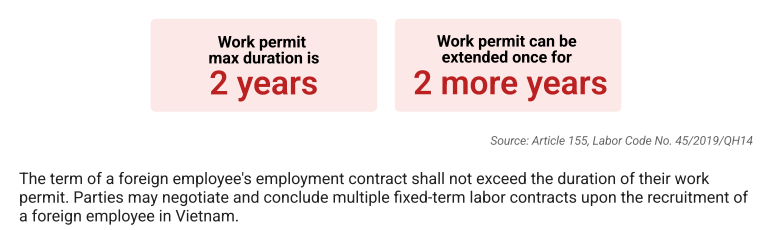
- Duration: A work permit is typically valid for up to 2 years at a time. It may be extended once (for another 2 years) if needed. After that, a new permit must be issued. If the employing company closes or the employment contract ends, the work permit is revoked.
Read Related: Difference between a Vietnam Work Permit and a Temporary Residence Card
Who Needs a Work Permit? Eligibility and Conditions
Under Vietnam’s labor law, most foreign workers must obtain a Work Permit (except certain exempt cases). As per Article 151.1 of the Labor Code 2019, foreign workers in Vietnam must meet the following conditions:
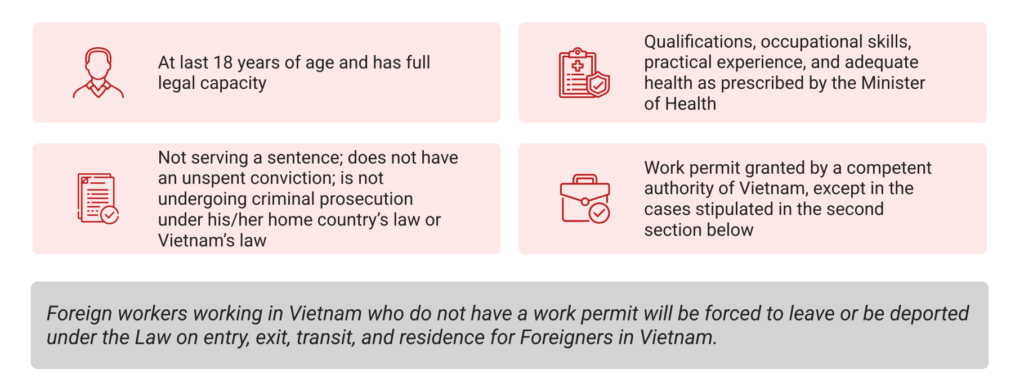
Foreign workers must adhere to these conditions and the Labor Code of Vietnam. They are entitled to protection under Vietnamese law unless stipulated otherwise by international treaties to which the Socialist Republic of Vietnam is a signatory.
Updated Experience Requirements (Decree 219)
Notably, Vietnam has relaxed some criteria for experts and technicians. Under Decree 219 (Aug 2025):
– An “expert” now needs a university degree and 2 years’ relevant experience (down from 3), or in priority fields (science, tech, innovation, etc.) only 1 year.
– A “technical” worker needs 2 years of experience (down from 3) with 1 year of vocational training, or 3 years of experience (down from 5) with training.
These changes target high-priority sectors, making it easier to qualify foreigners with specialized skills.
Work Permit Exemptions
Not all foreign jobs in Vietnam require a permit. The law carves out many exempt categories (Article 154 of the Labor Code, expanded by recent decrees). Some examples of exemptions include:
- Short-term Assignments (< 3 months): Foreigners here for promotion, trade fairs, or emergency technical fixes (e.g. servicing equipment) and who stay under 90 days usually don’t need a permit. However, in such cases the employer must notify authorities (see below).
- Media, Education, ODA Projects: Foreign journalists accredited by the MFA, and foreign experts or trainees on official development (ODA) projects (consulting, R&D roles, etc.), can be exempt. Also, teachers or managers in foreign-sponsored schools (e.g. on diplomatic mission grounds) often don’t need a WP.
- Investors and Owners: Significant capital contributors may be exempt. For instance, owning ≥ VND 3 billion (about USD 117,000) of a limited liability or joint-stock company qualifies for exemption under the law. Foreign board members with similar stakes are also exempt.
- High-Priority Sectors: Decree 219 added new sectors to the exemption list. Now foreign workers in finance, science, technology, innovation, digital transformation, and other government-designated priority fields can be exempt if approved by ministerial or provincial authorities.
- Family Dependents: Spouses of Vietnamese citizens and certain diplomatic dependents may be exempt (though they must notify authorities).
When an exemption applies, the foreigner does not need a work permit, but the employer must still submit a notification to the provincial labor authority at least 3 working days before the employee’s start date. This notification includes the person’s details and role. The processing is simpler, but compliance with notification rules is mandatory.
Check out InCorp Vietnam’s Infographic on Work Permit now!
Who Can Sponsor a Work Permit
Virtually any legal Vietnamese entity or foreign-invested enterprise can sponsor a work permit for an eligible foreigner. Examples include:
- Registered Companies: Domestic or foreign-invested companies established under the Enterprise Law or Investment Law.
- Contractors and Service Providers: Businesses providing services under contracts with Vietnamese partners.
- Representative Offices and Branches: Offshore companies operating in Vietnam through local offices.
- NGOs & International Organizations: Licensed foreign non-governmental organizations or UN agencies.
- Government and State Bodies: Ministries, departments, political or social organizations.
- Educational Institutions: Universities, schools, or training centers that hire foreign teachers or experts.
- Other Entities: Joint ventures, cooperatives, even business households (with legal status) can potentially sponsor foreigners in certain roles.
Each sponsor must be in good standing (valid business license, etc.) and must justify the need for foreign labor (see Application Procedure). Provincial labor authorities evaluate whether the position truly requires a foreign hire instead of a qualified Vietnamese.
Work Permit Application Procedures in Vietnam
To legally hire a foreign employee in Vietnam, employers must follow a detailed and structured process outlined below:
The process of obtaining a work permit involves several coordinated steps between the employer and the foreign employee. Recent reforms (Decree 219/2025) have streamlined this into a single, largely online, procedure. Below is an updated outline of the steps (for permits up to 2 years):
Step 1: Job Advertisement (Hiring Plan)
Before applying, the employer must publicly advertise the position. Under Decree 70/2023 (effective Jan 2024), vacancies had to be posted on the Ministry’s portal for 15 days. However, Decree 219 (Aug 2025) abolishes the portal requirement: now advertising on any public platform (company website, LinkedIn, newspapers, etc.) for at least 5 days before application is sufficient. This allows more flexibility while still documenting recruitment efforts.
Step 2: Prepare Application Dossier
The employer (or its agent) compiles the full work-permit dossier, which now combines what used to be two forms (approval and permit). Key documents include:
- Official Application Forms: The employer’s written explanation of the need for foreign labor (using Form 03 as per Decree 219) and the completed Work Permit application form (typically Form 11/PLI). These forms justify why no qualified Vietnamese is available for the position.
- Health Certificate: A medical report (issued within the last 12 months) showing the foreigner is fit to work.
- Criminal Record: A background check (issued within 6 months) confirming no pending prosecutions or convictions.
- Qualifications: Copies of the foreigner’s degrees, certificates, and evidence of relevant work experience (consularized and translated).
- Photos: Two recent passport-sized photos (4×6 cm, white background).
- Passport Copy: A certified copy of the entire valid passport.
- Corporate Documents: Employer’s business registration, corporate charter/resolution appointing the foreigner (for managers/executives), etc.
- Approval for Foreign Labor: If required, the written approval from authorities permitting the employer to hire this foreigner (unless the position is exempt from prior approval).
- Labor Contract Draft: A copy of the draft employment contract (term, salary, etc.).
- Other: Any specific documents per the worker’s category.
Step 3: Submit Application
The completed dossier is submitted to the labor authority in the province where the work will be done. Under Decree 219, submission is typically online via the National Public Service Portal. Crucially, the employer must submit between 10 and 60 days before the foreigner’s intended start date. (This aligns with the requirement to advertise 5 days in advance.)
Step 4: Review and Approval
Once a complete dossier is filed, the provincial People’s Committee (or a delegated body) has 10 working days to process it. During this time, they simultaneously review the hiring need and the work permit application. If approved, the work permit is issued electronically. If refused, the authority must provide a written explanation within 3 working days.
Tip: The unified process means there is no longer a separate waiting period for a foreign-hire approval letter before applying for the permit. Everything is handled in one step, reducing the total timeline to roughly three weeks.
Step 5: Receive Work Permit
Upon approval, the foreign employee receives the official work permit document (Form 12/PLI under current regulations). The permit can be collected by the employee or sent via the employer. This document is needed to get the work visa and TRC.
Step 6: Post-Permit Visa/Residence
With the work permit in hand, the foreigner can apply for a work visa (if not already in Vietnam) and a Temporary Residence Card for the permit’s duration. The TRC allows re-entry and longer stay without visa renewal.
Throughout the process, it’s wise to start early. Employers typically begin preparations at least 6–8 weeks before the foreign worker’s start date. This buffer accounts for document legalization, potential revisions, and coordination with consulates.
Employer Obligations and Updates
Under the new rules, employers have specific obligations:
- Prior Recruitment Effort: As noted, advertise the job (5 days on any platform) and document lack of qualified local candidates. Authorities may audit this.
- Timely Notifications: If a position is exempt and no work permit is needed, the employer still must notify the local labor office 3 days before the foreigner begins work.
- Local Processing: As of July 2025, authority for issuing WPs has shifted fully to Provincial People’s Committees (instead of central MoLISA). This means employers deal with local offices in the province of operation. It may speed up matters, but also means being aware of province-specific requirements.
- Record-Keeping: Maintain copies of all documents, permits, and notifications. The employer is responsible for compliance, and failure can lead to fines (often VND 10–20 million) and suspension of hiring privileges.
Processing Times and Fees
Processing Time: Thanks to the integrated procedure in Decree 219, the work permit process is now fairly quick. In practice:
– Expect about 10 working days for authorities to issue the permit once a complete dossier is filed.
– Total turnaround (from advertisement to receiving the permit) is on the order of 3–4 weeks if everything is in order.
– If any documents are incomplete, the authority will request corrections and pause the clock.
Fees: Vietnam’s government fees for work permits are modest and set locally. The official issuance fee generally ranges from VND 400,000 to 600,000 (about USD 16–24) depending on the province. For example, Hanoi’s fee is VND 400,000, while Ho Chi Minh City and Da Nang are VND 600,000. (These rates are subject to change by each local People’s Council.) There may also be a small fee for the initial foreign-labor approval application if required.
After the Permit: Visa and Residency
After receiving the Work Permit, the foreigner must apply for the appropriate visa and residence authorization:
- Work Visa / Business Visa: If the person is outside Vietnam, they apply for a work visa (LD visa) at a Vietnamese embassy/consulate, using the Work Permit as the main supporting document. If already in Vietnam (e.g. on a tourist visa), they should have their visa extended or converted to a work visa.
- Temporary Residence Card (TRC): The work permit is also the basis for a TRC, which serves as a long-term residence permit. A TRC is typically valid for up to the length of the work permit (max 2 years) and can be renewed. With a TRC, the foreigner does not need to exit Vietnam for visa renewals and can freely re-enter. We strongly recommend applying for a TRC immediately after obtaining the work permit
Integration Note: Decree 219 has introduced an online joint application option: employers may apply simultaneously for the work permit and the employee’s criminal record certificate via the national portal. This streamlines the steps and results in a coordinated issuance. (Previously these were separate procedures.)
Looking for assistance with a Work Permit in Vietnam? Explore InCorp Vietnam’s Immigration Services today!

clients worldwide

professional staff

incorporated entities in 10 years

compliance transactions yearly
Learn the Right Setup for Business
Expansion in the Vietnam
Frequently Asked Questions
Can I Work In Vietnam
- Yes, you can work in Vietnam if you obtain the appropriate work permit and meet the country's visa and employment requirements. It's important to secure a job offer from a licensed employer who can sponsor your work permit.
How To Get A Job In Vietnam
- To get a job in Vietnam, research local job boards, company websites, and recruitment agencies. Tailor your resume to meet local standards and apply for positions that match your qualifications. Ensure you have the appropriate work visa or permit if you're a foreign national.
How to get a work permit in Vietnam?
- To get a work permit in Vietnam, a foreigner must have a job offer from a Vietnamese company that will act as the sponsor. The employer must apply to the Department of Labor with required documents, including the applicant’s passport, health check, criminal record, qualifications, and relevant work experience. The process typically takes two to three weeks if all documents are in order. Work permits are usually valid for up to two years and can be renewed.