Thailand investment in Vietnam has been surging in recent years. Thai businesses registered 26 new projects (US$928 million) in the first nine months of 2025 – a sevenfold increase year-on-year. As of late 2025 Thailand is the 8th-largest FDI source in Vietnam (about 775 projects, $14.96B).
Why Vietnam appeals to Thai investors
Vietnam offers strong economic growth and favorable conditions that motivate Thailand investment. Economists forecast Vietnam’s GDP growth around 6–7% through 2025, among the highest in Southeast Asia. Vietnam’s stable political system, consistent growth track record and ample young skilled workforce make it an appealing destination. For Thai investors, Vietnam’s strategic location and multiple trade agreements (ASEAN, RCEP, EVFTA, etc.) mean products made in Vietnam can reach major markets with low tariffs, boosting export-oriented Thai manufacturers. Notably, the Vietnamese government is actively cutting red tape – for example, it plans to eliminate about 30% of business licensing conditions by 2026 – which should make Thailand investment easier. In short, Thailand investment benefits from Vietnam’s dynamic economy, regional connectivity and improving business climate.
Read Related: Ease of Doing Business in Vietnam: Why Do Foreign Investors Choose This Destination?
Key sectors and opportunities for Thailand investment
Thailand investment in Vietnam spans many industries. Thai companies have traditionally been active in manufacturing, retail, real estate, energy and logistics. Below are some major sectors where Thai SMEs can find opportunities:
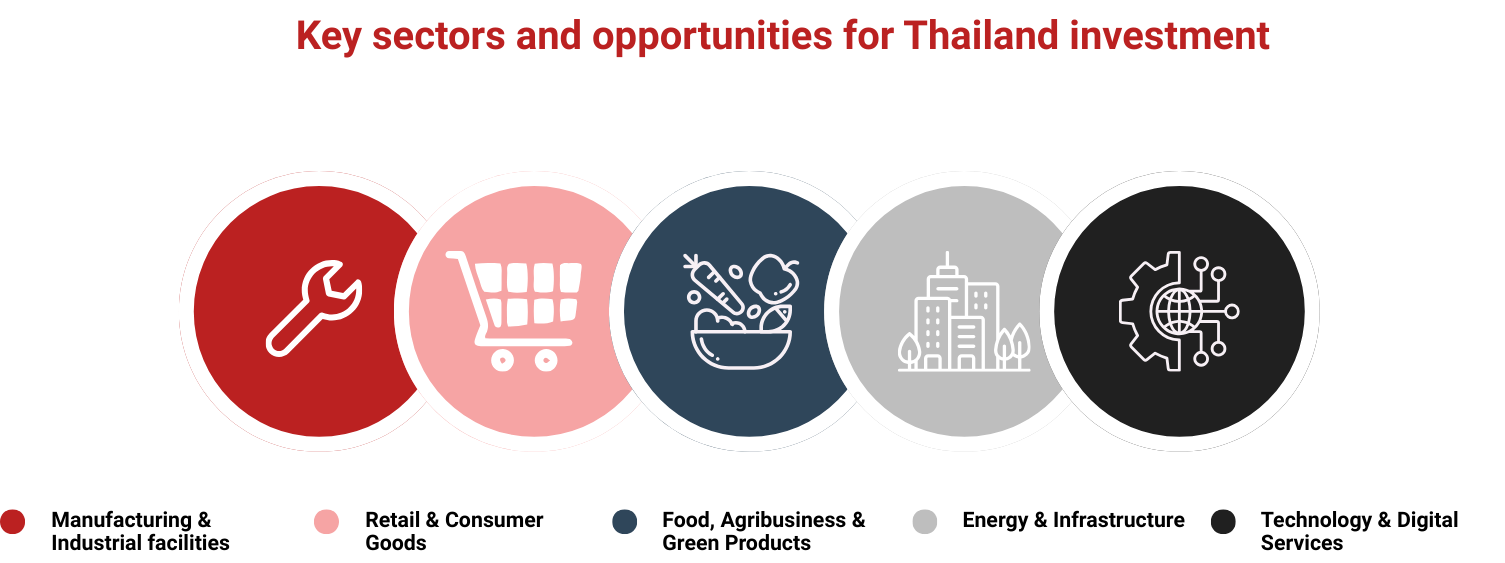
- Manufacturing & Industrial facilities. Vietnam’s economy is heavily export-driven, and its industrial zones have expanded dramatically – now totaling nearly 150,000 hectares of industrial land. This makes manufacturing a natural focus for Thailand investment. In fact, industrial real estate dominates investment in Vietnam: Cushman & Wakefield data show that from 2020 through mid-2024 industrial property transactions totaled roughly US$1.18 billion, far more than any other sector. In the first nine months of 2024 alone, industrial deals made up 91% of total real-estate transaction value. For Thai manufacturers and logistics firms, this means plentiful production parks and warehouses. Well-known projects (Amata City in Dong Nai, VSIPs, Long An Industrial Zones) already host many Thai factories.
- Retail & Consumer Goods. A growing Vietnamese middle class is increasing demand for retail and packaged goods. Thai retail giant Central Retail opened a new GO! shopping center in Hung Yen (northern Vietnam) and continues to expand. Thailand investment in retail and food & beverage is rising: Thai supermarket chains, convenience stores and food brands (e.g. Betagen dairy) are targeting Vietnam’s 100-million population. Vietnamese consumers are familiar with Thai products, which helps new entrants.
- Food, Agribusiness & Green Products. Vietnam has a large agricultural base. Thai food processors, spice and seasoning manufacturers, and specialty food SMEs can source local raw materials. Conversely, Thai fruit and snack producers can export via Vietnam’s logistics networks. Thai conglomerates (like SCG, CP Group and Central) are increasingly focusing on eco-friendly and green technologies in Vietnam. This opens opportunities in bio-packaging, renewable energy components, and waste management services.
- Energy & Infrastructure. Vietnam’s power demand is growing, and the government targets more renewables. Thai energy companies (electricity, solar/wind) can participate in power projects or industrial park utilities. Thai EPC firms might bid on infrastructure. Meanwhile, logistics and transport investment (ports, highways) are key: Thailand investment in logistics (warehousing, ports, cold chain) can leverage Vietnam’s role as a regional trade hub.
- Technology & Digital Services. Vietnam’s government promotes high-tech parks, AI, semiconductors and fintech. While large-scale ventures may be challenging, Thai SMEs in software, IT services, e-commerce platforms or digital marketing can partner with local firms. For example, Thai startups might support Vietnamese businesses in adopting technologies or provide back-end services. Vietnam’s growing IT workforce and R&D tax incentives help reduce setup costs.
Overall, Thailand investment in these areas can be boosted by Vietnam’s incentives. The government grants preferential corporate tax rates for “encouraged” projects (e.g. 10% CIT for 15 years on high-tech or infrastructure projects, otherwise typically 17% for 10 years). Small businesses benefit too: if a project is structured as an SME, it may pay only 15% CIT on initial revenues. In practice, Thai SMEs investing in manufacturing or services can often secure low tax rates and even exemption periods if they meet the requirements for priority sectors or underdeveloped areas.
Key regions and industrial hubs
Thailand investment is concentrated in certain Vietnamese regions that offer infrastructure, market size and investment support:
- Ho Chi Minh City and the Southeast (including HCMC, Binh Duong, Dong Nai, Long An and Ba Ria–Vung Tau). Ho Chi Minh City (plus adjacent provinces merged in 2025) is by far the largest magnet for Thailand investment. Local officials call it “the central destination of Thai investment capital”. Major Thai corporations (SCG, Central Retail/Big C, Siam Cement, Thai banks, etc.) already operate here in energy, retail, logistics and healthcare. The region is focusing its core (HCMC) on finance and digital economy, while Binh Duong and Long An serve as industrial hubs. Notably, Thai developer Amata plans a US$180 million high-tech park in the new HCMC area (Chau Duc), targeting smart manufacturing and logistics. The HCMC government actively courts Thai firms – for example, it pledged to smooth approvals for Amata’s project. In practice, Thai SMEs might choose industrial parks in Binh Duong or Dong Nai for factories, and invest in retail or services in core HCMC.
- Hanoi and the Northern/Red River region. Vietnam’s capital region is another key area. Provinces like Bac Ninh, Bac Giang and Hung Yen host many electronics and automotive plants (e.g. Samsung, Honda). Nearby ports (Haiphong) and border crossings (Lang Son, Lao Cai) facilitate trade. According to official data, Hanoi and its neighboring provinces accounted for a large share of FDI in early 2024. Thai investors often use Hanoi as a base for North Vietnam, focusing on industrial products or consumer goods. For example, Thai central bank filings and local news note Thai ventures in Bac Ninh and Hung Yen. Thailand investment in this region can leverage skilled labor (Hanoi has technical universities) and access to the growing Chinese-facing corridor.
- Central Vietnam (Da Nang region and beyond). This region (Da Nang, Quang Nam, Quang Ngai, Nghe An, Thanh Hoa, etc.) is an emerging hub. Da Nang city is developing tech parks and an airport expansion. New industrial zones are growing: for instance, WHA Group (Thailand) won approval in 2024 to build a 178-ha smart industrial park in Thanh Hoa province. Quang Ngai’s VSIP is also expanding. Thai SMEs in furniture, textiles or agri-food see opportunities here due to lower land costs and improving infrastructure. Tourism and hospitality are also big in central Vietnam, but that may suit large Thai chains more than small firms.
Each region offers different strengths. Generally, Thailand investment is strongest in the developed South (HCMC area) and the well-connected North (Hanoi area), with Central Vietnam offering greenfield opportunities. As a Thai investor, consider proximity to customers and suppliers, and use Vietnam’s industrial parks in those zones for good land and utilities.
Read More: Choosing the Ideal Business Location in Vietnam: The First Step of Success
Opportunities and incentives
Thailand investment in Vietnam is supported by several favorable factors and incentives:
- Tax and regulatory incentives. Vietnam gives significant tax breaks for qualified projects. For example, a new manufacturing plant in a priority sector can get a corporate tax rate as low as 10% for 15 years. Even projects outside priority sectors often pay only 17% for 10 years. Crucially for SMEs, a small project only pays 15% CIT on its first ~VND3 billion in revenue. There are also exemptions/holidays: new projects typically enjoy a few years of full tax exemption after they first generate profit, then a period at half rate. These incentives make Thailand investment more attractive by improving early cash flow. Additionally, many provinces offer land-lease discounts or import-duty exemptions on imported machinery. Thai SMEs should ask local authorities about special high-tech or R&D incentives, as Vietnam now explicitly favors those activities.
- Streamlined procedures. The Vietnamese government is actively cutting bureaucracy to attract investment. Reforms announced for 2025-26 aim to eliminate roughly 30% of redundant business conditions. Vietnam also set a goal of 1 million new businesses by 2030, signaling a push to simplify licensing and approvals. For example, most provinces now have an online investment registration portal, and one-stop shops to coordinate permits. In practice, Thailand investment projects often get approval faster than before, especially in approved IPs. Still, Thai SMEs should ensure all paperwork is complete, and can seek help from provincial investment promotion centers that are experienced with foreign (especially ASEAN) investors.
- FTA advantages and economic links. Vietnam’s web of free-trade agreements can indirectly benefit Thai exporters. By producing in Vietnam, a Thai firm may export component parts from Vietnam tariff-free to the EU or Japan (via EVFTA, CPTPP). Thailand itself trades heavily with Vietnam (bilateral trade was $20.2B in 2024), so many Thai supply chains already run through Vietnam. For example, Thai chemical or packaging exporters supply Vietnamese factories. Thailand investment in Vietnam fits this integration – it isn’t just capital outflow but deepening the production network within ASEAN.
- Workforce and costs. Vietnam’s labor force is young, well-educated (especially in tech fields) and generally lower-cost than Thailand’s urban centers. This allows Thai SMEs to achieve cost savings. Vietnam’s English proficiency (especially among engineers and managers) is improving, which helps Thai firms operate more smoothly. Overall living and labor costs remain competitive. These advantages are part of what drives Thailand investment — Vietnamese talent can produce goods at scale and reach global customers via Vietnam’s port network.
In summary, Thailand investment can tap a friendly policy regime. Tax breaks can increase project returns, and policy reforms ease entry. Coupled with Vietnam’s trade access and workforce, these incentives help Thai SMEs set up for success.
Challenges and realistic considerations
Thailand investment in Vietnam comes with important caveats. Prospective investors should prepare for the following challenges:
- Regulatory complexity and bureaucracy. Vietnam’s legal environment is improving but still evolving. Laws and regulations can be vague or change frequently. Getting licenses, permits and land titles often involves multiple agencies. Even after reforms, foreign firms report needing patience for paperwork. It’s wise to allow extra time and engage a local law firm. For Thailand investment, this means expecting a longer project timeline than in Thailand initially. Stay in close contact with officials, and be ready to follow up regularly.
- Overlapping jurisdictions. National laws, provincial people’s committees and district authorities may issue overlapping rules. This can create uncertainty. For example, one district may allow a certain type of factory but another may require extra approvals. Thai investors should map out all relevant rules (labor, environment, land use) with expert help. It’s common to adapt plans once you land in Vietnam. Don’t assume a Vietnamese license is automatic; double-check local regulations.
- Market and demand risk. While Vietnam is growing, some Thai investors have noted weak domestic demand in certain segments. Luxury goods or large appliances may not sell as quickly as expected. Competition is also intense, from Chinese imports to established Vietnamese brands. Thai SMEs should do careful market research and perhaps start with small batches or pilot programs. It’s best to customize products for Vietnamese tastes and price points.
- Infrastructure and operational gaps. Vietnam’s infrastructure has improved, but unevenly. Outside major industrial zones, roads and power can be less reliable. A U.S. trade report warns that companies may face “poorly developed infrastructure” and difficulties in land acquisition and tax compliance. For Thai SMEs, this means choosing factory locations within established industrial parks that have ready utilities. Also, logistics from inland factories to ports may add extra transit time and cost. Plan inventory and shipping routes accordingly.
- Land use and business setup. Foreigners cannot own land in Vietnam; they lease land-use rights (typically 50-year term, renewable) under their investment license. Be sure to check land lease duration and renewal terms. Often Thai firms set up a local subsidiary or joint venture in order to lease land and secure permits. Also note that certain industries (like retail trade, telecom) require special local partnering or conditional licenses. Consult legal advisors on the specific ownership and licensing requirements.
- Cultural and legal differences. Business culture differs: Vietnamese decision-making is often hierarchical and relationship-driven. Language barriers persist outside major cities. Thai managers should respect local protocols and consider hiring Vietnamese-speaking staff. Contract enforcement can be slow; keep thorough documentation. Corruption and “red tape” have reduced over the years, but still require vigilance. Vietnam ranks only 77th on global corruption indices, so exercise standard compliance measures.
- Intellectual property protection. IP infringement (e.g. product counterfeiting, online piracy) remains a concern in Vietnam. Thai SMEs should register trademarks locally and be prepared to enforce them. Avoid relying on trade secret alone; use formal patents if applicable. Work with distributors you trust to prevent grey-market re-export.
- Rising costs and competition. Vietnam’s wages and real estate prices have been climbing. The old “cheap labor” edge is eroding year by year. Thai SMEs should update cost models to ensure profitability. Focus on value-added niches (quality products, brand differentiation) rather than undifferentiated low-cost goods. Remember, Thailand investment now competes not just with local firms but with investors from China, Korea, Japan and Europe also moving into Vietnam.
In short, Thailand investment in Vietnam requires careful due diligence. Plan for bureaucracy, invest in local expertise, and start with manageable projects. Those who prepare for these hurdles will find that Vietnam’s long-term potential is well worth the initial effort.
Practical tips for Thai SMEs
Based on the above, here are some action points for Thai companies:
- Visit and network. Before investing, visit Vietnam’s business hubs (Hanoi, HCMC, Da Nang) to meet partners and officials. Attend trade fairs (e.g. Vietnam EXPO) and join chambers (ThaiCham Vietnam, Vietnamese-Thai business forums). Building trust in advance greatly eases Thailand investment.
- Start small or joint venture. Consider a joint venture or minority investment with a Vietnamese partner. This provides local insight and a shared risk. Alternatively, start with a representative office or small pilot plant. Gradually scale up once you understand the market.
- Use professional services. Hire reputable Vietnamese law firms, accountants and consultants who understand both Thai and local contexts. They can guide company registration, land leasing, taxation and labor issues. Also use contacts in Thai government investment agencies – they often have Vietnam desks to assist SMEs.
- Leverage incentives. Work with Vietnam’s Investment Promotion Agency (MPI) or local boards to identify tax holidays or land incentives for your project. For example, high-tech parks and special economic zones often offer the best packages.
- Plan finances carefully. Account for possible delays in permits and initial operations. Keep extra cash reserves for extended timelines. Also hedge foreign exchange risk: some Thai banks offer dong accounts or FX tools to manage renminbi exposure. Familiarize yourself with Vietnam’s new global minimum tax rules (Pillar 2) if your company is part of a multinational group.
- Cultural adaptation. Learn Vietnamese business etiquette – polite negotiation, gift culture at Tet, etc. Training Vietnamese staff or hiring bilingual managers is invaluable. Thai leadership should be ready for a consensus-driven approach in Vietnam.
- Long-term perspective. Vietnam rewards investors who stay patient. Many Thai success stories (like SCG’s long-term chemical investment) took years to mature. If you treat the venture as a 5–10 year plan, rather than a quick win, you’re more likely to succeed.
By following these steps, Thai SMEs can turn Thailand investment in Vietnam from an idea into profitable operations. Vietnam’s government considers investors’ success as its own priority, and many Thai firms find that supportive: a Vietnamese official even said “HCMC always accompanies, shares, and wants to attract more Thai investors”.
In conclusion, Thailand investment in Vietnam is a powerful growth opportunity for Thai SMEs. Vietnam’s future outlook is bright, and Thailand investment can be part of that trajectory. By leveraging Vietnam’s market and support, Thai SMEs can let their Thailand investment prosper. The momentum behind Thailand investment in Vietnam is strong, and Thai firms that plan carefully stand to gain considerably.
In summary, Thailand investment in Vietnam is not a fleeting trend — it is a growing foundation for Thai businesses’ regional ambitions. By leveraging Vietnam’s market and incentives effectively, Thailand investment can turn into real success for Thai SMEs.