Vietnam’s government has moved to streamline its business environment with a major update to the Law on Investment, aiming to reduce red tape for businesses. A centerpiece of this reform is the reduction of 38 conditional business lines and revisions to 20 others. These changes are poised to make it easier for startups and small-to-medium enterprises (SMEs) to enter the market, comply with regulations, and explore new opportunities.
What Are Conditional Business Lines in Vietnam?
In Vietnam, business lines refer to the specific activities a company is allowed to conduct, as stated in its enterprise registration. Conditional business lines (ngành nghề kinh doanh có điều kiện) are sectors where companies may only operate after meeting certain legal requirements. These conditions typically relate to minimum capital, professional qualifications, technical standards, or the need to obtain special licenses or permits.
The government imposes these requirements because such activities may affect national security, public order, social ethics, public health, or community welfare. As a result, these sectors are considered sensitive, and businesses must demonstrate compliance before fully operating. Common examples include banking, insurance, education, telecommunications, transportation, healthcare, and security services. In these fields, enterprise registration alone is not enough; additional approvals or certificates from competent authorities are usually required. Operating without meeting the required conditions can lead to penalties, suspension, or prohibition of the business activity.
This regulatory framework is governed by Vietnam’s Law on Investment, which includes an official list of conditional business lines published in an appendix to the law. Under the Investment Law 2020 and its updates, the list included more than 200 conditional sectors, ranging from major industries such as finance and energy to more specialized activities subject to safety or quality controls. The objective is to balance business freedom with protection of public and national interests.
If a business line is not listed as conditional and is not prohibited, it is considered an ordinary business line. In such cases, a company can operate simply by registering the activity, without additional licensing. For startups and SMEs, identifying whether a planned activity is a conditional business line is a critical early step, as it directly affects timelines, costs, and compliance planning.
To identify conditional business lines, businesses should consult the official list published by the government, particularly Appendix IV of the Law on Investment, which is also available on the National Business Registration Portal. Because the list can be amended by new laws or decrees, relying on official sources or professional legal advice helps ensure that businesses are working with the most up-to-date requirements.
Read Related: Ease of Doing Business in Vietnam: Why Do Foreign Investors Choose This Destination?
The Amended Investment Law: 38 Conditional Business Lines Removed, 20 Revised
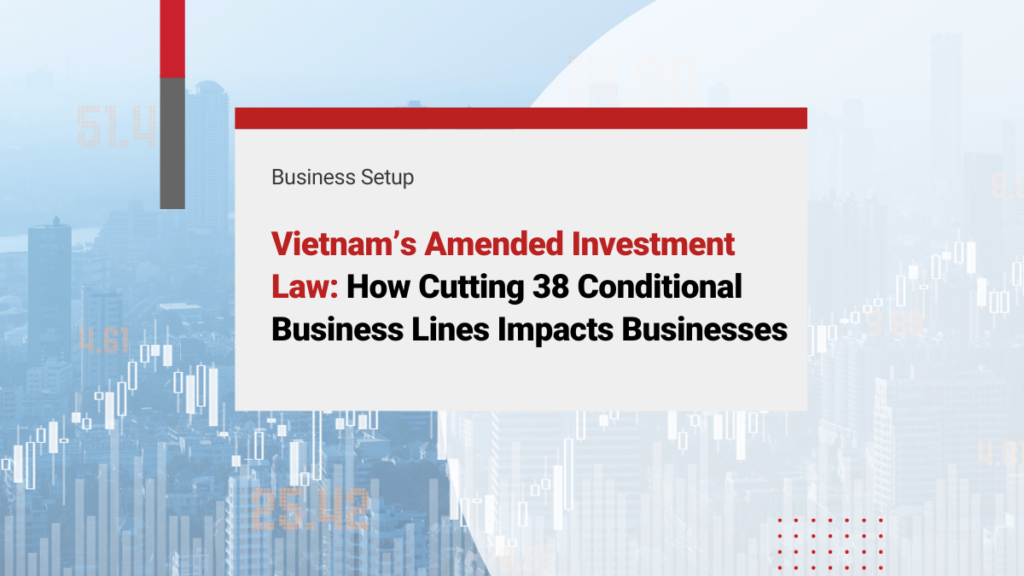
In December 2025, Vietnam’s National Assembly passed an amended Law on Investment aimed at significantly improving the ease of doing business. A central reform is the overhaul of conditional business lines, resulting in the removal of 38 conditional business lines and the revision of 20 others. Following these changes, the total number of conditional business lines will fall from 234 to 196, with remaining conditions concentrated mainly in sensitive sectors such as finance, banking, insurance, agriculture, construction, transportation, and selected regulated industries.
In practical terms, the 38 removed conditional business lines will no longer require sector-specific licenses or permits as a prerequisite to operation. These activities are either fully removed from the conditional list or no longer subject to a “license-first” regime.
The abolished lines span a wide range of sectors, including certain tax and customs services, insurance auxiliary services, inspection services, selected import–export activities, energy auditing, employment and labor outsourcing services, automobile maintenance, architecture and construction-related services, data center services, study-abroad consulting, non-endangered wildlife trading, cosmetic surgery services, art performance and event organization, land information system IT services, and other technical or service-based activities. While not exhaustive, this illustrates the breadth of sectors now freed from prior licensing requirements, reducing both entry time and compliance costs for businesses.
At the same time, 20 conditional business lines have been revised, meaning their regulatory scope has been narrowed, clarified, or restructured. A key policy shift is the move from pre-approval to post-inspection for many of these activities. Instead of requiring businesses to obtain licenses before operating, the new approach allows companies to start operations once they meet publicly announced conditions, with authorities enforcing compliance through inspections afterward.
To implement this, the government will issue two lists:
- List 1: Business lines that still require licenses or certificates before operation, typically the most sensitive sectors.
- List 2: Business lines where licensing is abolished and replaced by published conditions enforced through post-inspection.
This transition from “license first, business later” to “operate if compliant, then prove compliance upon inspection” reflects Vietnam’s effort to reduce administrative barriers while maintaining regulatory oversight. The reform is driven by high-level policy directives under Resolution No. 68 of the Politburo and Resolution No. 198 of the National Assembly, both calling for the removal of unnecessary business conditions. The amended law was passed on December 11, 2025, with strong legislative support, signaling clear political commitment to reform.
The amended Law on Investment takes effect on March 1, 2026, while the new conditional business line framework will apply from July 1, 2026. This transition period allows authorities to issue detailed guidance and gives businesses time to prepare. Until then, existing rules technically remain in force, but companies should closely monitor upcoming decrees that will confirm which sectors remain subject to pre-approval and which move to post-inspection management.
Read Related: Everything You Need To Know about Company Incorporation in Vietnam
Implications for Startups and SMEs
For startups and SMEs, the reduction of conditional business lines is more than just a legal technicality – it can have a tangible impact on how quickly and easily you can start and grow your business in Vietnam. Here are some key implications and benefits:
Faster market entry and setup.
By removing licensing requirements for 38 business lines, the amended law eliminates major entry barriers. If your startup operates in one of these sectors, you can now launch by registering the business and complying with applicable standards, without waiting for an additional sector license. This can shorten time to market by weeks or even months. Activities such as tax consultancy or customs-related services, which previously required approvals from authorities, can now begin operations immediately after enterprise registration, giving startups with limited runway a clear advantage.
Lower costs and lighter administration.
Fewer conditional business lines mean fewer dossiers, approvals, and related costs. This change benefits SMEs in particular, as they often lack in-house legal resources. For example, architecture or design startups no longer need to complete separate business licensing procedures before operating, allowing them to focus on hiring qualified professionals and delivering services. Creative businesses such as event organizers or studios also benefit from simpler setup, even though specific event content may still be regulated.
New opportunities in deregulated sectors.
Sectors previously constrained by licensing are likely to see increased entrepreneurial activity. Data center services, employment services, and HR-related businesses are examples where startups can now enter the market more easily, provided they meet technical or professional standards during operation. This opens space for innovation and growth in service-oriented industries that were once difficult for smaller players to access.
More competition and room for innovation.
Lower entry barriers increase competition, but they also give SMEs fairer access to markets once dominated by well-resourced firms. For instance, easing business licensing for cosmetic surgery services may encourage qualified practitioners to establish smaller or more specialized clinics, as long as professional and medical standards are met. This creates opportunities for innovation while expanding consumer choice.
Ongoing compliance still matters.
The reforms do not eliminate regulation entirely. Many sectors remain subject to technical standards and post-inspection oversight. The difference is that compliance is enforced after operations begin rather than as a prerequisite. Startups should therefore build compliance into daily operations from the outset, as inspections and audits will continue to apply.
Benefits for foreign SMEs and investors.
Foreign-invested startups also benefit from fewer conditional business lines and from a key reform allowing enterprises to be established before obtaining an Investment Registration Certificate. This simplifies market entry and signals Vietnam’s intent to attract foreign entrepreneurship. However, foreign investors must still check sector-specific market access conditions under separate regulations, as some industries remain restricted or subject to ownership limits.
Overall, the reforms make Vietnam more accessible for startups and SMEs by reducing upfront barriers, while shifting the focus toward ongoing compliance and operational quality.
Best Practices for Navigating Conditional Business Lines
Even with a friendlier regime, startups and SMEs should approach conditional business lines strategically. Here are some best practices for navigating these requirements when registering or operating a business in Vietnam:
Research your business line early.
Before registering a company or launching a service, check whether your activities fall under conditional business lines. The updated list will be issued under the amended law by July 2026 and published by the Ministry of Planning and Investment on the National Business Registration Portal. Searching by keywords or VSIC codes early helps you identify any extra requirements and avoid unexpected licensing issues later.
Understand the exact conditions.
If your business line remains conditional, identify the specific requirements that apply. Conditions vary by sector and are set out in decrees, circulars, or sector-specific laws. Knowing that a business line is “conditional” is not enough; you need to understand what qualifications, facilities, or standards are required. Legal or business advisors can help translate these rules into a clear compliance checklist.
Use official portals and guidance.
Government portals provide updated and reliable information, especially during the transition period. The National Business Registration Portal and ministry websites outline procedures, conditions, and document requirements. These sources are the best way to track which sectors have moved to post-inspection management and which still require pre-approval.
Prepare for post-inspection regimes.
For sectors shifting from licensing to post-inspection, compliance becomes an ongoing responsibility. Even without an upfront license, businesses must meet all technical and operational standards and keep proper records. Having internal compliance processes and documentation in place allows you to respond confidently to inspections.
Seek professional advice when needed.
Legal counsel or experienced advisors can clarify grey areas, especially for foreign-invested businesses or complex sectors. While this involves cost, it often prevents more expensive mistakes such as non-compliance or misinterpretation of the law.
Stay updated and manage transition risks.
Monitor new decrees and guidance issued in 2026, as these will define the final scope of conditional business lines. Businesses already operating in affected sectors should plan their transition carefully, maintain documentation, and communicate with relevant authorities if clarification is needed.
By following these best practices, startups and SMEs can confidently navigate the landscape of conditional business lines, even as it shifts towards a more relaxed regime. The key is to be proactive: know your regulatory requirements, fulfill them diligently, and keep informed about new developments.
Conclusion: Embracing a More Open Business Environment
Vietnam’s recent amendments to the Investment Law mark a meaningful shift toward a more open and entrepreneur-friendly business environment. By removing 38 conditional business lines and revising many others, Vietnam has lowered entry barriers for startups and SMEs, reduced licensing complexity, and shortened the path from idea to operation. This reform opens more space for innovation across professional services, technology, creative industries, and other service-oriented sectors that were previously burdened by regulatory hurdles.
At the same time, greater flexibility comes with greater responsibility. The shift from pre-licensing to post-inspection places more trust in businesses to comply with applicable standards on an ongoing basis. SMEs should embrace the streamlined system while maintaining strong internal compliance practices, staying informed about updated lists and conditions, and seeking professional advice when needed.
Overall, the reduction of conditional business lines reflects Vietnam’s broader commitment to transparency, fairness, and investment attractiveness. For entrepreneurs planning to start or expand in Vietnam, the message is clear: market entry is becoming easier, costs are lower, and opportunities are broader. With proper preparation and compliance, startups and SMEs are well positioned to take advantage of this more open business environment and grow alongside Vietnam’s evolving economy.