Vietnam’s visa policy has undergone significant changes, making entry simpler for most international travelers. The most important update: the E-visa system is now the primary method for obtaining a visa, with streamlined processes and extended stay durations.
Need support for a Vietnam Visa? Check out InCorp Vietnam’s Immigration Services
Key 2026 Updates at a Glance
Vietnam has eliminated most COVID-19-related entry restrictions and expanded its electronic visa system. From April 15, 2026, a digital arrival card is being piloted for arrivals at Tan Son Nhat Airport (SGN) in Ho Chi Minh City. Health declarations will become mandatory for all travelers from July 1, 2026.
Step 1: Determine Whether You Need a Visa
Before applying for any visa, check if your nationality qualifies for visa-free entry. As of 2026, citizens from 38 countries can enter Vietnam without a visa, with stays ranging from 14 to 90 days depending on nationality
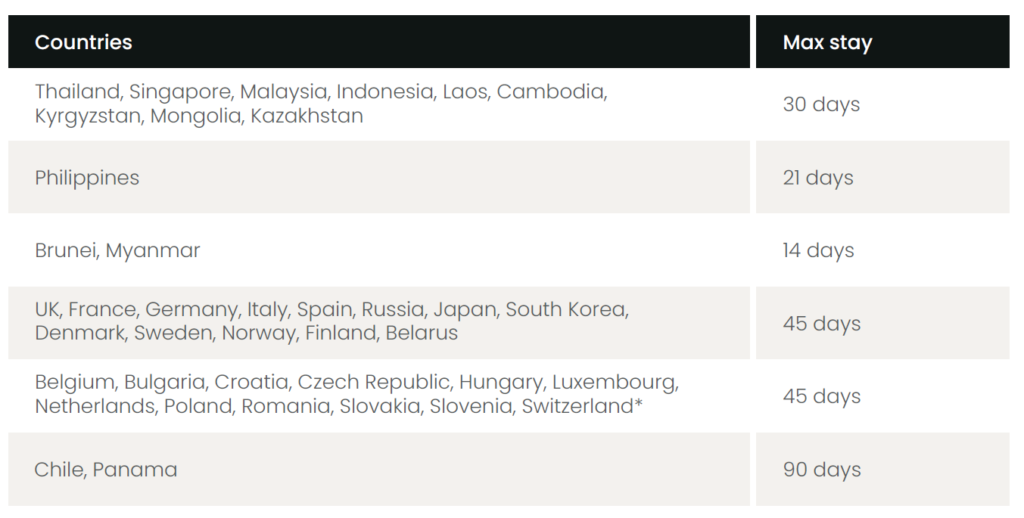
If your country is on this list and you are staying within the allowed period, no visa is required. However, your passport must be valid for at least six months beyond your arrival date and have at least two blank pages for immigration stamps.
Business and Investor Visa Extensions: For corporate travel with longer stays, extensions in-country may be possible. Business (DN1/DN2) and work (LD1/LD2) visas can be extended with company sponsorship, while investor visas (DT1–DT4) can be converted to Temporary Residence Cards. E-visas and tourist exemptions cannot be extended from within the country and instead require a border run
Step 2: Apply for an E-visa – The Recommended Method
If you are not visa-exempt, the 90-day E-visa is the official, primary method for entering Vietnam. This option is available to nationals of all countries and territories worldwide.
E-visa Specifications:
- Validity: Up to 90 days from the date of entry
- Entry type: Choose single entry or multiple entry
- Accepted ports: 83 international airports, land borders, and seaports
Application Process:
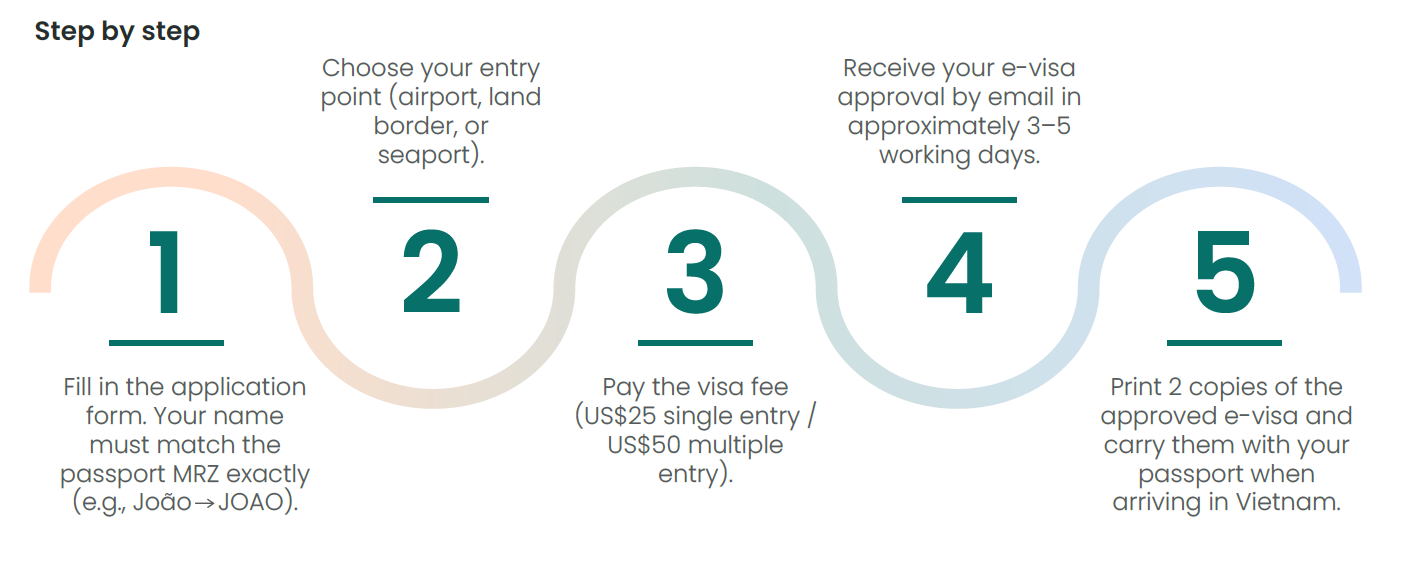
- Complete the online form – Use only the official government portals: evisa.gov.vn or thithucdientu.vn . (Domains updated from November 2024.)
- Upload required documents – A scan of your passport bio-data page and a recent digital passport photo (4×6 cm, white background).
- Pay the fee – US$25** for a single-entry visa; **US$50 for a multiple-entry visa, paid through the portal’s electronic payment gateway. The fee is non-refundable if the application is denied.
- Receive your E-visa – The approved visa is emailed to you as a PDF. Print two copies to present upon arrival.
Expected Processing Times:
Processing typically takes around 3 working days. For urgent cases, express services can deliver approval in 2–4 hours through authorized professional services.
The official processing time for an e-visa is 3–5 working days. Applications submitted through the embassy can be expedited within 24 hours for an additional fee.
Airlines and immigration authorities will not accept visa-on-arrival applications without a prior approval letter.
Step 3: Understand Ports of Entry and Exit Requirements
The E-visa is accepted at multiple entry points:
International Airports: Noi Bai (Hanoi), Tan Son Nhat (Ho Chi Minh City), Da Nang, Cam Ranh (Nha Trang), Cat Bi (Hai Phong), Can Tho, Phu Bai (Hue), Phu Quoc, Van Don (Quang Ninh), and Lien Khuong (Da Lat). Phu Quoc offers an additional 30-day visa exemption for direct international flights, and the new Long Thanh Airport has been added in 2026.
Land Borders: Moc Bai (Cambodia), Huu Nghi (China), Mong Cai (China), Lao Cai (China), Lao Bao (Laos), Cha Lo (Laos), Cau Treo (Laos), Bo Y (Laos), Na Meo (Laos), Nam Can (Laos), Tay Trang (Laos), Tinh Bien (Cambodia), Ha Tien (Cambodia), Xa Mat (Cambodia), La Lay (Laos), and Song Tien (Cambodia).
Seaports: Hon Gai, Cam Pha (Quang Ninh), Hai Phong, Nghi Son (Thanh Hoa), Vung Ang (Ha Tinh), Chan May (Thua Thien Hue), Da Nang, Nha Trang (Khanh Hoa), Quy Nhon (Binh Dinh), Dung Quat (Quang Ngai), Vung Tau, Ho Chi Minh City, and Duong Dong (Kien Giang).
Travelers entering by land or sea must specify their port of entry during the application. E-visas cannot be extended or renewed from within Vietnam; a border run (exit and re-entry) is required for longer stays.
Step 4: Complete the Digital Arrival Card (If Arriving at Tan Son Nhat Airport)
From April 15, 2026, a digital arrival card is mandatory for all foreign nationals arriving at Tan Son Nhat International Airport (SGN) in Ho Chi Minh City.
How to complete the process:
- Submit the declaration within 72 hours before your flight arrives – neither earlier nor at the airport
- Access the official portal at prearrival.immigration.gov.vn (the service is free)
- Provide personal details, flight number, visa type, and your first-night accommodation address in Vietnam
- You will receive a QR code – present this at immigration along with your passport
This initiative is currently a pilot program at Tan Son Nhat Airport and is expected to expand to Noi Bai (Hanoi) and Da Nang International Airport in the future.
Step 5: Ensure Compliance with Entry Requirements
Before boarding your flight, confirm you meet the following entry requirements:
- Passport validity: Your passport must be valid for at least six months beyond your intended date of arrival. Passports must also have at least two blank pages for immigration stamps.
- Visa: A valid Vietnam visa (E-visa or visa approval letter for VOA cases) must be approved before boarding. Airline staff will verify this before allowing you to check in.
- Health regulations: COVID-19 testing and vaccination requirements have been permanently lifted, with no pre-departure or arrival PCR/rapid testing required.
Phu Quoc Island Exemption: Travelers flying directly into Phu Quoc International Airport (PQC) from an international destination are exempt from a visa for up to 30 days. However, an E-visa becomes mandatory if you plan to leave the island to visit mainland Vietnam.
Step 6: Understand Other Visa Types for Special Purposes
For business, work, study, or investment purposes, Vietnam offers specific visa categories beyond the tourist E-visa.
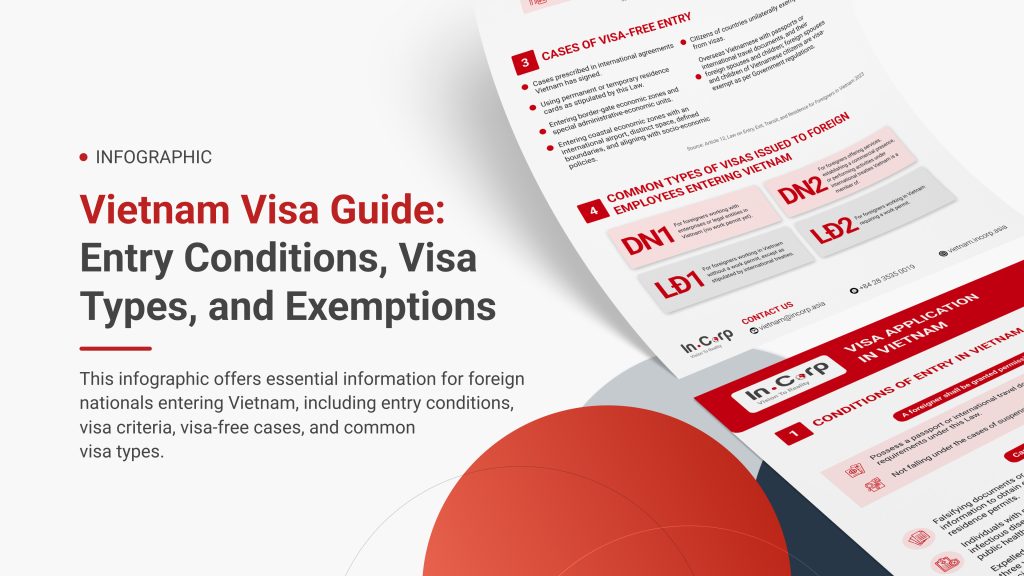
Business Visa (DN1/DN2):
- DN1: For those working with legally recognized businesses and organizations in Vietnam
- DN2: For those offering services, establishing a commercial presence, or conducting activities under international treaties to which Vietnam is a member
- Issued for 30 days or 90 days, single or multiple entry
Work Visa (LD1/LD2):
- LD1: For those exempt from work permits under international treaties
- LD2: For those requiring a work permit to be employed in Vietnam
- Valid for up to two years, extendable for an additional two years with an LD temporary residence card
Investor Visa (DT1–DT4): Issued based on capital investment amounts:
- DT1: From VND 100 billion – up to 5 years
- DT2: VND 50 billion to below VND 100 billion – up to 5 years
- DT3: VND 3 billion to below VND 50 billion – up to 3 years
- DT4: Below VND 3 billion – up to 12 months
Student Visa: Granted to individuals enrolled in university courses in Vietnam. Students may initially enter on a tourist visa and then switch to a student visa at the Immigration Office after enrollment.
Diplomatic Visa: Provided to members of delegations invited by Vietnamese government officials and consulate personnel. Typically free of charge unless otherwise stipulated by bilateral agreements. Valid for up to 12 months and requires an official letter from the applicant’s government or consulate.
Step 7: Know Your Options for Extending Your Stay
If you hold an E-visa or a tourist visa exemption: In-country extensions for these visa types are suspended. Instead, a “visa run” (border run) is required – you must exit Vietnam to a neighboring country (Cambodia or Laos) and re-enter with a new E-visa or a new exemption stamp.
If you hold a business, work, investor, or diplomatic visa: Extensions can be processed directly at the Vietnam Immigration Department in Hanoi, Da Nang, or Ho Chi Minh City. Processing for in-person extensions takes up to 10 business days, so start the application at least two weeks before your current visa expires.
If you overstay your visa: You will face fines of at least US$10–20 per day of overstay. Overstaying beyond 15 days may result in deportation and being blacklisted from re-entering Vietnam for up to three years.
Common Mistakes to Avoid
- Applying through third-party websites – Only use evisa.gov.vn or thithucdientu.vn for your application
- Incorrect passport validity – Your passport must be valid for at least six months from your arrival date
- Selecting the wrong port of entry – Ensure the port you specify matches your planned arrival point, or you may be denied entry
- Forgetting the digital arrival card – If you are arriving at Tan Son Nhat Airport, complete the online declaration within 72 hours of your flight
- Assuming an E-visa can be extended from within Vietnam – E-visas cannot be extended in-country; you must perform a visa run
- Relying on visa-on-arrival as a first choice – VOA is now reserved for urgent cases and requires a pre-approval letter; it is no longer a standard option for ordinary tourists
Download the full PDF guide for the Vietnam Visa Guide now!

clients worldwide

professional staff

incorporated entities in 10 years

compliance transactions yearly
Learn the Right Setup for Business
Expansion in the Vietnam
Frequently Asked Questions About Vietnam Visa Application
Can I still get a Visa on Arrival (VOA) at the airport?
- Yes, but only for urgent or emergency cases where you could not apply for an E-visa in advance. You must obtain an approval letter from the Vietnam Immigration Department before flying – no agency can issue a visa at the counter without it. For 99% of travelers, the E-visa is now the correct and faster method.
I’m arriving at Ho Chi Minh City (Tan Son Nhat Airport). What extra step do I need?
- From April 15, 2026, you must complete a digital arrival card online within 72 hours before your flight. Use the official portal prearrival.immigration.gov.vn (free). You will receive a QR code to show at immigration along with your passport and visa. This is currently required only for Tan Son Nhat Airport.
I have a 90‑day E-visa. Can I extend it while staying in Vietnam?
- No. E-visas cannot be extended or renewed from inside Vietnam. If you need to stay longer than 90 days, you must exit the country (e.g., to Cambodia, Laos) and apply for a new E-visa from outside Vietnam. For long‑term assignments, you need a business, work, or investor visa arranged by a sponsor.
My country is on the visa exemption list. Do I need to do anything else?
- Ensure your passport is valid for at least 6 months from arrival and has two blank pages. You do not need a visa for stays up to your country’s allowed duration (e.g., 45 days for UK, Germany, Japan). However, if you arrive at Tan Son Nhat Airport, you still need to complete the digital arrival card (same as visa holders).