Foreign individuals and multinational entities have been pouring into Vietnam’s economic free zones over the past few years, looking to form manufacturing companies and enjoy tax benefits for distribution and export. Vietnam now hosts nearly 450 industrial zones (IZs) across more than 93,000 hectares, plus dozens of export processing zones (EPZs), high‑tech parks, and coastal economic zones (EZs). Many investors begin by exploring company incorporation in Vietnam because setting up a legal entity is the crucial first step before operating inside a free zone.
But here’s the 2026 catch: The old “locate anywhere and get automatic tax breaks” era officially ended in early 2026. Incentives now depend heavily on where you go, what you make, and how clean and high‑tech your operation is.
Top Free Zones in Vietnam: A Deep Dive into Four Key Destinations
Not all industrial parks are created equal. The four destinations below represent the most popular, strategically important options for foreign manufacturers evaluating a free zone setup.
VSIP (Vietnam‑Singapore Industrial Park)
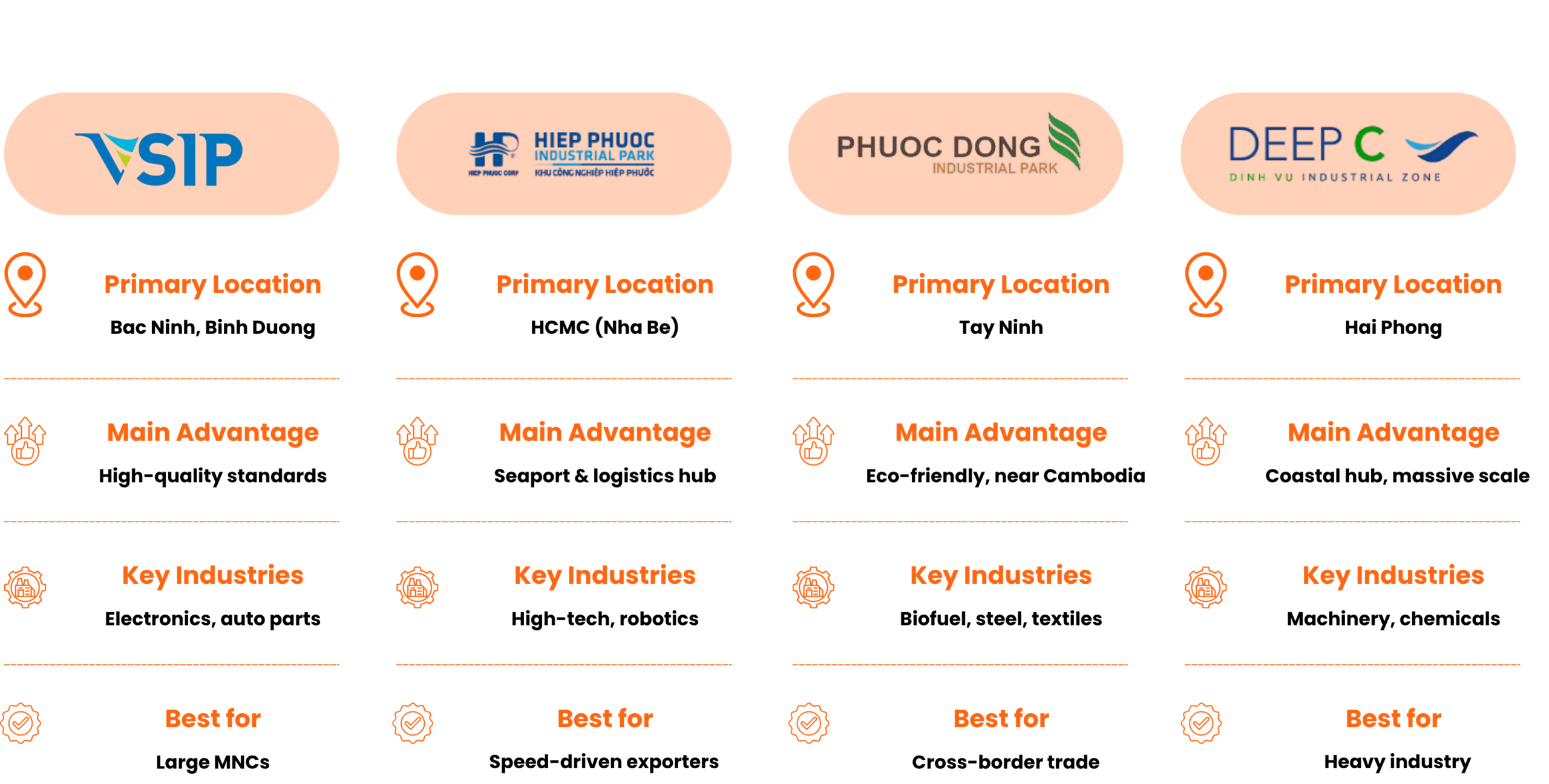
This industrial park was built in 1996 as a joint venture between Becamex IDC (Vietnam) and Sembcorp (Singapore), VSIP is widely recognised as the gold standard for industrial development in Vietnam. It has since expanded to six provinces, including Quang Ngai, Hai Duong, Nghe An, Hai Phong, Binh Dinh, and Bac Ninh.
- Why investors love VSIP: It offers a complete “plug‑and‑play” package—fully built infrastructure, stable utilities, on‑site customs, and even residential areas for workers. You won’t waste time negotiating power connections; it’s a hassle‑free environment that lets you focus entirely on production.
- Major industries: Electronics, automotive components, consumer products, and pharmaceuticals. Bac Ninh’s VSIP alone has attracted giants like Samsung, Foxconn, and Amkor.
- Who should choose VSIP? Large‑scale manufacturers needing reliable infrastructure, high volumes, and strict delivery schedules.
Read More: The Ideal Business Location in Vietnam: The First Step of Success
HPIP (Hiep Phuoc Industrial Park)
Located in Ho Chi Minh City’s Nha Be District, HPIP covers over 4,000 hectares of industrial land, including ready‑built factories. Its biggest selling point is location—right next to Vietnam’s financial capital, with an on‑site international seaport system.
- Why investors love HPIP: Speed. With in‑park customs services and direct port access, you can move raw materials in and finished goods out incredibly fast.
- Recent developments: HCMC recently approved HPIP Phase 3 (500 additional hectares). The park also heavily prioritises clean, high‑tech industries like automation and robotics.
- Who should choose HPIP? Fast‑moving consumer goods, electronics assembly, or any business where logistics speed directly impacts profitability.
PDIP (Phuoc Dong Industrial Park)
Situated in Tay Ninh province, PDIP is part of a larger 3,285‑hectare urban‑service complex combining industrial, commercial, and residential areas. It is known as one of Vietnam’s most innovative, environmentally focused parks.
- Why investors love PDIP: It sits directly on the transport axis connecting Ho Chi Minh City to Phnom Penh, Cambodia—a massive advantage for cross‑border trade.
- Major investment sectors: Biofuel, steel components, logistics, and textiles. As of early 2026, VND 3.6 trillion (roughly US$150 million) in new infrastructure projects have broken ground here.
- Who should choose PDIP? Companies looking for a balance of lower operating costs and access to both Vietnamese and Cambodian markets. It’s an excellent fit for eco‑conscious brands.
The Economic Zone of Dinh Vu-Cat Hai
Dinh Vu – Cat Hai is not just another industrial zone. It is a massive coastal economic free zone spanning 22,540 hectares in Hai Phong, positioning itself as one of the most powerful industrial hubs in northern Vietnam.
What makes it stand out is both its scale and strategic location. The zone has attracted over 22.9 billion US dollars in foreign direct investment, equivalent to more than 12 million US dollars per hectare, nearly three times the national average.
Its industrial ecosystem is built around heavy machinery, electronics, chemicals, and electrical equipment, making it highly suitable for large scale manufacturing operations.
Dinh Vu – Cat Hai is best suited for mega projects and companies in heavy industry or electronics that require deep sea port access and close connectivity to southern China’s manufacturing network.
Read Related: Vietnam’s Industrial Zones: A Key Player in Global Manufacturing
Reasons to Set up a Business in Vietnam Free Zone
Setting up a company in the right Vietnam free zone can serve as a strategic advantage for businesses in the long run. Currently, Vietnam has 250 industrial and export processing zones in four major economic zones: Southern Key Economic Zone (SKEZ), Central Key Economic Zone (CKEZ), Northern Key Economic Zone (NKEZ), and Mekong River Delta Economic Zone (MeKEZ).
Read Related: Vietnam’s 16 Active Free Trade Agreements
Below are the reasons why foreign entrepreneurs establish their firms in free zones in Vietnam:
Reap the Tax Benefits (But Read the Fine Print)
Under the old system, almost any manufacturer in a free zone got a tax holiday. That changed with Decree 320/2025/ND‑CP. Now, only qualifying projects—high‑tech, green, R&D‑intensive, or those in special hardship zones—receive the ultimate package. Eligible projects can access:
- Preferential CIT: Corporate income tax at 10% for up to 15 years (or 30 years for strategic projects).
- The “4+9” Package: 4‑year CIT exemption followed by 9 years at a 50% reduction for high‑tech and digital projects.
- Duty Exemptions: Import duty exemption for fixed-asset machinery and a 5‑year tax holiday on imported raw materials for manufacturing.
Enjoy Additional Government Incentives (Non‑Tax)
Because the global minimum tax (Pillar Two) now caps tax benefits for large MNEs, Vietnam has shifted toward non‑tax supports:
- Up to 15 years of land rent exemption in extreme socio‑economic hardship areas.
- 30% land rent reduction for the first 5 years for SMEs and high‑tech startups.
- 2% annual interest rate subsidy on loans for green and circular economy projects.
More Benefits for Trading Companies
- Tariff cuts for goods traded within ASEAN under Vietnam’s 16 active free trade agreements.
- VAT exemptions for goods manufactured, processed, or imported within an Export Processing Zone (EPZ) and sold to export markets.
- Access to government infrastructure grants when establishing operations in a free zone located in difficult socio‑economic conditions.
Is Labour Still Low-Cost?
| Region | Monthly Minimum (VND) | Monthly Minimum (USD) |
| Region I (Hanoi, HCMC, Haiphong) | 5,310,000 | ~$204 |
| Region II (Suburbs, Hue, Da Nang) | 4,730,000 | ~$182 |
| Region III (Provincial cities) | 4,140,000 | ~$159 |
| Region IV (Rural areas) | 3,700,000 | ~$142 |
Insight: In practice, you must budget US
250–250–350 per month for unskilled labour once mandatory social, health, and unemployment insurances are factored in.
Investing in Vietnam? Check Out InCorp Vietnam’s Business Incorporation Services
Step‑by‑Step: Setting Up Your Business in a Free Zone (2026 Process)
To avoid costly delays, follow these sequential steps when entering a free zone.
Step 1: Check if Your Project Qualifies for Incentives
Before signing any land lease, ask the zone management board: Is my industry on the encouraged list? Can I commit to a net‑zero model? High-tech, R&D, and renewable energy sectors get priority.
Step 2: Choose Your Zone Type and Location
Match your industry to the right park. Don’t place a low‑tech warehouse in a high‑tech free zone—you’ll pay full taxes with none of the benefits.
Step 3: Get Your Investment Registration Certificate (IRC)
Under the Amended Law on Investment 2025, foreign investors can now establish a business entity before obtaining the IRC under certain conditions. Projects located in EPZs, high‑tech parks, and pilot free zone areas may even be exempt from multiple upfront approvals, dramatically cutting wait times.
Step 4: Incorporate Your Company
Most manufacturers choose a Limited Liability Company (LLC), which allows 100% foreign ownership. A Joint Stock Company (JSC) is generally only required if you plan to publicly list shares.
Step 5: Post‑Licensing Formalities
- Register for a tax code and open a capital contribution bank account.
- Sign a sub‑lease with the park developer.
- Submit your labour usage declaration and register for mandatory employee insurances from day one.
2026 Compliance Notes for Free Zone Investors
Regulatory compliance is tighter than ever. Keep these three major shifts in mind:
- Global Minimum Tax (Pillar Two): MNEs with annual revenues above EUR 750 million now face a 15% effective tax rate in Vietnam. If local incentives drop your CIT below 15%, your home country may top it up. Seek non-tax supports instead.
- Amended Law on Investment 2025: The government has shifted from strict pre-licensing to strict post-licensing governance. Setup is faster, but environmental, labour, and fire safety audits will be intense.
- New Customs Circular (121/2025/TT-BTC): Effective February 2026, you must use the VNeID digital customs system. Expect lightning-fast clearance for compliant businesses, but immediate audits for irregularities.
Final Practical Takeaways for Your Free Zone Strategy
- Verify before you sign: Do not assume every industrial park hands out tax holidays. Verify current CIT incentives with the management board before you commit to a free zone investment.
- Green and Tech wins: If you can prove R&D spending, clean energy usage, or a circular economy model, you will unlock the most lucrative packages.
- Leverage fast-track mechanisms: HCMC’s new free zone trade areas and Hai Phong’s pilot FTZ offer dramatically faster approvals (from 48 months down to 15 days in some cases) and foreign‑currency flexibility.
Vietnam’s industrial landscape has matured. While the country no longer hands out blanket tax breaks to every factory that arrives, the right free zone still offers some of the most competitive and lucrative manufacturing opportunities in all of Southeast Asia. Ensure your strategy is tech-forward, compliant, and correctly located to reap the maximum rewards in 2026 and beyond.

clients worldwide

professional staff

incorporated entities in 10 years

compliance transactions yearly
Learn the Right Setup for Business
Expansion in the Vietnam
Frequently Asked Questions
What does freezone mean?
- A freezone (or free trade zone) is a designated area within a country where businesses benefit from preferential tax treatment, simplified customs procedures, and relaxed regulations to encourage foreign investment and trade. In Vietnam, such zones are often part of export processing zones or special economic zones, where companies may enjoy exemptions or reductions in corporate income tax, import duties, and VAT.