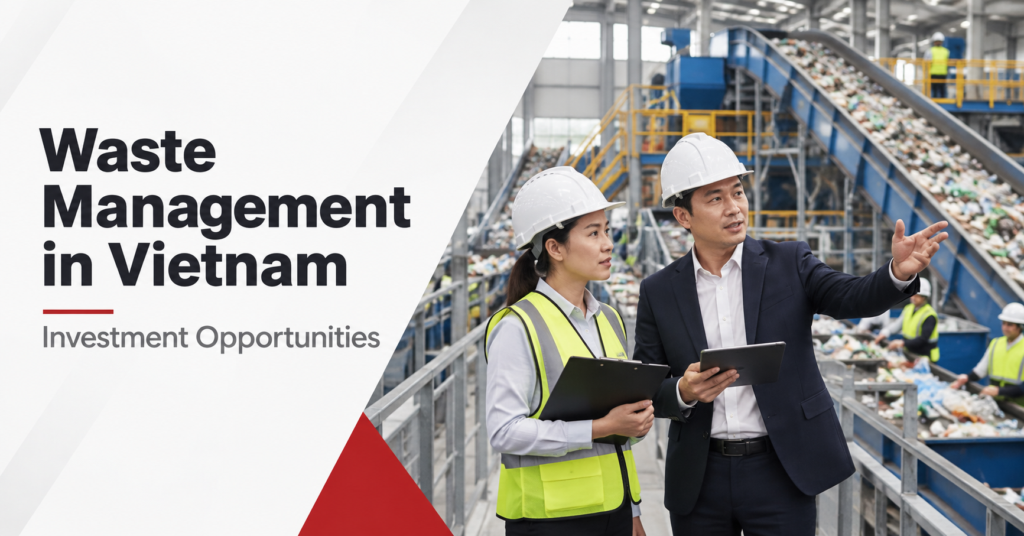
Vietnam offers foreign businesses opportunities in recycling, industrial waste treatment, wastewater systems and environmental technology. The strongest commercial case depends on the waste stream, the paying customer and the reliability of the supply contract—not simply the volume of waste generated nationally.
A recycling plant needs consistent material and buyers for its output. A treatment operator needs a service contract with a viable tariff. An equipment supplier needs customers able to fund installation and maintenance. This guide explains these business models and the approvals investors must plan before committing capital.
Key Takeaways
- Recycling, industrial treatment and equipment supply have different customers, licences and investment requirements.
- Vietnam's WTO schedule permits wholly foreign-owned refuse-disposal businesses following the expiry of its transitional ownership restriction, subject to the remaining service limitations.
- Foreign-invested operators are restricted from collecting refuse directly from households; services are permitted at designated collection points.
- Land suitability, environmental classification, treatment permissions and operating trials must be addressed during project development.
What Is Driving Demand for Waste Management?
The World Bank's plastics circularity study found that Vietnam recycled approximately 33% of the key plastic resins assessed in 2019. This is a historical baseline covering PET, LDPE, HDPE and PP, rather than a current recycling rate for all Vietnamese waste. It illustrates the gap between the use of materials and their recovery into productive supply chains.
More recent policy creates a clearer source of demand for recycling services. Decree 110/2026/ND-CP allows obligated producers and importers to contract qualifying recyclers or producer responsibility organisations. Operators that can document eligible recycled quantities can therefore serve a compliance need as well as sell recovered materials.
Wastewater is another substantial opportunity. The US International Trade Administration reports that only an estimated 16% of urban wastewater was collected and treated in 2024. It also identifies demand for industrial treatment, advanced components, monitoring and reuse systems. For investors, the opportunity includes equipment and operating services as well as ownership of large treatment assets.
Where Are the Opportunities for Foreign Businesses?
|
Business model |
Likely customers and revenue |
What makes the project viable? |
|---|---|---|
|
Packaging and plastics recycling |
Manufacturers, importers, PROs and buyers of recycled material |
Secure feedstock, controlled contamination, compliant recycling outputs and reliable buyers |
|
Industrial waste treatment |
Factories and industrial-park tenants paying treatment charges |
Correct waste categories, licensed capacity and predictable customer volumes |
|
Hazardous-waste treatment |
Industrial generators requiring specialist handling |
Permitted waste codes, safe storage and transport, specialist technology and residue management |
|
Wastewater treatment and reuse |
Industrial parks, factories and municipal projects |
Suitable inlet-water assumptions, an enforceable service tariff and stable maintenance funding |
|
Waste-to-energy |
Municipal waste suppliers, treatment-service purchasers and electricity buyers |
Waste supply quality, treatment payments, power arrangements and emissions compliance |
|
Equipment and monitoring |
Plant owners, contractors and industrial customers |
Local installation support, spare parts, measurable performance and after-sales service |
Packaging Recycling and EPR Services
EPR can create demand for collection, sorting, recycling and verifiable reporting. A recycler should specify the materials it accepts, the output it produces and how it separates quantities claimed by different clients. A PRO can coordinate the service, while the physical recycler must hold appropriate environmental permissions.
Commercially, this favours operators that can provide both processing capability and transparent records. Build the reporting cost into the service price. Contracts should state how rejected material, contamination and unusable residues are treated.
Industrial and Hazardous-Waste Treatment
Factories need dependable outlets for waste generated by production. A treatment business can secure recurring revenue through long-term service contracts, but each waste stream must fit the facility's technical process and permitted scope.
For hazardous waste, evaluate the entire chain: packaging, temporary storage, vehicles, transfer documentation, treatment equipment, emergency response and final residues. A plant designed for one chemical or waste category should not price another stream without testing compatibility and treatment cost.
Wastewater Technology and Operating Services
Foreign suppliers can offer treatment modules, membranes, monitoring equipment and technical operation support. The International Trade Administration identifies demand for advanced treatment, automation, monitoring and reuse.
A practical entry route is supplying equipment and service support to an established Vietnamese contractor or industrial customer. Owning a centralised facility requires a larger commitment to land, construction, customer connections and tariff collection.
Waste-to-Energy and Municipal Treatment
Municipal treatment can offer scale, but the economics depend on more than electricity sales. Investors need enforceable waste-delivery arrangements, a treatment charge, clear responsibility for sorting and a plan for ash and other residues. Moisture and non-combustible content affect the energy output and operating cost.
Model the project under lower waste volumes, higher moisture, delayed treatment payments and major equipment downtime. These scenarios show whether the project can service its financing when actual operations differ from the design case.
Can Foreign Investors Own a Waste Management Company?
For refuse-disposal services under CPC 9402 in Vietnam's WTO schedule, the transitional foreign-equity restriction has expired. Wholly foreign-owned participation is therefore possible within the committed scope. The schedule retains exclusions for services supplied in the exercise of governmental authority and allows certain geographical restrictions for national security.
Crucially, foreign-invested enterprises are restricted from collecting refuse directly from households. They may provide services at collection points designated by municipal or provincial authorities. A business plan based on door-to-door household collection must address that restriction before investment.
The market-entry assessment should separately classify refuse disposal, wastewater treatment, equipment distribution, engineering and other services. Each activity may bring its own rules. Investors using a local partner can assess the structure through InCorp's joint-venture guide.
What Approvals and Documents Must Investors Prepare?
Define the Project and Establish the Company
Prepare the investor's legal documents, ownership structure, financial-capacity evidence, proposed site and project proposal. The proposal should identify the waste streams, designed capacity, technology, investment funding, construction phases and operating model.
Under Article 19 of the current Investment Law, foreign investors may establish the company before completing IRC procedures, while meeting market-access conditions at establishment. The project still needs its applicable investment approvals and registrations. InCorp's company registration guide explains the corporate establishment work.
Secure a Site Suited to the Activity
The site must support the proposed industrial use and waste-treatment process. Review the land or sublease documents, permitted use, access roads, utilities, drainage and distance from sensitive receptors. The design must accommodate reception, sorting, treatment, residue storage and emergency access.
For an acquisition, compare the actual plant layout and operations with its approvals. Existing buildings or machinery do not establish that the buyer can introduce additional waste categories or increase throughput.
Complete the Environmental Assessment and Licence Work
The ordinary environmental route depends on project classification, capacity, pollution risk and location. Vietnam's implementing framework was updated by Decree 48/2026/ND-CP. Classification determines whether the project requires environmental impact assessment (EIA), environmental licensing or another applicable procedure.
A project requiring EIA must describe its baseline environment, process, emissions, impacts, mitigation, monitoring and consultation. An environmental-licence dossier sets out the actual facilities and the emissions and waste activities proposed for authorisation. Prepare the following technical information early:
- Site plans, process diagrams and the mass balance for incoming material and outputs.
- Waste types, hazardous-waste codes where relevant, source volumes and designed capacity.
- Wastewater and air-emission treatment systems, discharge points and monitoring arrangements.
- Storage and transfer arrangements for hazardous materials and treatment residues.
- Incident prevention, emergency response, trial-operation and environmental management plans.
- Existing project approvals, EIA approval where required, and supporting legal documents for the site and project owner.
Some eligible projects can use the special investment procedure under Article 28, which replaces certain pre-approval steps with commitments. This requires a specific eligibility assessment; it does not remove the obligation to meet environmental standards during operation.
Complete Construction and Operating Readiness
Obtain the applicable construction and fire-safety approvals, install the approved treatment systems and complete required trial operation and monitoring. Before receiving commercial waste, verify that the facility's environmental licence covers the actual waste categories, capacity and treatment methods.
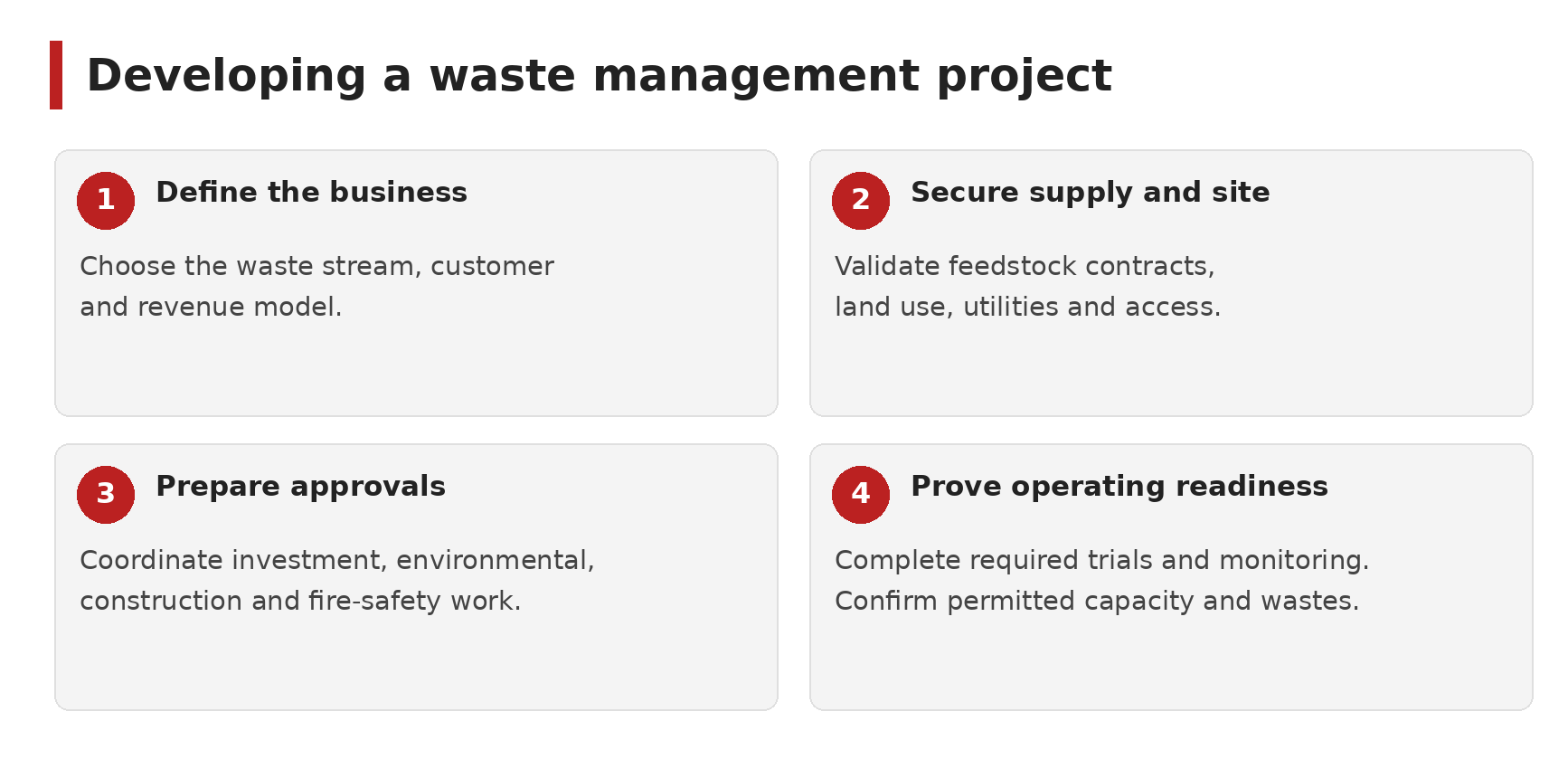
The project sequence above combines the investment framework with the current environmental implementation rules.
What Should the Financial Model Include?
Prepare separate revenue assumptions for treatment services, recycled-material sales and energy sales. Include collection and transport, contamination losses, utilities, chemicals, maintenance, testing, labour and final residue disposal. For equipment supply, include local warranty support and spare-parts inventory.
A useful investment checklist is:
|
Commercial question |
Evidence to obtain before committing capital |
|---|---|
|
Will sufficient waste arrive? |
Supply contracts with minimum volumes, quality specifications and delivery obligations |
|
Who pays for treatment? |
Identified counterparty, tariff mechanism, payment security and adjustment provisions |
|
Who buys the output? |
Offtake specifications, indicative or binding prices and rejection criteria |
|
Can the facility operate as designed? |
Independent feedstock tests, technology references and performance guarantees |
|
What happens to residues? |
Licensed disposal route and realistic transport and disposal costs |
FAQs
Can a Foreign Investor Own the Entire Treatment Company?
Wholly foreign-owned participation is possible for committed refuse-disposal services after expiry of the WTO transition. The actual activity, investor treaty eligibility and remaining service restrictions must fit the proposed model.
Can a Foreign-Owned Company Collect Household Waste Directly?
Vietnam's WTO commitment restricts direct collection from households. Foreign-invested providers may operate at collection points designated by local authorities.
Does Every Waste Project Need the Same Environmental Licence?
No. The requirements depend on waste type, capacity, process, location and environmental classification. Hazardous-waste activities need a scope that covers the specific waste and treatment operations.
Can EPR Create Revenue for Recyclers?
Yes. Obligated producers and importers can contract compliant recycling services. The operator needs evidence of eligible recycling results and the appropriate environmental permissions.
Conclusion
Vietnam's waste sector offers several viable entry routes, from equipment supply to ownership of treatment facilities. The investment case should connect a defined waste stream with a paying customer, suitable technology and the correct permissions. Securing those elements before construction gives foreign investors a stronger basis for financing and long-term operations.